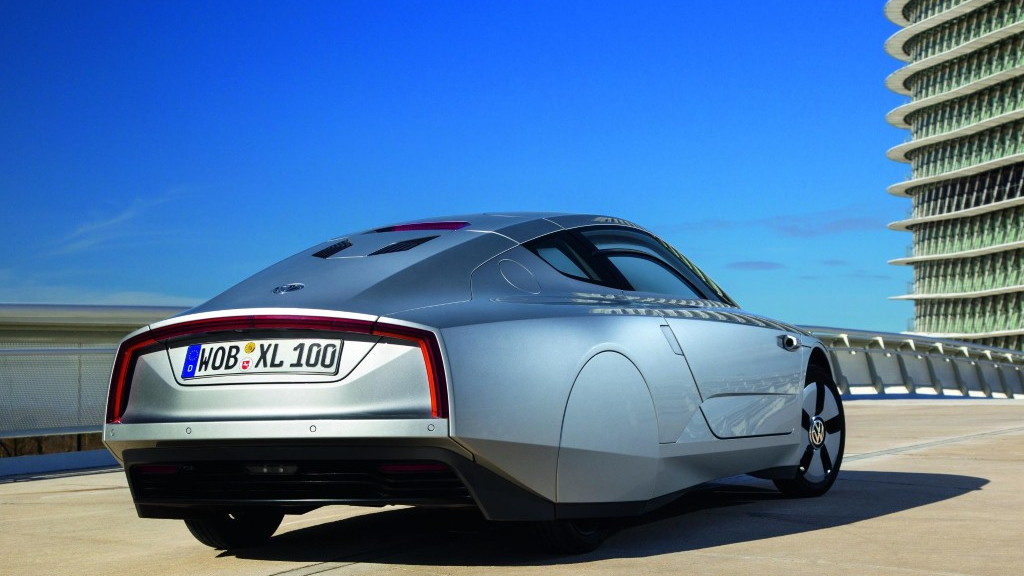

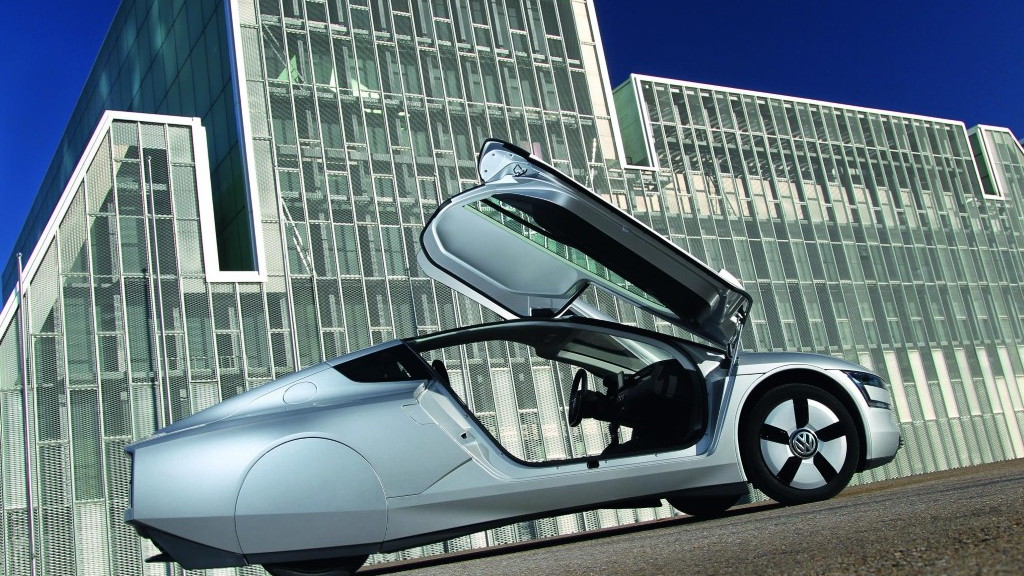
Volkswagen XL1 plug-in diesel hybrid
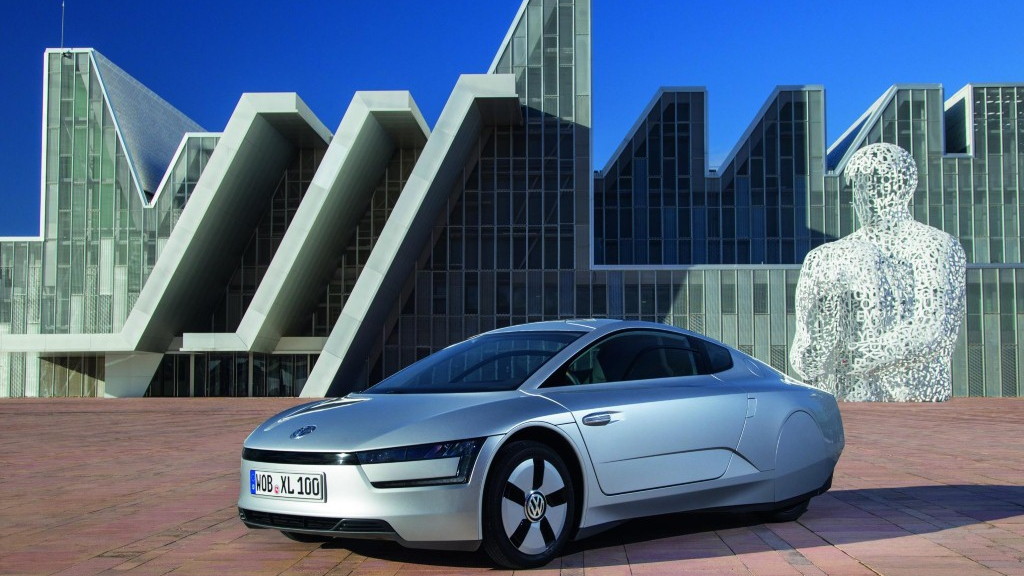
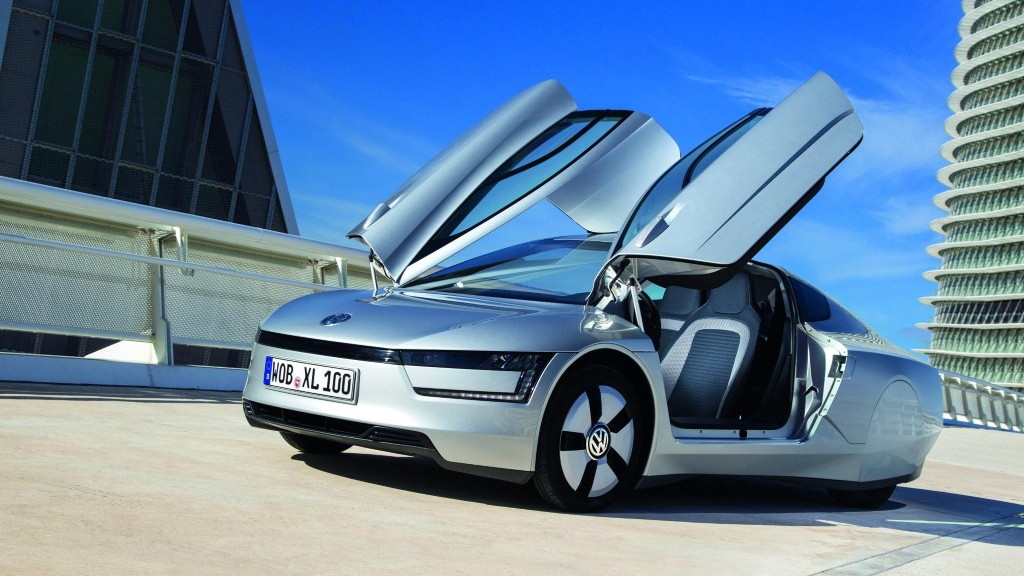
The Volkswagen XL1 is a plug-in diesel hybrid with a body seemingly beamed in from a future time.
It's the physical representation of the benefits of reducing weight and improving aerodynamics. The small body may only take two people, but it's allowed for an incredibly streamlined body with a drag coefficient of only 0.189.
Low weight--only 1,752 lbs--means only a small engine and electric motor is needed to deliver respectable performance. Much of the car is constructed from carbon fiber, aluminium and titanium.
VW says the car will do 261 mpg, though the real figure will be lower than that should it ever be tested under EPA guidelines. Even so, it'll still use comfortably less fuel than any vehicle currently on sale.
A diesel engine of only 0.8 liters and 2 cylinders capacity produces 47 horsepower, with a further 27 horses delivered by the electric motor. Power reache the wheels via a 7-speed dual-clutch gearbox.
Those figures sound miniscule by modern standards, but the XL1 should reach 62 mph in12.7 seconds. Top speed is 98 mph.
Operating alone, the small battery can deliver up to 31 miles of range, and can be charged via plug or regenerative effect.
The price you pay for being green...
The negative aspect to all this is cost. The XL1 is unlikely to be built in large numbers, and What Car estimates a cost as high as $100,000 or more.
Holger Boch, XL1 project leader, says "It's clearly going to cost a lot more than a Golf - it's made of carbonfibre and has two engines. The people who buy it will be people who like technology and who like being seen in a low-CO2 car."
Thankfully, its drivetrain may be put to more practical use, in cars like the VW Up city car.
Whether either of these will ever reach the U.S. is unclear, though Volkswagen will reveal more details at the upcoming Geneva Motor Show.
+++++++++++
Follow GreenCarReports on Facebook and Twitter.
Have an opinion?
Replace the DSG with a 6 speed manual gearbox. Maybe the weight comes up to 2000 lbs. With 47 HP and great aerodynamics this car should be able to cruise at 85 on level ground. My 81 Rabbit can, and it will take a lot less power to push this shape.
If it gets 120 MPG and costs around $20K, sign me up!
The problem will be getting it through the US bureaucracy. Maybe a new rule that says that any car that gets better than 100 MPG and meets EU smog and safety can be sold in the US.
Again, VW is going "backward"... trading MPG for acceleration...
NO different from the Volt's claim of 230mpg before it was released...
(Obviously this depends on how far/regularly you drive...)
The electric motor should help it feel quicker than it is - I think some people are way too concerned about acceleration. At least all the way up to 60MPH - when you drive onto most highways, you have an entrance ramp where you are already going 30-35mph, so getting up to 60mph is quicker.
I think it can't cost more than $50K - it is limited production and it is a halo car, they'll have to sell them.
Neil
I guess those "on-ramp" lights aren't used in your neighborhood or 90 degree/uphill on ramp doesn't exist either...
I can't see this car handling a tight on ramp curve at 35mph...
Also, I am pretty sure that 261 MPG is a fake MPG with Electric miles includes. NOT different from my Volt's display of 250+ MPG...
So, let us offer a good 'range extender' and an "eco" mode when we don't need performance. But offering an efficient vehicle without the possibility of performance is very limiting in my opinion.
Think of it as a "hybrid" concept. Hybrid basically allow you to have the efficiency of Atkinson cycle engine (basically useless in everyday driving) but the performance of an electric motor (for accleration). I think the next generation of plugins needs to do better than the hybrids today. Offering superior performance while allowing you to have the efficiency when you decide to be efficient.
I'll take the ~31 miles of all-electric range - the total battery pack size is reported to be 5kWh and assuming (never a good thing?) that they are using 90-92% of that, that means the XL1 is about 145-150Wh/mile. Which not surprisingly is a little bit better than the EV1 - and almost entirely proportional to the Cd's of each car. The EV1 in production had a Cd of ~0.20 and the Cd of the XL1 is just under 0.19.
(con't.)
Neil
The Volt already accomplishes this does it not?
http://www.autocar.co.uk/car-news/scoop/vw-hybrid-use-xl1-tech
I hope that this is referring to the Up! Lite - but if it is the Up!, then that is okay, too. Here's the Up! Lite:
http://www.google.com/search?q=VW+Up!+Lite&hl=en&tbm=isch&tbo=u&source=univ&sa=X&ei=Ot4rUevzNafp0gGFiICwAw&ved=0CEoQsAQ&biw=1920&bih=1066
Neil
Have an opinion?Join the conversation!