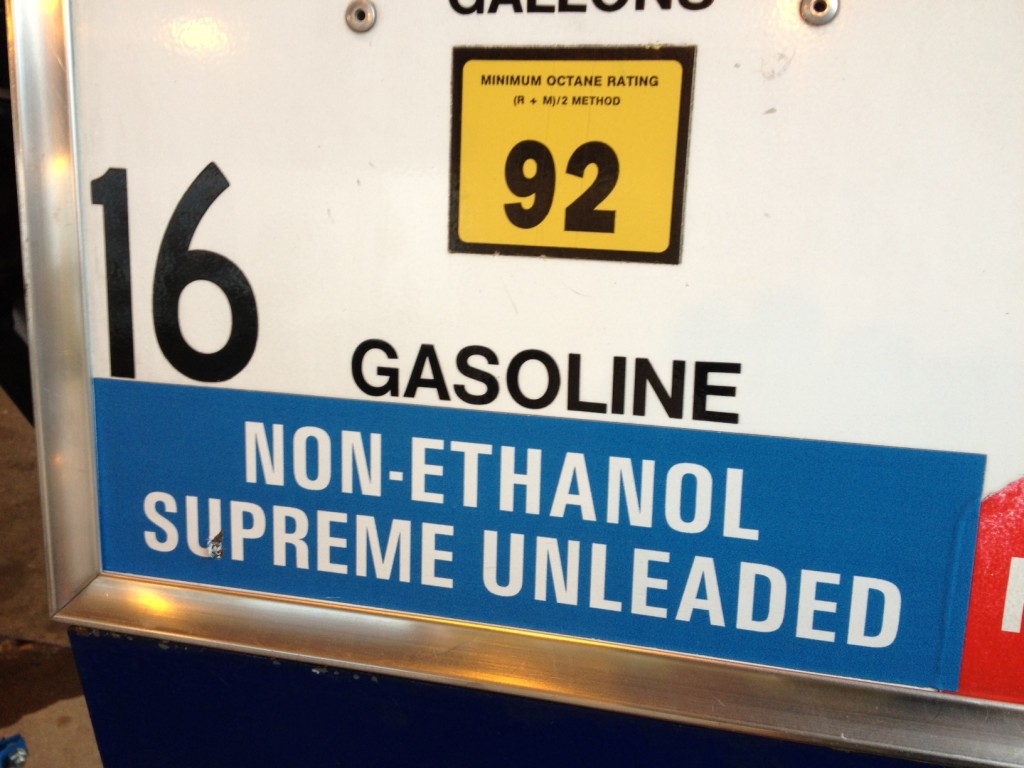
Non-ethanol gasoline pump
The upsides of adding more ethanol to fuel include a reduced reliance on foreign petroleum production and reduced emissions of some air pollutants. Ethanol also raises gasoline's octane rating without the greater use of some of ingredients that may be more harmful to the environment (or to people).
But the primary downside of adding more ethanol to fuel—aside from issues relating to corn crops and food supply—is that it lowers the actual energy content of gasoline. According to the U.S. EPA, vehicles will typically get three to four percent fewer miles per gallon on E10 than on what it terms 'straight gasoline.' And of course, those are extra gallons of ethanol that you'll need to truck around the country.
Lower mileage...but how much lower?
The three-to-four-percent figure is what's widely accepted by the industry; on the other hand, the American Coalition for Ethanol found, through their own study, found that E10 only lowers mpg by about 1.5 percent on average.
On older vehicles, the affects of ethanol are a little more pronounced. Especially in vehicles from the 1980s and earlier, rubber-containing components such as gaskets, seals, and fuel lines can harden and fail earlier when run on ethanol-containing fuel, according to restorers, mechanics, and classic-car enthusiasts. Vehicles built in 2001 or later have already been approved for 15-percent ethanol, though.

Non-ethanol gasoline pump
In all fairness, that's not the right term. All gasoline is a blend of ingredients and compounds—like toluene, xylene, pentane, butane, heptane, napthalene, isopentane, and others—and ethanol can be one of them.

Non-ethanol gasoline pump, with Six Month Road Test Hyundai Veloster
In order to get a reasonable estimate on how much fuel efficiency differs with standard E10 as opposed to non-ethanol gasoline, we filled our Six-Month Road Test Hyundai Veloster with non-ethanol, 92-octane premium gasoline, from Olson Brothers in Milwaukie, Oregon—found via pure-gas.org—and drove for 204 miles in all, including about 50 miles of suburban and urban stop-and-go and about 150 miles of steady-speed expressway driving, mostly at 65-70 mph.
We've spent so much time with the Veloster in these conditions that we know it would return between 33 and 34 miles per gallon. But with this tank the trip computer showed nearly 37 mpg.
Based on those results, we're relatively confident in saying that non-ethanol gasoline boosts mileage; and it may even boost mileage versus ten-percent-ethanol gas by nearly ten percent.
Higher mpg, but no money saved
That's a significant improvement, and it's more than double the difference we expected. But even then, financially, the argument starts to fall apart when you consider that we paid $4.799 a gallon for the non-ethanol gas. With regular-grade, 87-octane, E10 gasoline costing $3.49 a gallon just a few hundred feet away from where we got the 'pure' gasoline, it was hard to argue that the more-than-35-percent price premium was worth it.
It's also worth pointing out that we noticed no difference in performance for our 2012 Hyundai Veloster. The engine and powertrain felt just as responsive as ever, with no change in smoothness. The Veloster seemed like an ideal 'normal car' candidate, as its 1.6-liter direct-injection engine is tuned more for fuel efficiency than outright performance.So should you seek out 'pure' gasoline? If you have a late-model car, we see no need to do so, as regulation has made non-ethanol gasoline so hard to find, and at so much of a premium, that it's cost-prohibitive. But if you have a classic-car, we recommend it; and with E15 blends just around the corner and higher federally-mandated volumes of ethanol nudging that ever-closer to U.S. pumps, these are questions we'll need to ask again quite soon.