Ethanol has been problematic for several years now.
Promoted as a way for the U.S. to grow its own vehicle fuel, the alcohol was so popular several years ago that Congress passed a Federal Renewable Fuels Standard as part of the 2007 Energy Independence and Security Act.
Now Hart Energy has issued a study saying there is no viable way U.S. fuel producers can comply with the mandates.
Hart expects the law to be changed within a few years.
The 2007 regulations require 36 billion gallons of ethanol to be included in U.S. vehicle fuel by 2022--a volume more than three times the 11.1 billion gallons used in 2010. For 2015, the requirement is 15 billion gallons.
But already the requirements for non-corn ethanol are not being met.
The new study, US & Brazil Ethanol Outlook to 2022, notes that to meet the required volumes of ethanol, the U.S. would have to import substantial quantities from Brazil--quantities that Hart says will not to be available at the times they will be needed.
In fact, Hart says, Brazil won't return to its 2008 ethanol export levels until 2019.
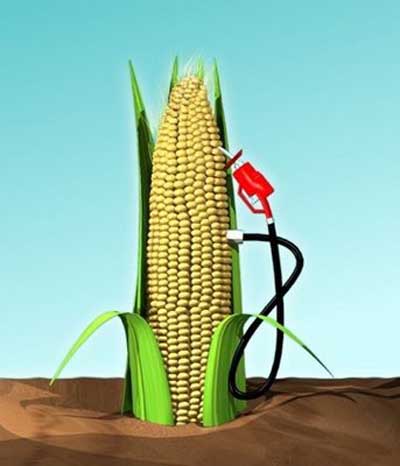
Corn Ethanol Pump
Reasons include under-investment in sugarcane production, high global sugar prices (which make it more attractive to use the cane for sugar rather than fuel), and increasing global demand for ethanol.
At the moment, Hart points out, the U.S. actually exports more ethanol than does Brazil. Together, the two countries produce 80 percent of the world's supply of ethanol.
As a fuel, ethanol turns out to have several drawbacks:
- The U.S. practice of distilling it from corn yields the lowest productivity per acre of any feedstock
- Growing crops to serve ethanol feedstock either displaces food crops or requires more land to be farmed
- The overall carbon footprint of corn-based ethanol is dubious at best
- Ethanol acts as a solvent and can damage engine parts (especially rubber seals) not designed with it in mind
- By volume, ethanol has about 30 percent less energy content than gasoline, so fuel economy falls when ethanol is used--meaning more frequent fill-ups
So-called Flex-Fuel vehicles are produced by most U.S. automakers, but the vast majority of them never see a drop of E85 ethanol, a fuel that is available at less than 3,000 of the nation's 25,000 gas stations.
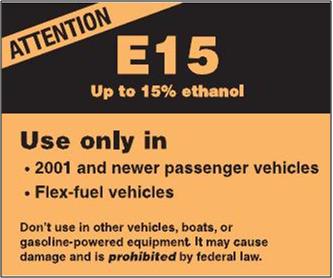
Proposed EPA E15 gasoline pump warning label for ethanol content
Additionally, automakers fearful of engine damage fought an EPA proposal to boost allowable ethanol in gasoline from 10 to 15 percent.
Those rules are moving slowly, and it's unclear that gas retailers will make the investments necessary to install new "blender pumps" that mix ethanol and gasoline as requested by customers.
Last December, rather to everyone's surprise, Congress ended ethanol subsidies and removed tariffs on imported ethanol.
Hart Energy will host a webinar on its study findings on Tuesday, May 15, through its Global Biofuels Center.
+++++++++++