With stellar sales of the Chevrolet Volt last month, we haven't heard quite as much of the silly "electric cars are a sales failure" meme lately.
After their first full year of sales, each of the two modern plug-in electric cars on sale during 2011 outsold the Toyota Prius hybrid in 2000, its first year on the market.
But will that trend continue? Will plug-in cars sell better than hybrids did in their second and subsequent years on the market?
One analyst, John Gartner of Pike Research, has an unequivocal answer.
Yes, he says, they will.
His projections, contained in a blog post last week, shows combined plug-in sales totals exceeding combined hybrid sales totals not only in their first year but continuing to 2017.
That seven-year projection is shown in the chart above, contrasted against historical hybrid sales figures for 2000 through 2006.
Gartner writes:
When you consider that [plug-ins] cost much more than a hybrid and require significant changes in consumer education and behavior (e.g.,understanding the charging of the vehicles), the [plug-in] launch can be viewed as a relative success.
Lest we forget, the US light duty vehicle market was actually smaller in 2011 (13.7 million) than it was during the 2000s, which makes the [plug-in] launch that much more impressive.
Pike projects that after seven years, plug-in vehicles will have outsold hybrids by 90 percent in total units.
Plug-ins, for the purposes of this analysis, include both battery electric vehicles (e.g. Nissan Leaf, Mitsubishi i) and vehicles with both a plug-in battery pack and a combustion engine (e.g. Chevrolet Volt, Toyota Prius Plug-In Hybrid).
He lists three factors that will contribute to plug-in sales reaching higher levels than did hybrids at the same stage:
- Gasoline is more expensive now, proportionately, than it was on average during hybrids' first seven years on the market;
- More consumers are aware of national security issues around the consumption of imported oil; and
- The number of plug-in vehicles offered by automakers will be greater in early years than was the number of hybrids.
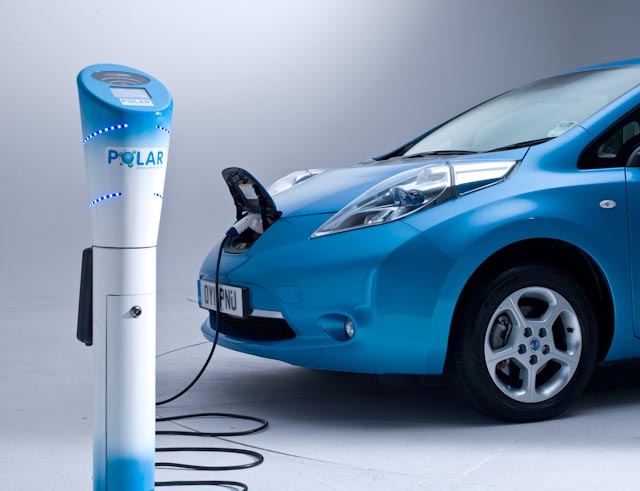
Polar Charging Post and Nissan Leaf
Nonetheless, Gartner suggests that President Obama's goal of 1 million plug-in vehicles on U.S. roads by 2015 was too aggressive, and may not have been projected based on the hybrid sales data that many analysts use to estimate plug-in vehicle sales.
To us, the fascinating thing about projections for plug-in sales is how widely they vary.
Pessimistic forecasters say no more than half a million plug-ins will be sold in 2020, out of total global production of perhaps 100 million vehicles, while Nissan CEO Carlos Ghosn expects them to take fully 10 percent of sales in markets where they are offered.
It promises to be a fascinating decade filled with more fuel-efficient vehicles and increasing numbers of plug-in cars that use very little or no gasoline at all.
Where do you come down on plug-in sales projections? Do you think Pike Research has its numbers right?
Leave us your thoughts in the Comments below.
+++++++++++