It still hasn't really registered in public awareness, but as we've said before, U.S. gasoline consumption has been falling since 2006.
Now, it turns out that U.S. energy imports have been falling as well--from 60 percent in 2005 to just 45 percent last year.
That can be attributed to two factors: more fuel-efficient cars, and more domestic energy production, including both oil and vastly increased natural-gas output.
The recent economic downturn may have proved a blessing in disguise for boosting the efficiency of the overall U.S. vehicle fleet.
U.S. drivers have delayed replacing their cars, with the average age of vehicles on the roads now at 10.8 years, the highest it's been since World War II.
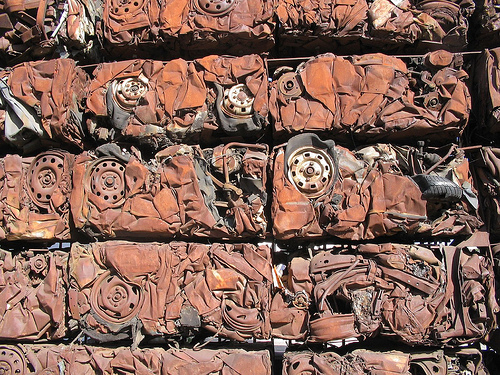
Cars Crushed Into Cubes
In fact, for the last three years, the U.S. has scrapped more vehicles than it sold--meaning the country's total vehicle population actually fell slightly from 2008 to 2011.
Sooner or later, though, those 10- and 15-year-old cars will have to be replaced. It may already have started, as car sales have strengthened over the last six months.
But many of them will be replaced with 2012 and later models that have to meet stiffer gas-mileage standards than the 2009 models that drivers might otherwise have bought.
That'll boost overall fuel efficiency even faster.
And for those who can afford newer cars, it may make coping with gas prices that could rise to $5 a gallon this summer slightly less painful than it would have been otherwise.
Still, energy politics remains deeply contentious, no more so than in a U.S. presidential election year.
About those gas prices?

Barack Obama
Despite widespread political banter that it's the president's job to ensure that they remain low so U.S. drivers don't suffer, most people recognize there's very little the president can do about gas prices.
And none other than the magazine that proudly promoted itself as "the capitalist tool" has laid out exactly why, in a nice two-part series entitled "The Truth About Obama, Oil, and the Gasoline Blame Game."
Read it here: Part I and Part II.
Among the points made by author Rick Ungar, supported by links to data:
- Domestic crude oil production has risen every year since 2008
- U.S. energy companies are still drilling only a portion of the lands already leased to them
- The U.S. dollar remains weak, meaning imports of everything cost more
- U.S. refineries, more efficient than ever, now produce more gasoline than we consume--so they're exporting it
- The much-discussed Keystone Pipeline might, at best, lower gas prices by 1 to 4 cents per gallon
- Speculators betting on further oil-price rises may play a significant role in today's gas prices.
In any case, the message is that--despite high gas prices--whether you're motivated by a concern for the planet or by a desire for U.S. energy security, things seem to be getting better.
On the ecological side, U.S. cars are getting more efficient and we're burning less gasoline every year. And that's a trend that will continue, since the overall U.S. vehicle population won't increase dramatically.
(China and India, well, that's another story altogether.)
And on the energy security front, the U.S. is less dependent on foreign oil imports today than it was even five years ago.
Perhaps we can celebrate together.
+++++++++++