Electric cars are often described as "zero emission vehicles".
That's true, to an extent - you won't find a drop of any substance eminating from their non-existent tailpipes. But naturally, they get their energy from somewhere, and that somewhere is a country's electricity grid.
Those can be less than clean, as China's recent smog problems from coal-burning plants illustrate. It means China is a pretty bad country to run an electric car.
Bottom of the pile: India
According to Shrink That Footprint (via The Guardian), India is the dirtiest country in the world in which to run an electric car, thanks to an electricity grid dominated by high-carbon coal.
That puts the carbon dioxide emissions equivalent of an electric car in India are a staggering 370 grams per kilometer. 70 g/km of that figure results from manufacturing (the figure is 40 g/km for a gasoline vehicle), the rest is down to the dirty electricity that powers it--when it's working at all, that is.
For comparison, equivalent CO2 from the same vehicle in the U.S. would be 202 g/km. In the U.K, 189 g/km. In Canada, it's only 115 g/km. In nuclear-dominated France, that figure drops to 93 g/km, and right at the bottom of the chart are Iceland and Paraguay, with figures of 70 g/km.
Both countries generate their power from entirely low-carbon sources--geothermal in Iceland, and hydropower in Paraguay. Post production, lifetime CO2 emissions in both countries are almost zero.
In these two countries, an electric car would already have worked off its manufacturing emissions next to a gasoline car in a matter of months.
MPG equivalent
To put those numbers into an understandable format, Shrink That Footprint has worked out the MPG equivalent for an electric car powered on each grid.
In the U.S, when grid emissions are taken into consideration, the average electric car has an MPG equivalent of around 40 mpg.
Note:
It's far more complicated than that in reality, and we're guessing that figure doesn't take the well-to-wheels oil chain process into consideration--but for the purpose of this comparison, it's easiest to stick with 40 MPG.
The estimate well-to-wheels for a gasolione car in 2010 was 465 g/mi, or 744 g/km... but then you'd need to look at where coal comes from, or uranium, or the materials to build wind turbines. In other words, it gets far too complicated for reasonable comparison.
We'd also note that this figure is rising anyway--the U.S. grid, like many Western nations, is getting cleaner.
In India, with its entirely coal-generated electricity, the same electric car would be as dirty as a car doing only 20 mpg. China is marginally better, at 30 mpg. The U.K. would come out at 44 mpg, France at a plug-in hybrid-rivaling 123 mpg, and Paraguay at 218 mpg.
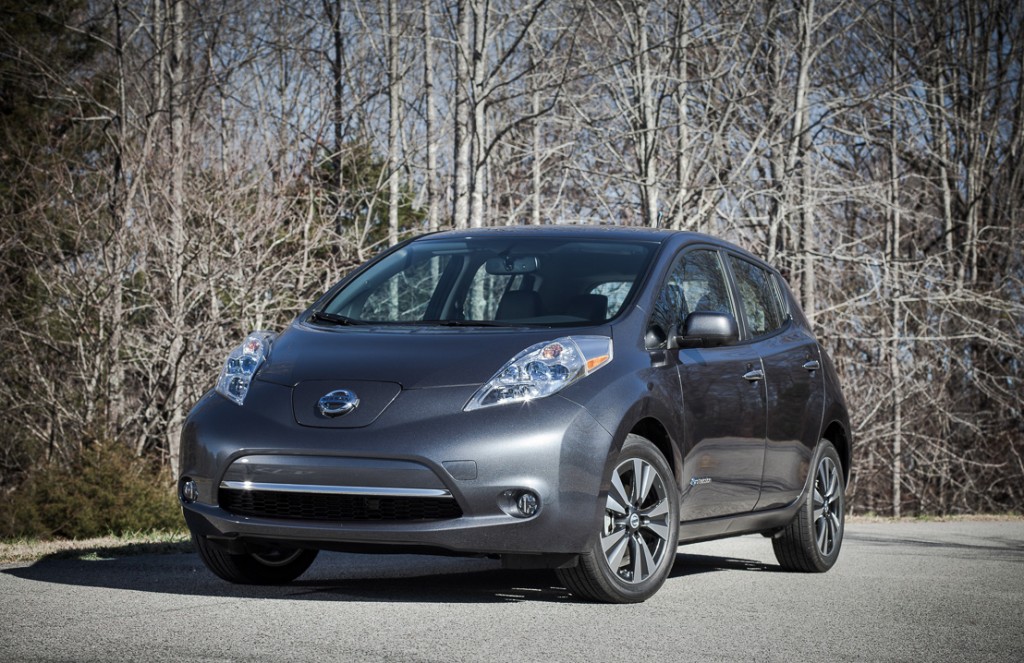
2013 Nissan Leaf
Manufacturing matters
At the cleanest end of the scale, manufacturing emissions play a huge part in just how clean a vehicle is.
Shrink That Footprint has used a 70 g/km figure, from which the 218 mpg figure is extrapolated. If manufacturing emissions dropped by just 20 g/km, the MPG equivalent would shoot up to 652. Raised by 20 g/km, it would fall to 131 mpg.
The same drop or increase in India, with its already-dirty energy mix, would see rises and falls of only 1 mpg for the same 20 g/km manufacturing difference. In the U.S, it's a 4-6 mpg difference.
Conclusion
There are several things to take from the data.
The first is that the impact of running an electric car depends hugely on where you're running it, and where the electricity is coming from. It's worth remembering at this point that those electric vehicle owners generating their energy from solar will be sitting nicely alongside Paraguay and Iceland in terms of low emissions--so from a green standpoint, it's worth doing.
Next: Manufacturing does play a large part in a car's emissions, but the significance of this varies depending on how clean the car is in the first place. Manufacturing is 100 percent of a car's total emissions in a place like Paraguay, but only a fraction in India.
The lesson there is that a smaller, lighter, less resource-intensive car will already have had a smaller impact on the environment before it reached you. Combine that with electricity--the sub-900 lb, hand-built Renault Twizy, for example--and the car's overall impact is incredibly low.
Additionally, electric cars are clean in other ways, not just CO2. With no tailpipe emissions, there are none of the nasty pollutants you get from any car with an internal combustion engine.
For standing right next to, the electric car will always be greener.
Finally, electric cars will continually get cleaner as the local grid improves. Cleaning up the grid is the quickest way of making electric vehicles cleaner--not to mention making your TV, oven and every other electrical appliance cleaner, too.
+++++++++++