
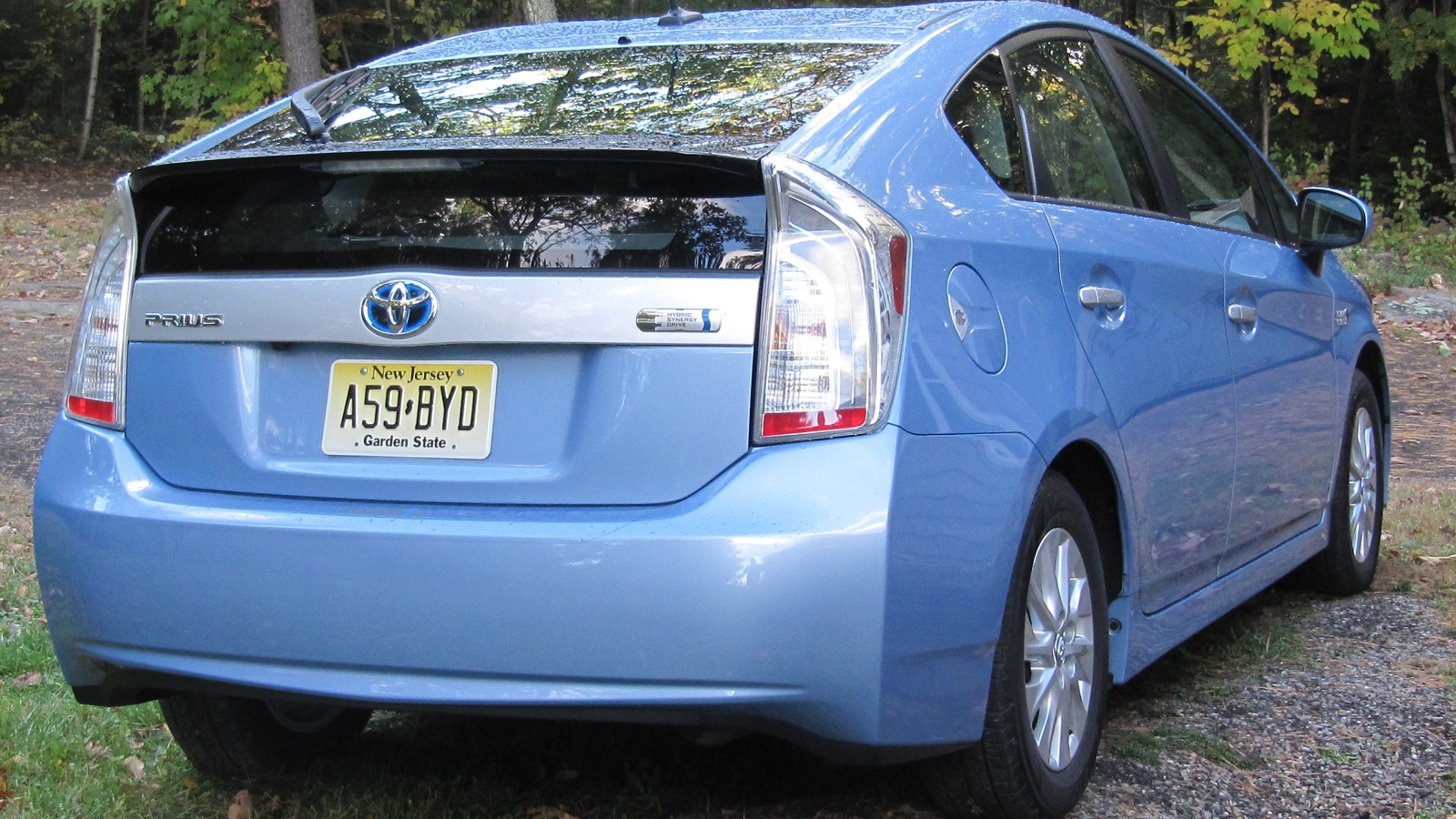
Is the 2012 Toyota Prius Plug-in Hybrid The...
2012 Toyota Prius Plug-In: Quick Drive Report
2012 Toyota Prius Plug-In: Parsing The EPA...
The plug-in Prius will travel all-electrically at much higher speeds than a standard Prius hybrid. We saw 61 mph at one point, though in general the engine kicked on under medium-to-hard acceleration, above roughly 50 mph, and going up even gentle hills.
We experienced a couple of judders and audible clunks from the powertrain, something we’d never had either in the previous plug-in Prius or conventional Prius hybrids.
Not an electric car
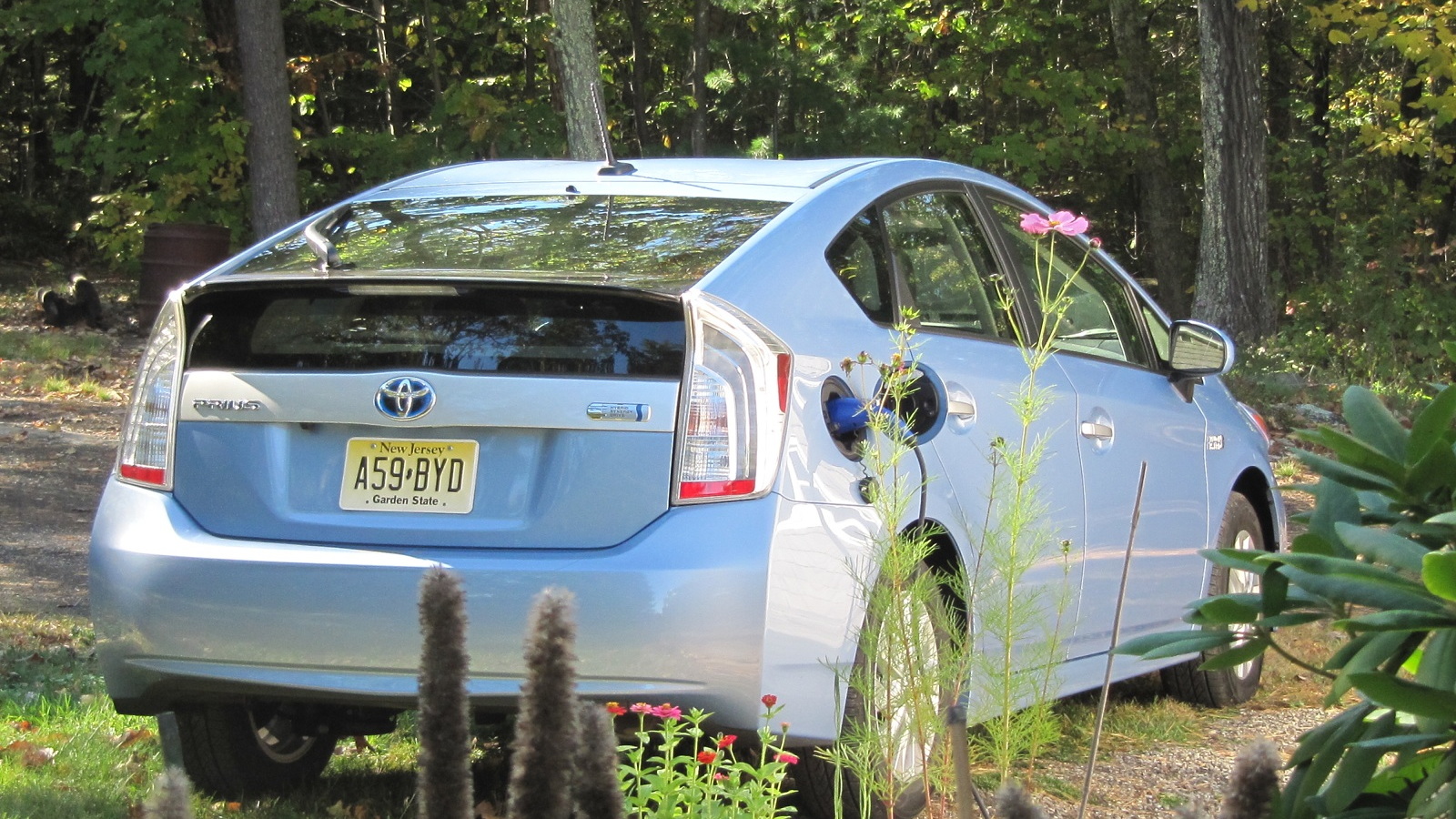
The pack can be recharged either using the 110-Volt charging cable it comes with—housed in the small well at the back of the load-bay floor—or using a 240-Volt Level 2 charging station.
To make our peace with the Toyota Prius Plug-In Hybrid, we concluded that it shouldn’t be viewed as an electric car—or treated like one behind the wheel.
It remained frustrating enough to keep the car in all-electric mode that we gave up halfway through our test.
Instead, we simply drove the car to keep up with traffic, ignoring the engine noise (a muffled howl under heavy acceleration) when it switched on.
And we resolved to ignore the electric-range estimate, which usually started at 11.0 miles and quickly declined—a disadvantage to showing range in tenths of a mile. (Though being able to add 0.2 miles back just by careful braking before stop signs was rewarding.)
A slightly better hybrid?
As a Prius hybrid, the plug-in Prius works fine. It definitely has more electric range and can operate electrically at higher speeds.
But we continue to wonder: Is that enough to get owners to plug it in regularly—and often—for the limited electric travel it offers?
For some buyers, that’s exactly what they want--and it's important to check whether the numbers add up. One reader explained recently why he chose the Prius Plug-In over the Volt and Leaf—because it fits his driving patterns best.
We wonder whether there will be drivers who buy the plug-in Prius—especially in California, for its single-occupancy HOV-lane access—and never bother to plug it in at all.
Under those circumstances, it’s simply a much more expensive Prius hybrid.
Dated display
Other that being a not-very-electric car, the Prius Plug-In had all the virtues and vices of the third-generation Toyota Prius we’ve tested several times.
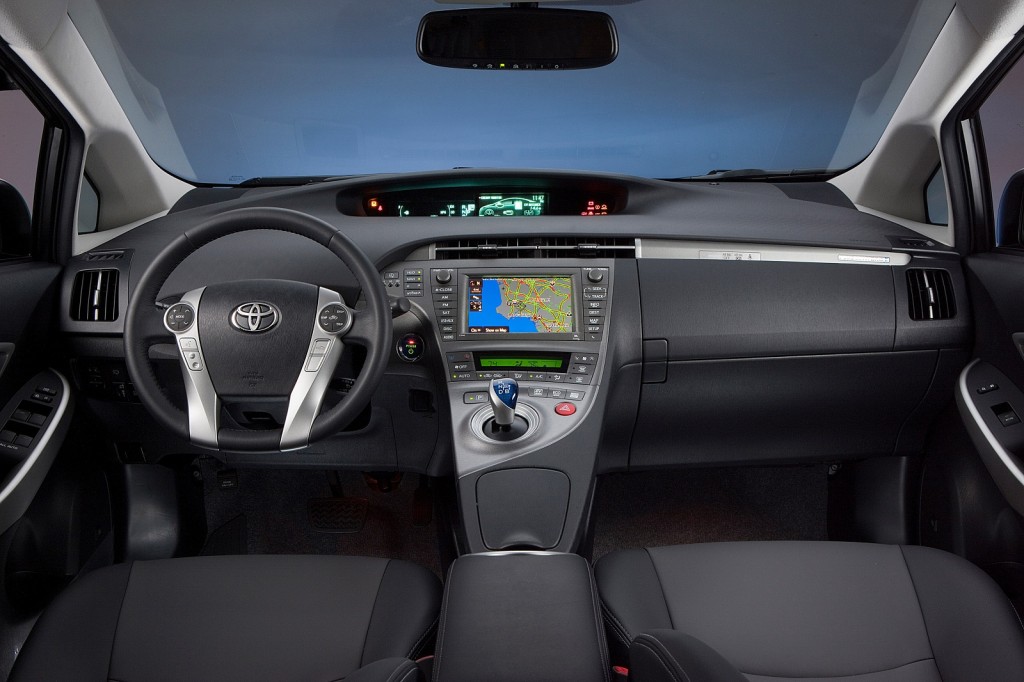
Now in third year of its life, the Prius Multi-Information Display on the horizontal screen high up in the center of the dash is beginning to look dated against the full-color graphic displays of other plug-in hybrids and electric cars.
It scatters numbers, diagrams, and icons across a long horizontal monochrome display, and it’s simply less intuitive—let alone visually pleasing—than displays in plug-ins from Ford or Chevrolet.
We’ve never been big fans of the high “flying buttress” console design, which swoops down from the center of the dash and offers an awkward storage space underneath.
Functional flaws
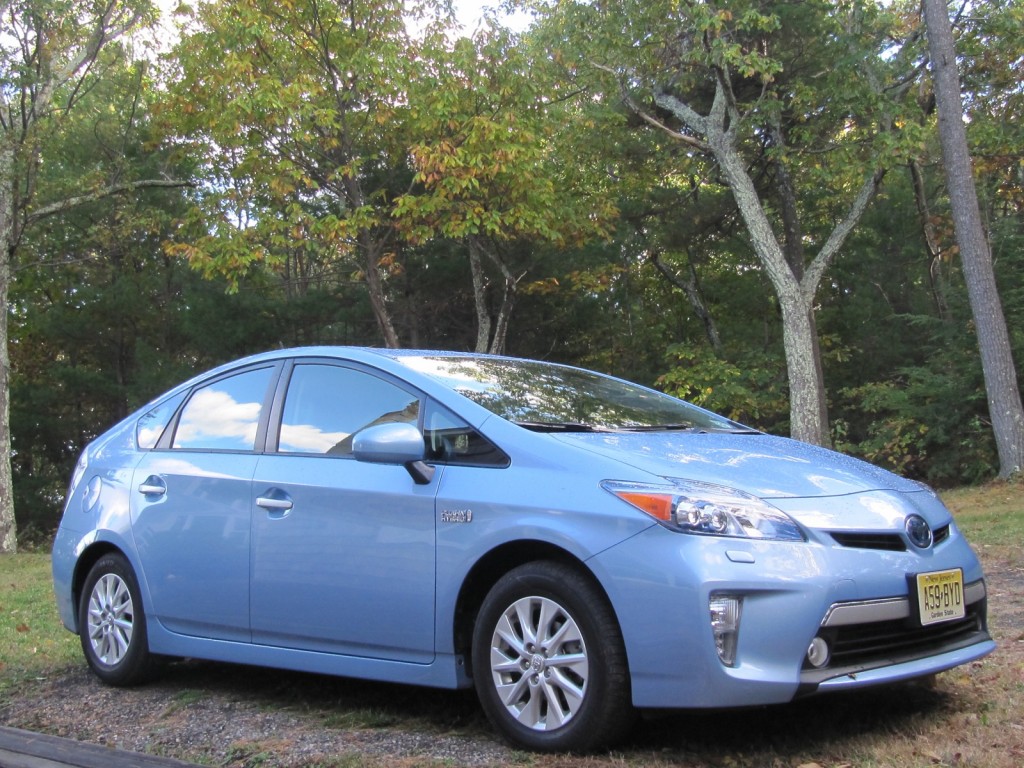
The plug-in Prius uses differently patterned and, to our eye, more attractive dark plastics than a standard Prius hybrid for its dash and interior trim.
Have an opinion?
The GCR driving cycle seems ill fitting to the PiP or to the Volt, for that matter.
Some earlier data on Fuelly suggested that PiP owners were getting 30% of their miles electrically. Not great, but better than I expected.
Volt owners were getting 60%-70% of their miles from electricity. Much better, but worse than I was expecting.
So this all comes down to how the vehicles are used with neither vehicle getting better than 90% for average drivers.
I think this shows why plug-in hybrids are viewed with a suspicious eye by devotes of the BEV. How can you be sure that people are actually using a plug-in hybrid as intended?
For example, my Volt is 100% Electric during my daily commute to work but burn gas on weekends or when my Wife "borrows" it during her 200 miles drive... So, it end up with a 75-80% Electric miles.
If I stop letting my wife use it, the electric miles percentage will go up to 95% easily... Even at 75% electric, my Volt is saving me about $1500 - $2000 per year in gas money vs. a 40 mpg car (I get to charge at work).
"Electric when you want it, gas when you need it".
Your EV ratio is much higher than the average so there are other non-vocal Volt owners that have very low EV ratio.
Average is a non-robust statistic. The GM volt site is looking at total miles, and a few people that have already racked up 40-50K miles already are adding lots of ICE miles. The median is more robust and can be much higher. For example on voltstats which has about 10% of volt owners, the "average" %EV is 70, but the median is 80%, meaning that more than half the owners are using more than 80% ev and anyone using less is a "below average" driver.
It is based on the assumed hwy/city driving and distance. Almost useful as his PIP's claimed 12 miles EV range...
John B was pretty close with the range he gave. Your EV% is much higher than average. That's all I was pointing out.
The real concern should be with the PiP and whether 10% or 30% EV miles is really worth the effort.
Also, looking forward to the C-Max Energi, what do we think the percent EV miles will be? Will it be less than the Volt, or about the same? Does this come down to consumer behavior?
The low hanging fruit appears to be the first 11 miles that Prius PHV was designed for. That covers 29%. The more EV miles you add, the less percentage the electricity can cover.
Volt turns on the gas engine for heat under extreme cold. That's the advantage of a hybrid anyway.
Volt only turns on the engine when the battery temperature reaches extreme low state, not the cabin... Big difference.
Heating the cabin takes a lot of energy. Which fuel do you think is best suitable to heat the cabin?
My commute is 10 miles each way. Perhaps if I could find a way to plug-in at work, the PiP would be a good match.
I still wonder how the "winter condition" is going to impact the C-Max Energi range in your part of the "world"...
C-MAX cargo is not flat and Volt doesn't have midsize interior nor 5 seats.
As for the interior, no doubt the C-Max is nicer than the Prius. Mind you, I love my Prius, but that isn't to say that it doesn't have some short comings.
As for the back of the Volt, I have never much cared for the layout. I think the cargo access in the Prius is excellent.
In case you are not aware, Toyota is doing $3,500 to $5,000 cash bonus for Prius PHV base and Advanced, in my area. That makes it more affordable than C-MAX Energi.
EPA rated its electric miles at 117 MPGe (29kWh/100mi). Pretty good for a midsize considering it more or as efficient as a compact BEVs (i-MiEV, Fit EV, Focus EV, etc...).
If the gas engine kicks in, EPA rated it at 50 MPG (0.2gal/100mi). Both gas and electric will blend automatically and intelligently (without discriminating neither fuels) to provide 95 MPGe. It will utilize the strengths of both fuels so you can EV in city/suburb
Here is the key difference between Prius PHV and Volt. One uses gas depending on driving conditions (including temp) but the other depends on the range. Two totally different takes on how and when to use two fuels.
Using ICE gas as heater? I rest my case.
"One uses gas depending on driving conditions (including temp) but the other depends on the range. "
Volt's range is FAR MORE realistic and useful for 75% of the American commuters.
Last time I looked, Most people commute by themselves and no need for extra cargo space.
Midsize cars outsold compact cars in the US. Plugin hybrids are great for a single vehicle household (EV can't). They are not just used for commute.
20 EV miles covers 51% of the commute. It takes 40 miles to cover 75%? It is beyond the diminishing point of return. Those figures are based on a single charge per day. Two charges per day is more realistic. Volt battery size is over-sized for sure. Look at the results.... interior volume, price, weight, gas MPG, etc.
BTW, the electric miles at 117MPGe is crap. B/c it is ONLY if you drive it "Nicely". if you don't (at mile 6), the engine came on. So, the "nice" part of the EV was "efficient". Well, it is NOT. It is SCAM. Again, you believed in this stupid scam.
It is like saying that Volt's 38 EV miles can easily be 50 miles and if it is 50 miles range, then its MPGe is around 128 MPGe.
"intelligently (without discriminating neither fuels"
That is the problem. The point here is to discriminate against using GASOLINE!!!!!!!!!!!!!
That is whole freaking point of "being green".
The universal appeal for being green is to use less energy, which translates to lower emission. You are talking about social benefit (energy security). I disagree that has anything to do with being green. Global issue (emission) takes president over national/social issue.
Per EPA, Volt emits 260 gram of greenhouse gas per mile, using national average electricity and gas. Prius PHV emits 210 g/mi. A regular Prius 222 g/mi.
Your "cherry picking" only shows your bias which is completely ignorant in this case...
Again, as efficient as Prius get, EV powertrains are 2 to 3 times more efficient than ANY Gas engines out there. If efficiency is what you "claim" to care, then try to stay in EV mode as long as you can should be your top goal!
Don't you read your GCR articles? It has been explained about this topic long time ago already.
Really? are you really that clueless?
Does performance has anything to do with it? Does safety has anything to do with it? Does features have anything to do with it?
I have commuted 12 miles with a bicycle. It takes me over an hour and I had to stop to get a drink. I inhaled exhausts and will never again.
The point was to use EV for short local frequent trips without compromise. That's where EVs shine -- not use the battery as an expensive heavy cordless heater.
You already made compromise b/c it is NOT real EV. Turn on mild heat, load up with 2 adults and EV mode is on.
I have driven it for over 1 week during its demo program. It sucked. NO different than how Voelcker described in his article. It is totally distracting to try to keep it in "EV" mode.
At that rate, the Volt mpge is over 128....
In that case, I will take the 5-star rating over the extra cargo space anyday.
Not to mention extra peformance.
If extra cargo or the gas mileage is so important to you, buy a Prius V and regular Prius, both are WAY BETTER VALUE than the PIP.
Your PIP suck at performance. 0-60 is more than 10 sec. worse handling and poor braking. It also has only a 4 star rating in safety and an "fake" EV mode.
You have no idea how I drive in NY. I have seen slow Volt drivers going 50 mph trying to max out their EV range.
Your hate toward Prius is extreme and it shows, Mr. Li. If you must, hate the driver, not the car.
It is "SCAM" attempt by Toyota.
Just about every CA Prius Plugin owners that I know have the GREEN Carpool stickers.
Also, I have seen plenty of Prius Plugin "hogging" the public charging stations for more than 4 hours. NO PIP would that amount of time for charging!!!!
Maybe this is the Toyota's idea of "ruining" public charging spaces for all BEVs.
I think at least the C-Max Energi and Volt gives its owner a realistic way of using its EV mode.
If you can stay in your PIP's EV mode, then you are probably also close enough to walk or bike to work....
But I have never viewed this PiP as a "scam" but as a "transitional" technology. I thought perhaps gen 1 of the PiP would be 11 e-miles and gen 2 might be 20 e-miles.
Honestly, I am less worried about the "blended" versus "ev" operating mode of the plug-in hybrids. As long as a significant percentage of the energy comes from electricity, I am fine with that.
The problem with the PiP isn't that the drive train is "blended" , it is that it runs out of juice too soon to blend with the gasoline.
Prius Plugin was engineered from ground up to be an ICE based car first and EV mode was just a "bonus".
Volt was engineered from ground up to be an EV which engine as an "extender".
That is why I felt that Toyota's 1st attempt was a poor one. But with its recent attitude toward EVs by Toyota, I am NOT surprised. I am just glad that there are other auto makers out there that bring something better to the market.
The downside is that more and more PIP are "hogging" the almost limited public charging facilities...
Prius PHV uses electricity where it makes sense -- suburb/city. It uses the high energy density fuel (gas) for high piwer demand. It doesn't pretend to be an EV. It is an honest plugin hybrid and uses the strength of both fuels.
Going by your logic, Volts are "hogging" up charging stations of BEVs. Volt even sound the alarm if an EV owner tries to remove the plug even if it is full.
Remember that a mid size typically cost $3k more than a compact. A compact is lighter and more fuel efficient. This isn't the case with Volt. Think about which is the scam, especially with the tax credit amount.
B/c GCR consider Volt as an EV. GM claim it as an EREV. I consider it as EV+. Volt can operate without a drop of gas. Your Prius PHV can't!
Volt takes 4 hours to fully charge from empty. It will operate without any gas. So, Volt owners might actually need a charge. Pip on the other hand can NOT and wILL NOT operate in EV mode alone without gas.
Also, Toyota does NOT have thermal cooling like the Volt. Volt will use power to maintain its battery temperature in extreme heat and cold. It actually has compressor working even when the battery is full. Pip just has a "fan"...
Really? it is your argument? Volt has far larger battery. That is the basis of tax credits.
I was talking about the charger that bundled with the plugins. L2 chargers cost extra and even with that, 4 hours for Volt is longer than Prius PHV 3 hours on regular 110V outlet.
EREV is a marketing term. It is not an official engineering term, BTW. In term of engineering, both Prius PHV and Volt are plugin hybrids.
Prius and Prius PHV has active thermal cooling. It regulates the battery temp with A/C and heater. The air is drawn (has 2 fans) directly from the cabin so if the driver is comfortable, so is the battery.
My family are moving away from Toyota ... my wife has traded her Prius for a Volt, and I will soon trade my Camry Hybrid for either the Focus EV or 2013 Leaf.
I used to think Toyota a bold, forward-thinking company ... but they actually seem rather timid. No surprise, I guess as they've invested heavily in nickel medal hydride technology and don't want to advance too quickly.
I hope your commute with Volt does not increase your carbon footprint (GHG emission). Just a warning because, per EPA, Volt would emit 260 g/mi using average grid electricity. A regular Prius is 222 g/mi. It widely depends on the source of your electricity.
My driving needs are small (5-10 miles per day on average), so a full EV would fit me perfectly. We have my wife's Volt for any extended trips.
thought that people wouldn't buy a hybrid but Toyota stuck
with it and now everyone has jump on the bandwagon you guys
are just haters Japanese cars
Also, C-Max might have less MPG than Prius, but it sure beats the "pants" of Prius in performance...
Please use more "," and "." next time you write. It is hard to read some of your comments.
Prius PHV covers 71% with 50 MPG gas engine. Volt covers 36% with 37 MPG gas engine. Which plugin makes the best of gas?
It takes 10 hours to fully charge Volt with a bundled charger. It takes Prius PHV 3 hours. Gas refuels in minutes. Which plugin takes longer to refuel?
I mentioned about interior volume and the number of seats. These are most of the criteria to take account, not just electric mile. We know EV mile is very important to you because you are fixated on it.
The Prius PHV takes longer to refuel because I have to stand at the pump while it refuel much more often. I don't car how long the Volt sits in my garage -- I dont even have L2. It takes me < 10seconds to plug in in my garage (plug is hanging ready to use). If I want to get more EV milage in the PHV I have to plug it in multiple times a day, wasting more of my time. (plugging at work takes me > 1min).
Your fixation on how long charging takes makes it clear you have no idea what a PHEV is about.
I guess you like to "cherry picking" your answers.
First of all, LEARN SOME BASIC FACT BEFORE YOU POST WRONG STUFF AGAIN. Volt uses 10.5KWh out of its 16KWh.
Volt uses MUCH longer EV range b/c EV power train are MORE EFFICIENT than any gas engine. You EVEN proved the FACT that even in the PIP, EV mode was more than 2x more efficient. So, staying in EV mode is the way to double efficiency.
Sure, I NEVER said that Volt is better at gas. But that is the point. Volt is designed to be EV first and hybrid second. PIP is designed to be hybrid first and EV, well NOT really... That is my COMPLAIN! If you haven't got that, you just need to go back and read all my post.
As far as charging time goes, that is stupid.
Sure, PIP has more space and seat. But Volt has better SAFETY RATING, BETTER braking, BETTER 0-60mph, BETTER braking, BETTER handling, quieter, better looking, more high tech features, more powerful vehicle.
EV miles are important to me. So are safety, performance and power. Apparently, you value space, seating and MPG in gas mode more than I do. That is why I said regular Prius are better value since those are the "PIP advantage". But why pay more for it?
You may not have the overnight charging and EV range worked out but there are Volt owners that obviously do need fast refueling. On average, 39% of Volt miles are on premium gasoline. If they can recharge the battery in minutes, they wouldn't be running on gas.
However, fuel production (upstream) is the missing piece to the puzzle. Gasoline is about 2x more efficient than electricity in fuel production. That is the reason why Leaf and Prius tailpipe + upstream emissions are similar.
Volt uses more electricity than Leaf (per mile). It also has less efficient gas engine than a Prius. Prius PHV uses less electricity than Leaf and it's gas engine is 1 MPG higher than a regular Prius, on the highway.
For a gallon of gas, the difference between 50 MPG and 37 MPG is 11.8 kWh of energy. That energy loss is more than a full Volt battery.
Short trips happens to be those frequent trips to local stores/malls/hang outs. For those trips, Prius PHV can covers them in electric miles. EPA said it'll cover 29% of all miles with electricity. Not bad for a 4.4kWh battery huh? Yup, it doesn't rob interior space neither.
Another reason to choose Prius PHV is for the lower emission (carbon footprint). 210 g/mi is lower than 222 g/mi for the regular Prius. Plugging in doesn't have to increase emission like Volt (260g/mi). A well designed plugin hybrid can lower emission.
Really? like hybrids ten years about?
I think hybrids were anything but a sure thing ten years ago and Toyota made this technology viable.
It is not Toyota's fault that EVs are a difficult economic proposition.
Regarding the tailpipe emission, 2011 Volts are not e-ATPZEV emission rated. 2012+ improved and achieved e-ATPZEV but you can still tell the difference with the cleanest plugin (see below).
http://priuschat.com/attachments/2012-plugin-hybrid-exhaust-png.34726/
But my points are clear. Prius are good cars and PIP are NOT.
After I argued with Dennis, it is clear that he has pointed out all the advantage of PIP over a Volt, gas mode MPG, space and 5 seating. Well, all 3 of those factors are COMMON with a typical Prius AT MUCH LOWER PRICE point. So, the "Plugin" doesn't really bring any additional advantage over the Volt compared with a regular Prius.
That is why I keep saying that PIP is a POOR effort by Toyota while Prius is a "benchmark" that everyone use to measure against.
So, if you want to go EV or Plugin, then PIP Is NOT your best choice. (why choose worse performance, lower safety and higher price over a regular Prius? 6 e-mi?)
The 6e-mile is disingenuous, as the PiP gets 11 miles of CD range on EPA testing... yes it started the ICE after 6, for hard acceleration. But once it started it its warm so that when its finally out of CD (5 miles more), the engine is warm and it will get better milage with lower emissions.
Its a basic PHEV, not an EREV, so one should not expect it to be an EV, its a hybrid with a slightly bigger battery. Good hybrid, not EV.
http://green.autoblog.com/2012/10/10/gm-volt-com-founder-trades-in-chevy-volt-for-ford-c-max-energi/
Notice that he got a C-Max Energi instead of the crappy Prius Plugin.
Why NOT just go with C-Max Energi? It seems that PIP is looking worse and worse with every plugin hybrid coming out...
If Toyota had put in a larger electric motor and put in a 10KWh battery, I would have been on board.
That is why I said PIP is a poor effort by Toyota.
In another word, those are your trade-off for having bigger battery and more EV miles with your Volt. Volt obviously works for your life style, which is why you chose it.
However, you continued to bash Prius PHV without acknowledging those trade-benefits. That's why I jumped in and pointed out the benefits.
To me, Volt is a good car. It has emission level of a 42 MPG hybrid. Is it a good plugin hybrid? No. Is it a step toward the right direction? Yes.
The best VOLT on the volts stats burned 0.9 gallon so far. The best Prius Plugin has burned more than 1 tank of gas.
That is the point. Try to get to gas free travel.
A compact 4 seater make-believe EV with a tailpipe that never uses gas and happens to weight 3,780 lbs. Wow!
There are pluses and minues for both fuels (electricity and gasoline). I don't discriminate against either and appreciate the synergy created when driving with both under various conditions.
Stop your discrimination against gasoline. Look beyond the tailpipe emission and include the upstream fuel production.
It's all about proper definitions about what constitutes an EV. Without proper definitions people, including reporters on this subject clearly get confused by phenomenons like the PIP.
Would you call yourself vegetarian if "only 1/3" of what you ate was meat?
The PiP definitely isn't an EV. Nor is the Volt, for that matter, but so what? This doesn't diminish in any way the potential huge gas savings both bring.
IMHO the only company who can currently claim to have a "range-extended EV" is Tesla.
EREV is an engineering term, being considered for official inclusion in SAE standard J1715. EREV is-a PHEV is-a HEV
Having liquid cooling is a good thing.. ask the leaf owners in AZ if they would rather have had liquid cooling. Toyota may/can baby the battery more and won't have the same problem since people won't notice the range loss as much as in a BEV. Air cooling is not near as effective. Your battery can be much much hotter than the driver.. it generates more heat and has greater thermal mass. Since the battery is small, it will not get as hot as a Leaf as it will stop drawing current in 10-15min rather than an hour.
Miles gained per hour of charging for Volt and PiP are similar - they charge about the same rate.
Leaf battery has passive cooling and active heating (with winter package). Nothing is done to cool off the battery (just depends on the surrounding air). Winter package can heat the battery pack so heating is active.
Leaf needs active cooling either with air or liquid in high temp states. Both Prius PHV and Volt have active cooling. Prius PHV uses cabin air actively with fans. Volt uses coolant actively with water pump.
Volt's cooling system comes on even when you are charging and plugged in.
However compared to the Volt (after 20,000 miles) the Prius hybrid technology is at best ....dated. The PIP is only a (very) small step IMHO in advancing the HSD Toyota technology.
And the Volt rides, accelerates, and handles SO much better than either our Prius or Camry. With the federal and California state incentives and the GM promotions the Volt seems so much more functional (unless you MUST have 5 seats).
In term of emission (tailpipe and beyond -- US average), Volt is a step backward. The only plugin with lower emission than Prius PHV is the tiny i-MiEV. Ford Focus EV ties with it.
Go check it out yourself. Punch in your zip code and it'll tell you your regional emission and the US average.
http://www.fueleconomy.gov/feg/Find.do?action=bt2
If the emission is increased for more EV miles, is it a step forward? In my opinion, it is NO. I think Toyota carefully packaged the Prius PHV with everything in mind.
The emission has NOT increased for the Volt. In fact, in today's Volt's stats mix, it is WAY BETTER than what EPA uses in its estimation and PIP is WORSE than what EPA uses in its mix.
Get on with facts...
Per eGrid's latest data, there has been about 5% lower emission in the grid electricity.
http://www.epa.gov/cleanenergy/energy-resources/egrid/index.html
So Volt's emission may come down from 260g/mi to 252g/mi. As a baseline, a regular midsize Prius is rated 222g/mi and that doesn't require you to plug it in.
Also, it is using the "average" electricity generation emission for the number.
1/3 Volts are sold in CA alone (fact mentioned repeated each monthly sales). West coast account for almost 40% of the sales. So, how is it fair to use the "average" grid to represent the Volt?
The real-world data is actually worse than what EPA predicted (64%EV) so the actual emission should be higher.
But whether buying or leasing, I agree, how one plans to use the vehicle is critical. If we didn't have another car with decent storage, the Volt would not have worked for me. For my commute, about 38 miles, 61 km., the Volt works very well.
Toyota has $3,500 (Base) to $5,000 (Advanced) cash bonus with 0% finance going on. In CA, I think the amount is less (just $2,000 for Base) but there is $1,500 state rebate. Add in $2,500 federal tax credit and you have a $26k plugin that is capable of covering 29% of the miles in electricity. That's about the same price as Prius III (comparably equipped).
In another word, the plugin feature is basically if you can jump on the deal.
Does your PIP has leather seating? No. Does it have touch screen and configurable screen? No. The so called Lane departure are avaiable on the 2013 Volt.
Personally I would call performance a "requirement" too. YOU FAILED to bring that up!
The Advanced model has LED headlamp, parking assist, radar cruise control, etc... not available even on the top of the line Volt. Toyota is giving $5k cash bonus plus the $2,500 federal tax credit to even out the incentive with the Volt.
In NY, you can get a Base Prius PHV for the same price as Prius THREE (similarly equipped). That's a really good deal considering a plug and bigger battery is virtually free.
Proven reliability track record is a requirement to many. Different strokes for different folks, I guess.
A similar equipped Prius III has $2,1000 off according to truecar.com. But it has ZERO state and federal incentives.
PIP: $32k - $5.5k = $26.5k (not including extra $500 you have to pay in higher sales tax)
Prius III: $26.3k - $2.1k = $24.2K.
The difference is $2.3K for 6 miles EPA rated all electric miles + electricity cost. But you end up with a car that is "less safe" and has worse performance than the regular Prius...
Again, the $2.3k is something a lot of people MORE THAN willing to pay for a green HOV sticker. As proven by the sales of PIP in CA vs. HOV sticker applicant (against Volt ratio).
BTW, I just bought a Base Prius PHV for $25k - after tax credit. It has more features (heated seats and remote A/C) than a regular Prius Three. A plug is definitely a bonus.
There are people flying to NY, NJ or Boston area to get such deals and driving back home.
Charge often to raise the EV ratio.
I am getting over 100 mpg on my PiP.
Your 100mpg (FAKE one, ask JB what he thinks about it) is SILLY in comparing with many Volt owner's 250mpg+ or Leaf's infinity MPG....
And you must drive like grandma...
You are insulting the owner and claiming his data is fake. You can't get any more Volt fanboi than that.
Look, Prius PHV is about using less energy (and emitting less emission). It is optimized to use less electricity and less gasoline to do more work without sacrificing the interior space. There are so many dimension to it than EV range.
Always keep an open mind and a compassionate heart.
"Fan boy", I using the EPA STICKER. It says on it!!!! Owner's mileage has NO MEANING in this argument b/c you are quoting the EPA miles.
EPA miles for Volt is 38 (35 for the 2012/2011 model) miles and owners frequently get 46-50 miles. In those miles, Volt's MPGe is in the 128 range, FAR greater. But that doesn't mean all Volt owner uses it.
Now let us look your 6 miles 117MPGe. In those SAME FREAKING miles and condition, the VOLT is in the 120+mpge range due to the "light condition" load.
Prius PHV use less energy b/c its performance iS CAPPED INTO SUCH LOUSY STATE THAT IT WILL SAVE ENERGY! If Volt's performance is capped in the same crappy performance state, its MPGe will be way better.
Volt weights more than the Equinox SUV. There is no way it can use less electricity per mile than Prius PHV. BTW, Volt is only 1 second faster than Prius PHV. It is not a sport car by all mean.
Another thing to note is, by design, Prius PHV will limit large electricity loads. Hence it limits the battery usage for driving conditions where EV is superior (city/town/suburb traffic). By doing so, the electricity consumption remains low at 29kWh/100mi (117 MPGe).
Volt on the other hand allows the battery up to 100 mph and drain the battery in about 15 mins. Then you are left with 37 MPG on premium gas.
That is the BIGGEST "SCAM" about Green HOV sticker. But to be fair, that is really the fault of CARB instead of Toyota. Toyota just did a good job "SCAMMING" the system.
I think the green sticker for the highway speed EV is silly. EPA rated 2011 Volt with 93 MPGe on EV mode (more in city and less on highway). Prius PHV is rated 95 MPGe for using both electricity and gasoline (city and highway combined).
Did you know that when the ICE is running, it revs at 1,000 rpm? During that time, the battery also powers the wheels resulting in 100+ MPG at highway speed (over 62 mph)?
If you don't understand those two impact efficiency, then stop wasting my time...
GREEN sticker is for air pollution. Your EPA number doesn't apply here. B/c it is intend for the pollution at the point of the exhaust. PIP can't operate properly at hwy speed without using its engine...
yeah, @ 1,000rpm which results in such crappy performance, then why don't you add some foot pedals to assist the car too...
Using gas engine for high speed and long trip makes sense because gasoline has superior energy density. Majority of the energy spent at high speed is pushing air. If you drive your Volt at top speed on the battery, the juice would run out in about 15 mins.
Battery is great to drive around town, extending the driving time from a smaller battery. If you average 11 mph in town (stop signs and traffic lights), Prius PHV gives an hour in EV mode. It'll also give 50 MPG on the highway. That combination gives the best of both worlds.
You still haven't answered why the extra 150lb battery made the PiP worse in crash result.
Time after time, I explain to you that EV allow you to offset your emssion by installing solar and charging under solar. PIP doesn't provide much since its smaller battery.
Sure, PIP "actively" cool its battery thru the cabin air. But if it is parked in the AZ hot climate, does the FAN work well? Fan only reduces the thermal resistance at the junction boundary but it is limited to ambient temperature. Volt's active liquid cooling can take it much farther than amibient air temperature.
Now as far as your silly arguement on Volt's efficiency and how "inefficient" hybrids are during short trips. Well, that is why Volt works. It is designed to work in all short trips. Plus, it allow you to offset the CO2 emission by installing your own solar.
Now, let us go back to efficiency. Leaf is more efficient than Tesla, why? B/c of design for PERFORMANCE.
If I drive as slow as Prius Plugin's performance, Volt will get better efficiency as well. EPA will NOT and do NOT take performance into consideration.
If your goal is to use only renewable energy, get an EV. Why do you have a 37 MPG gas engine?
Are you saying using gas for range is ok? But it is not ok to use it for hard acceleration or high speed driving?
Think about it.
Let me tell you why, b/c it added weight without doing anything to change the frame which was NOT optimized for anything heavier. So, it showed how "marginal" the design was in Prius.
Now, the gas engine is designed so once in blue moon you can take a long trip without getting another car. 75% American commute within 40 miles per day. That is why Volt is designed for those situation.
If your commute is extra long most of the time, then getting a regular Prius is fine.
Volt is designed so you can experience all the EVs features without worrying about long distance.
EV is FAR MORE EFFICIENT THAN GAS EGINE EVEN UNDER HARD ACCELERATION AND HIGH SPEED!!!!!!!!!
That assumes those with 5 miles commute want to spend extra money on the oversized battery.
People can plugin at work as well. That makes Volt 76 miles EV range, way oversized for them.
51% of American commute is within 20 miles per day. That group of American are likely go with a less expensive, more functional plugin that gives 20 EV miles.
EV such as Leaf emit more greenhouse gas emission than a gas Prius per EPA. They took account of emission from the tailpipe as well as fuel production.
Volt emits even more emission than the Leaf. In fact Volt emits roughly the same as a 42 MPG gas car.
http://www.fueleconomy.gov/feg/Find.do?action=bt2
The current PiP has an 11 mile EV range with a 4.4 kWh battery. What if Toyota offered a 8.8 kWh battery option that enabled a 20+ mile EV range? Assuming $550(*) per kWh for extra capacity, the option would add ~$2400 to MSRP. Does option add value? What range would you consider useful, given incremental upfront cost?
(*) Note: A federal rebate of $417 applies to each additional kWh of capacity. The rebate for electric drive vehicles starts at $2500 with a min. 4 kWh battery max's at $7500 for 16 kWh (or larger) battery capacity. A small capacity increase requires few changes, but larger than few kWh would impact vehicle architecture.
Volt is the "king" in terms of providing you the LONGEST EV range without worrying about range like a traditional EV. It is the closest thing to a "practical" EV.
I will even consider a "smaller" (2 seater) and more sporty Volt with 60 miles range over the current Volt.
Why don't you get a Model S with 260 miles EV range? Why lug a gas engine, exhaust pipe and gas tank around?
I would love to have a Model S. But when I bought my Volt, Model S wasn't available yet. And You failed to mention the $100k price tag.
That is why I have always said Fisker Karma is silly b/c for the price, you can get a Tesla S and a Prius/Volt/C-Max....
Here comes the trade off part since there is no free lunch. There is MPG penalty in hybrid mode when the juice runs out. It is rated 43 MPG instead of 47 on regular hybrid. The trunk has less space due to the extra battery. When you fold down the rear seats, the floor is not flat (see pic below).
http://media.photobucket.com/image/recent/darrelld3/2013_ford_c-max_energi_06-984.jpg
Energi top speed (with gas) is also lower (102 vs 115 mph). I believe it is due to PSD gearing tweak to enable 85 mph EV speed without spinning ICE. Prius PHV EV limit is 62 mph.
Top speed beyond 100mph is almost pointless even for speed fan like me. B/c that is almost impossible to find roadway like that to cruise.
Now, getting to 100mph is important. B/c that shows how much passing power you have. That is where PIP failed...
My Volt reached 98 mph this morning passing slow traffics on an uphill today. And I still got to work using about 27 miles of range traveling 22.5 miles... All were done in EV mode with super smooth performance and handling.
Thanks for the picture of the floor in the back-I was wondering what it looked like back there.
C-MAX hybrid uses path prediction algorithm to optimize MPG. It will do very well on the familiar routes but lower MPG on new and unfamiliar routes. New owners are finding that out and their MPG is slowly raising with over a few thousand miles on the odometer. However, they have not reached the EPA rating yet.
MrEnergyCzar
It covers about half (29% vs 64%) the electric miles as would the Volt, per EPA. For the remaining gas miles, 50 MPG is more efficient than 37 MPG.
It is important to look at efficiency of both fuels because they use both.
For the record its a 2013 but I'm getting 12.9 and sometimes 14 (hilly where I live). Not sure why those with long commutes would buy one and then bitch - a little research would've helped. My commute and daily trips allow for a charge in between so I'm in EV mode 95% of the time.
Every day, my wife drops off kids at school (needing 5 seating!), runs errands and returns home (home based business)which entails approximately a 20 mile loop (approx 90 min) she then would be able to plug in at our home office (for approx 6 hrs) until it's time to pick kids up at school &/or errands.
However, twice a week, she has to make sales calls that may involve 150 mile round trips during the day. Every night the car can be plugged in to recharge.
We have looked at Volt (not enough seating), PIP (not enough cargo capacity) Nissan Leaf (not enough range for sales days).
Do you think the Ford C-Max Energi is our best fit?
C-Max Energi cargo: 19.2 cu.ft
Prius PHV passenger: 93.7 cu.ft
C-Max Energi passenger: 99.7 cu.ft
Prius PHV has more cargo volume but Energi has more passenger volume. C-Max Energi has more EV range but Prius PHV has 50 MPG gas engine. Prius is wider while Energi is taller. That may be the determining factor based on the type of cargo you load. The rear seats can be folded down. Prius PHV floor will be flat but not the Energi.
Either choice is good for you guys. Go test drive and see which you like better.
Here is a tip. Charge often and save money. Don't pay for the extra battery you won't need and end up sacrificing interior size.
http://media.photobucket.com/image/recent/darrelld3/2013_ford_c-max_energi_06-984.jpg
It is faster, better performance and potentially safer (since PIP is rated 4 star).
Also, based on list price, the after rebate price will be better in the C-Max as well.
Another thing to worry, if you live in CA and getting green HOV sticker is important to you, then you might want to consider PIP.
I personally will take the C-Max b/c its better performance.
I can't stand a car that take longer than 10 sec to get to 60mph. That is "short bus" slow...
We live in Oregon - no HOV sticker. But I looked at our electric bill. It only costs about 8 cents per KWH. Now I'm trying to get info on how much electricity will be needed to charge the battery pack on the Energi. Any Idea on true EV range? Thanks again!
I did have a lucky break. Purchased the car in RI had 5000 miles on it and totaled it on Interstate 75 in FL.
Now I back driving a 2013 Prius standard hybrid. Best hybrid on the market since day one.
Please show us your figures!
Have an opinion?Join the conversation!