![Continuous electric miles in 2011 Chevrolet Volt range-extended electric car [photo: David Noland]](https://images.hgmsites.net/med/continuous-electric-miles-in-2011-chevrolet-volt-range-extended-electric-car-photo-david-noland_100397743_m.jpg "Continuous electric miles in 2011 Chevrolet Volt range-extended electric car [photo: David Noland]")
Continuous electric miles in 2011 Chevrolet Volt range-extended electric car [photo: David Noland]
Last week, an article on this site asked, "How Far Can The 2012 Chevrolet Volt Travel on Electricity Alone?"
As a Volt owner, I felt duty-bound to answer that question, and to take up the challenge of beating the 60-mile figure claimed by the driver of an Opel Ampera, the European version of the Volt.
In the summer, I typically get 40-45 miles of all-electric range, with modest use of air conditioning and fairly aggressive driving in Sport mode. (I love the Volt's instant torque and see no reason not to use it.) For a maximum-range drive, of course, I would have to tone down the acceleration and turn off the A/C.
But before my attempt, I considered a number of other factors that affect the Volt's range, some of them not so obvious.
Outside air temperature. In winter, my Volt's range drops dramatically; when the temp hits the teens, I'm looking at maybe 25-miles. But hot weather doesn't seem to have much effect on the battery; when the mercury tops 90 degrees, I still get close to 40 miles.
So I wondered: what's the ideal temperature for maximum range in a Volt? In other words, at what point is no energy required to either heat or cool the battery?
For the answer, I called Kevin, my personal Volt advisor. (When you buy a Volt, you get a personal adviser to answer questions about the car. I've pestered the poor guy almost to death.)
"The battery likes to be at 87 degrees," came the reply. "But since the battery produces some internal heat when the car's running, the ideal outside temperature for maximium range is the high seventies or low eighties."
Speed. In a nutshell, the slower the better--up to a point.
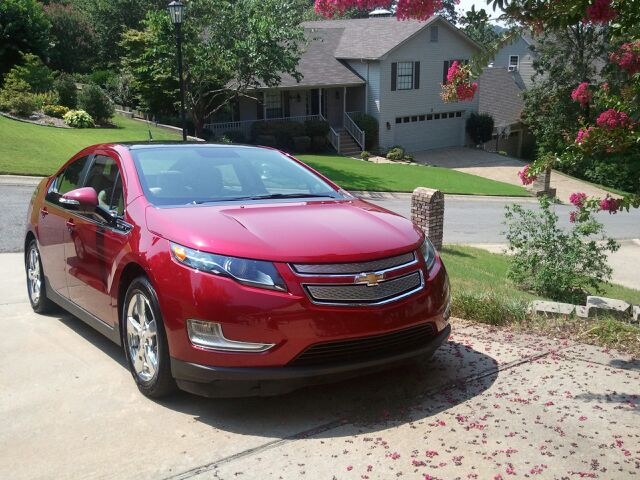
2011 Chevrolet Volt on test in Little Rock, Arkansas, July 2011
Aerodynamic drag, the primary retarding force on a car at higher speeds, increases with the square of the velocity. Thus drag is four times higher at 80 mph than 40 mph. So slowing down is the single best way to boost range. If you're driving a Tesla Model S, for example, you can increase your range 40 percent simply by slowing from 75 mph to 55 mph. Slow to 35 mph and you'll almost double your range.
But electric motors are designed to be efficient in certain rpm ranges, and if you get too slow, the motor starts to lose efficiency. At some point, it actually takes more juice per mile to go slower.
In the Tesla Model S, the max-range speed is about 20 mph. I have not been able to determine the Volt's max range speed, but I'm presuming it's smewhere in the same ballpark. Bottom line: I need to drive as slowly as I can. That means sticking to back roads where I can keep my speed in the 30-40-mph range without disrupting traffic.
Terrain. In another nutshell, the flatter the better.

2011 Chevrolet Volt plugged into Coulomb Technologies 240V wall charging unit
Because of regenerative braking, electric cars don't waste as much energy as gas cars climbing and descending hills. But only about 60-70 percent of the battery juice required to get you up the hill is regained coming down the other side.
So my route had to be as flat as possible--a tough assignment in New York's Hudson Valley, as I know only too well from years of riding bicycles around the region.
For my destination, I chose New Paltz, a funky college town about 30 miles from my home, reachable by back roads over reasonably level terrain. (I picked the route partly because I have ridden it on a bike many times, and know all the nuances of its gentle ups and downs.) If I could complete the round trip on battery power, I would break the 60-mile barrier.
On a last-minute tip from Kevin, I pumped my tires up to 38 psi, the latest updated recommendation for the Volt. (My owner's manual says 35.) The higher the tire pressure, the less rolling resistance.
Continuous electric miles in 2011 Chevrolet Volt range-extended electric car [photo: David Noland]
With a full charge, the range estimator showing 39 miles, and the in-dash thermometer reading 74 degrees, I very gently pulled out of my driveway and very gently accelerated toward New Paltz.
I did not use extreme hypermiling techniques for this drive. My tempo was that of a little old lady in no particular hurry. I did not disrupt traffic in any way.
I did do a bit of coasting here and there, and stayed near the speed limit in 30-mph and 40-mph zones. In the few 55 zones, I would maintain at least 45 mph.
The Volt's battery charge indicator has 10 bars, which blink off sequentially as battery charge wanes. The first bar vanished at 4.9 miles--not bad, considering that the first few miles were the hilliest part of the trip.
The second bar blinked off at 9.6 miles. I was on pace for 48 miles, but I knew things would improve as we entered the flatter part of the route.
Sure enough, I got 6.0 miles out of the third bar and an astounding 6.8 miles out of the fourth bar, a 68-mile pace. (Presumably it was a bit downhill.) As I approached New Paltz, I was still showing six bars. A 60-mile round trip looked feasible.
But the sixth bar blinked off--indicating half the battery charge remaining--about a mile short of town, at 27.9 miles. When I pulled into the parking spot, I showed five bars and 28.7 miles.

Volt Battery Pack
After a pleasant open-air lunch, I returned to the Volt and was surprised and delighted to see six bars. But with the temperature now up to 81, the car had become oppressively hot sitting in the sun, and I had to briefly turn on the A/C.
The reborn Bar No. 6 disappeared almost immediately, and No. 5 shortly thereafter. I was paying the piper for the gravity-assisted 6.8 miles of Bar No.4.
I gradually came to see the inevitable: I wasn't going to make it home on the battery, and I wasn't going to hit 60 miles. But I continued my little-old-lady driving technique as the last three bars blinked off at miles 36.0, 41.9, and 47.1. The Volt's gas engine eventually kicked on at 53.5 miles, four miles from home.
With conservative driving and no A/C, at the ideal temperature over slightly hilly terrain, I'd managed to stretch my typical range by about 30 percent.
Could I hit 60 miles on dead-level terrain? I'm pretty sure I could. On a flat race track, at a steady 30 mph, 65 miles wouldn't surprise me. In a 2013 model, which has about three miles more EPA range than my 2011 model, even 70 miles might be within reach.
But I'm happy to go back to Sport mode, A/C, and 40 miles range. After all, when my engine kicked on at the end of my test run, it was the first time I'd burned gas in almost a month.
David Noland is a Tesla Model S reservation holder and freelance writer who lives north of New York City. This is his third article for High Gear Media.
+++++++++++