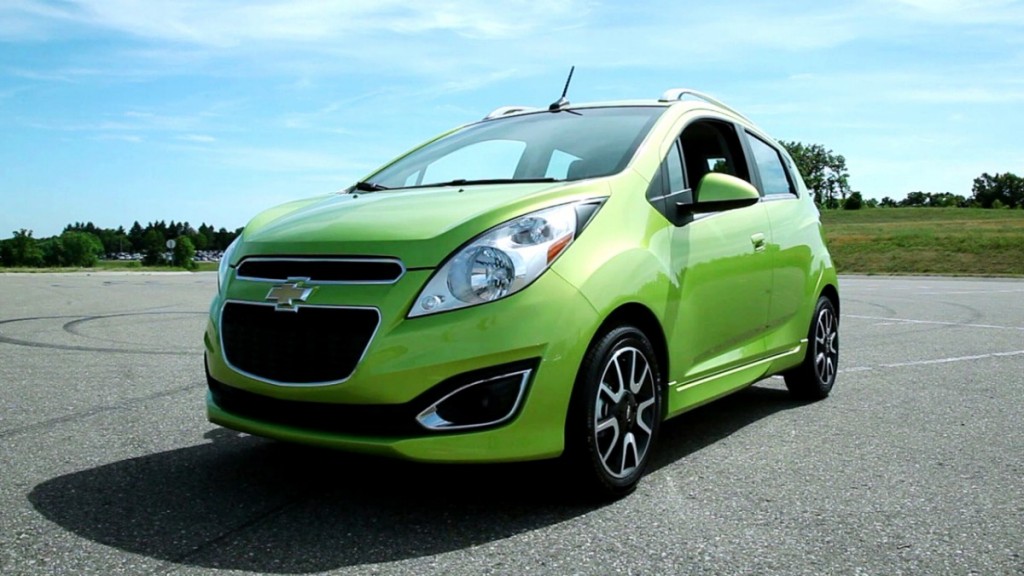
Earlier this month, we told you that the diminutive 2013 Chevrolet Spark with manual 5-speed transmission had received official EPA ratings of 32 mpg city, 38 mpg highway and 34 mpg combined.
Now Chevrolet has received the ratings for the 2013 Spark with automatic 4-speed gearbox: 28 mpg city, 37 mpg highway, and 32 mpg combined.
Fitted with the same 1.2-liter inline-4 cylinder engine as the manual Spark, it offers the same 85 horsepower.
That equates to gas mileage figures only 1 mpg better than the much larger 2012 Sonic Sedan with automatic 6-speed gearbox, while the manual 6-speed Sonic Sedan actually beats the manual Spark in highway efficiency.
Starting at $13,920, the automatic Spark is slightly less fuel efficient than its manual-box sibling, but if you're looking for a five-door minicar with automatic transmission, the Spark is your only choice.
At $12,995 for the 2013 Spark LS with manual transmission, the Spark is Chevrolet’s cheapest car -- and the smallest it has ever sold in the U.S.
But with the much larger 2012 Sonic Sedan LS with manual transmission starting at $14,660 -- and the Sonic Sedan LS with automatic starting at $15,730, the tiny Spark may be in for some tough competition from its bigger, more powerful brother, especially among those who want to do a fair amount of highway driving.
+++++++++++

Follow GreenCarReports on Facebook and Twitter.
Have an opinion?
See our review of the (Europe-only) Volkswagen Up for a modern-day counterpart, and a discussion of why it likely won't be sold in the States:
http://www.greencarreports.com/news/1076352_volkswagen-up-the-coolest-high-mpg-small-car-we-cant-have
Your old Sprint probably had the 1.0 L 3-cylinder engine that produced ~50 hp, and a transmission geared for economy. The Spark @ 85 hp produces 70% more power than the Sprint! And it certainly doesn't weigh anywhere near 70% more.
Considering engine advances, GM could probably give you the same fuel economy of your old car in the Spark if the power to weight ratio was the same. (Most in the motoring press would likely ridicule a car with 12-14 second 0-60 acceleration, but that's another topic.)
I think you would find that the old Sprint would have unacceptable acceleration as a new car today. As the article below discusses, most of the improvement in engine power over the last 20-plus years has gone to heavier cars and better acceleration, and relatively little to better fuel efficiency (though that will change from now through 2025):
http://www.greencarreports.com/news/1022351_surprise-heavier-more-powerful-cars-get-worse-gas-mileage
I was satisfied with the acceleration those Suzuki 1.0L powered cars offered, and in fact I still am (I still have one of the later 1.0L Metros, as well as a 1st generation Insight -- what the Metro wished it could be when it grew up! :) ) I'm honestly not sure why the roughly half a million American buyers of those cars found their acceleration acceptable (tolerable?) then, but would not today. ~10% of buyers even opted for an even less powerful (49 hp) and more efficient variant (XFi) when it was offered.
Roads are also more crowded today than ever...
The Chevy Spark only has a 84HP engine, yet doesn't get any better MPG than say a 150HP Honda Civic or 140HP Chevy Cruze..
So the Spark will be slow and an unimpressive driving experience. It simply doesn't make sense to buy a boring car when there is no advantage in the 'boring' factor.
This is a common trend with tiny cars, they are less aerodynamic than regular sized cars, and they have tiny engines to try and make up for it, but fail. Their city MPG isn't good either.
Other cars that share these characteristics; Tiny unimpressive engines with tiny cars and unimpressive MPG is the Scion iQ and the SMART car.
Have an opinion?Join the conversation!