A government-funded laboratory that helped pioneer the battery technology behind many electric vehicles, including the Chevy Volt, has recently begun to focus on developing technologies to improve natural gas-powered vehicles, in anticipation of government and industry soon seeking to bring consumer-friendly natural gas cars to market.
“Our conclusion is that natural gas as a transportation fuel has both adequate abundance and cost advantages that make a strong case to focus interest in the technology as a real game changer in US energy security,” said Mike Duoba, an engineer at the auto research center at Argonne National Laboratory near Chicago, Illinois.
“In terms of consumer ownership and use costs, the case to make a switch from current fuels to CNG is much more compelling than for other alternative fuels like ethanol and electricity,” he added.
Already, Duoba and his colleagues at Argonne’s Transportation Technology Research and Development Center have conducted tests for compressed natural-gas powered vehicles, mostly vans, ordered by AT&T for its corporate vehicle fleet, according to news release from the lab published online Wednesday.
But now some researchers at the lab are “ramping up focus” on compressed natural gas research in two key areas, according to Duoba: vehicle systems analysis and engine research and testing.

2012 Honda Civic Natural Gas
Specifically, Argonne’s auto research center has a variety of sensors that can “characterize the entire CNG (compressed natural gas) vehicle system,” as well as “dynamometers that explore all aspects of engine operation and control.”
The equipment will help Argonne to improve the efficiency of existing natural gas powered vehicle engines. Argonne hopes to be able to cut down on the amount of space that natural gas takes up in a car’s tank (more than an equivalent amount of gasoline, requiring more frequent refueling), and build a new native “bi-fuel” engine, one that can handle gasoline and compressed natural gas equally well, instead of currently available conversion kits, which just modify gasoline engines to support natural gas.
One catalyst for Argonne’s pivot was a February announcement by the Department of Energy of a new $30 million research competition to “find ways to harness our abundant supplies of domestic natural gas for vehicles.”
But the other is a more broad acknowledgement that might prove more of a threat to the slow-growing electric vehicle market: America is sitting on an abundant supply of natural gas, which has been especially cheap lately.
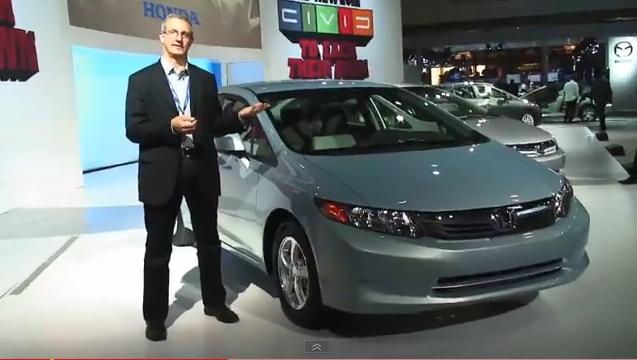
2012 Honda Civic Natural Gas model at New York Auto Show, April 2011
“Only about 17,000 out of 12.8 million [vehicles] sold in 2011 were Leafs and Volts,” Duoba told TPM, also noting that: “At least for some time, compared to plug-in vehicle batteries, CNG storage offers lower weight, higher energy storage and lower costs - as well as faster refueling/recharging.”
So why haven’t more companies yet attempted a compressed natural gas vehicle for the consumer market? After all, in the United States, the only available product is the Honda Civic GX (replaced this year by the 2012 Honda Civic Natural Gas), a car which until recently was only sold in a handful of states.
As Duoba noted, this was in part due to the “chicken and egg problem” of the lack of refueling stations. But now industry heavyweights including T. Boone Pickens and Shell Oil have announced plans to begin installing hundreds of compressed natural gas fueling stations.
As for environmental impact, that too remains a point of contention when it comes to compressed natural gas vehicles versus electric cars.
Because although electric and plug-in hybrid vehicles produce few to no emissions of their own while operating, the power they suck from wall outlets and charging stations often does come from fossil fuel plants, leading the Department of Energy to state that the average annual emissions per all-electric vehicle is 8035 pounds of carbon dioxide (CO2) equivalent. Yet while CNG vehicles “can produce significantly lower amounts of harmful emissions,” according to the Energy Department, the only commercial vehicle on the market, the Honda Civic GX only saves 25 percent on carbon emissions per mile to its comparable gasoline counterpart.
However, Duoba said that Argonne’s primary goal wasn’t necessarily cutting down on emissions, but reducing dependence on foreign energy sources.
“Various technologies have been successful at reducing the environmental impact (criteria pollution) over the decades,” Duoba wrote. “To the extent that consumption of foreign petroleum has not been reduced to acceptable levels, this could be viewed as the principal motivation.”
Editor’s note: This article has been updated in copy to clarify that Argonne is not stopping or reducing its research into electric vehicle technology, but that some researchers are now increasing their focus on compressed natural gas vehicles.
This article, written by Carl Franzen, was originally published on TalkingPointsMemo, an editorial partner of GreenCarReports.
+++++++++++