Carmakers are beginning to realise that saving gas and reducing emissions, and making a fun car to drive aren't mutually exclusive.
At the top of the market there are now plenty of high-performance hybrids to choose from, but what if your budget is a little lower - nearer the $20,000 mark?
That's where the 2012 Honda CR-Z and 2012 Hyundai Veloster come in. Both are compact coupes, both do in the region of 40 MPG on the highway, and both are designed to be fun to drive. So which should you choose for a bit of green fun?
Economy and emissions
With a six-speed manual transmission, the Hyundai hits the all-important 40 MPG highway rating, which looks good in the brochure and is sure to bring in the customers. That dips to 38 MPG with the dual-clutch auto, though to compensate, city mileage is better at 29 MPG, to 28. The overall mileage is 32 MPG for both transmissions.
The Honda gets higher overall mileage - 34 MPG combined with the 6-speed manual, and 37 combined for the continuously-variable auto. The auto just misses out on a 40 MPG figure for highway mileage, getting 39 - with 35 in the city.
As such, the Honda is the cleaner according to the EPA fueleconomy.gov site, using 8.9 barrels of petroleum per year to the Hyundai's 10.3 barrels, less tailpipe CO2, and a better smog score. At $3.79 per gallon of gasoline, it'll also cost you approximately $250 a year less in gas than the Hyundai over 15,000 miles.
Performance and fun
Economy is only one facet of these coupes - the other is fun. The Hyundai starts off well by offering the more powerful engine. It uses a 138-horsepower 1.6 with direct injection and variable valve timing. You'll complete the 60mph sprint in between 9 and 10 seconds depending on the transmission.
Honda's coupe delivers you to 60mph in somewhere just under ten seconds, which isn't particularly quick, but close enough to the Hyundai - the lack in engine capacity made up by the electric assistance - a feature that also gives the car useful torque at low revs, beneficial for both performance and economy.
Both cars are fun to drive, as you'll see in our full reviews of each. The Honda is certainly more nimble and exciting than its humble Insight underpinnings suggest.
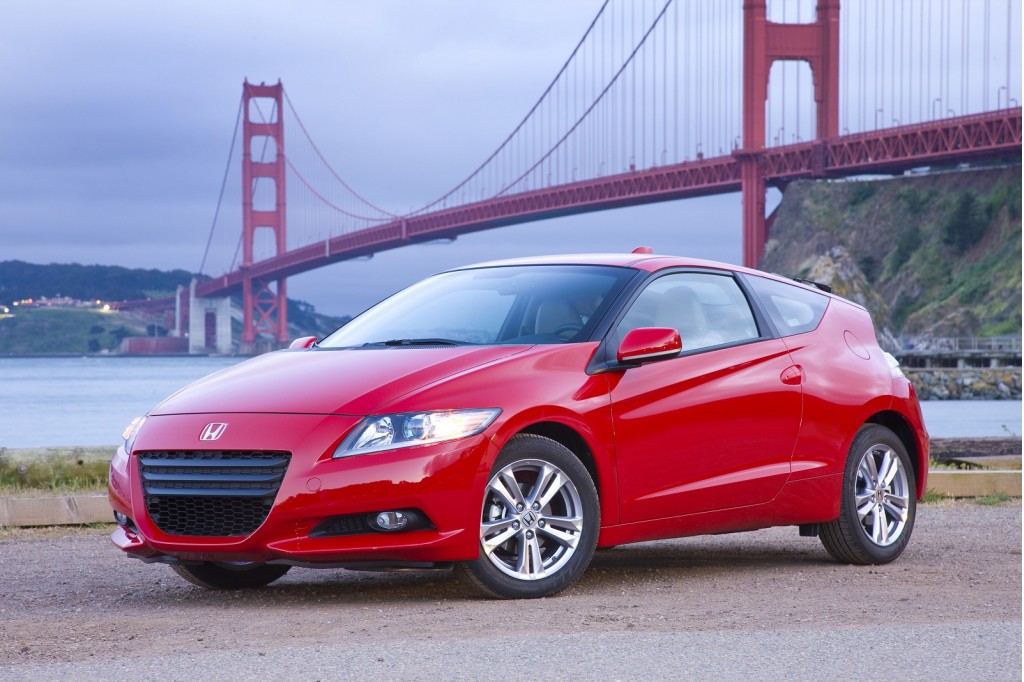
2012 Honda CR-Z
Practicality and value
The Veloster takes a fairly easy victory here. The asymmetric door layout may not be to all tastes as far as styling is concerned, but it improves access to the rear seats. The CR-Z doesn't even offer rear seats, though luggage space is improved as a result.
The cabin is light and airy though, and the build quality is good. We did find a few seat comfort issues when we reviewed the car though, so try both out to see which fits you best.
The Veloster is the cheaper of the two vehicles - it starts with an MSRP of $17,300 to the CR-Z's $19,545. That gets you the manual transmission in each. Another $650 gets you CVT in the Honda, bringing the total to $20,195. The dual-clutch auto adds $1,250 to the Veloster's price. The CVT is worth having in the Honda for the economy gains, but it may not be as fun to drive as the manual car.
Verdict
Choosing between Veloster and CR-Z is closer than some of the other comparisons we've looked at, because the hybrid isn't as clean-cut on economy in this instance. It's close though, and if your driving takes in a mix of routes, the CR-Z should be the more efficient, and cleaner choice overall.
However, if value is your deciding factor then it's hard to argue against the Hyundai. It gets up to 40 MPG, has two more seats and costs less to buy.
Both cars show that economical need not mean boring though - more cars like this please, auto industry.
+++++++++++