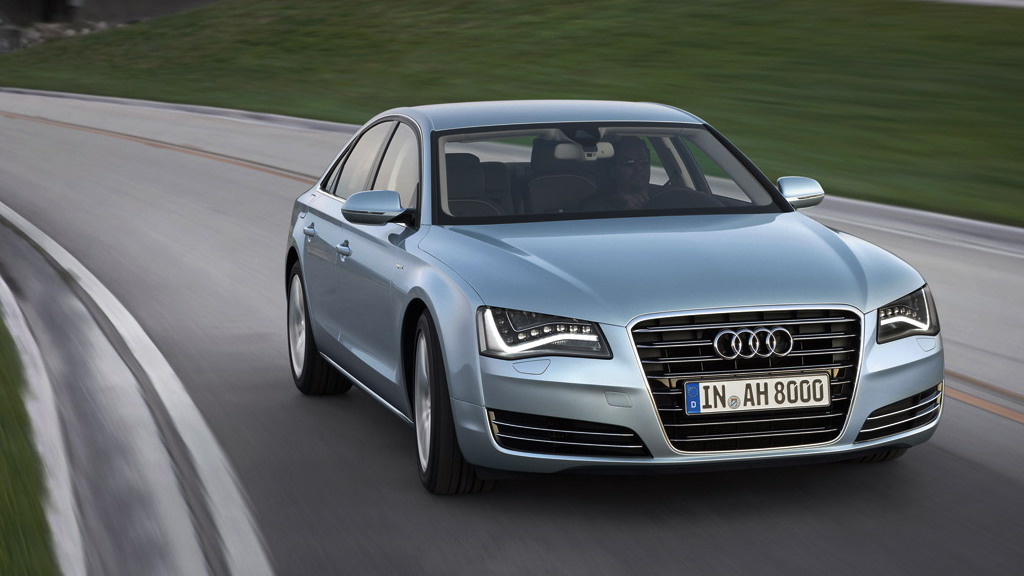
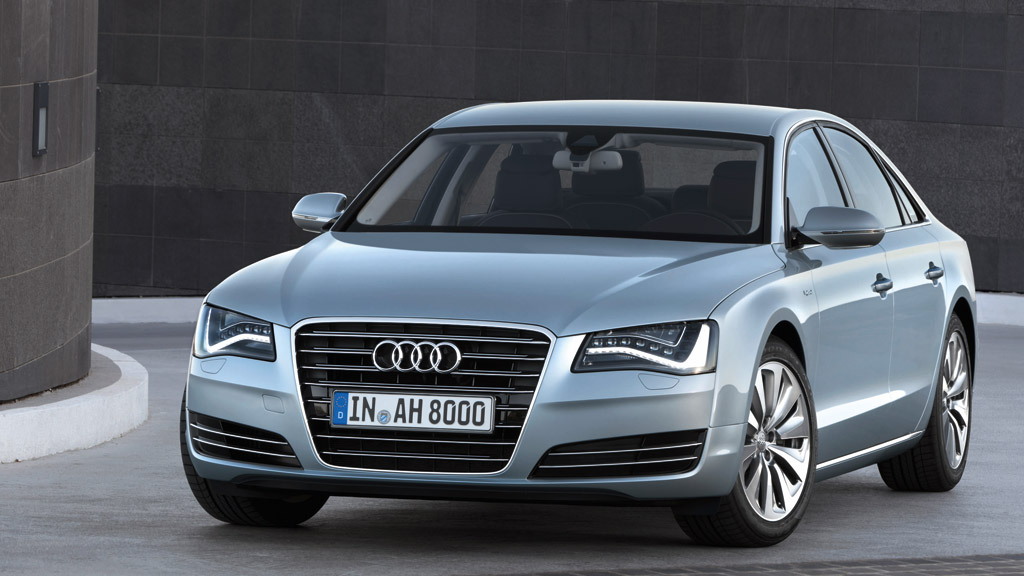
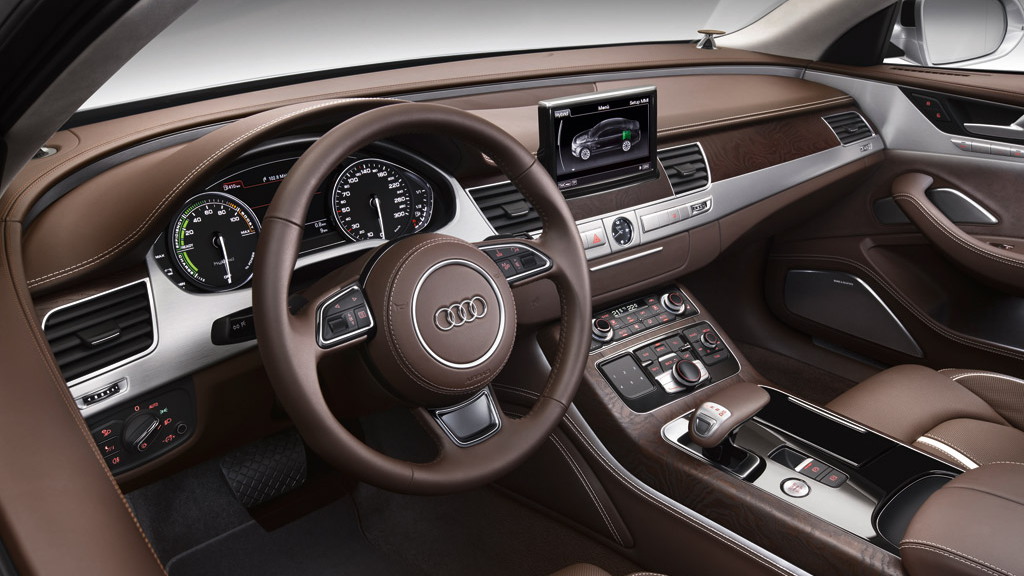
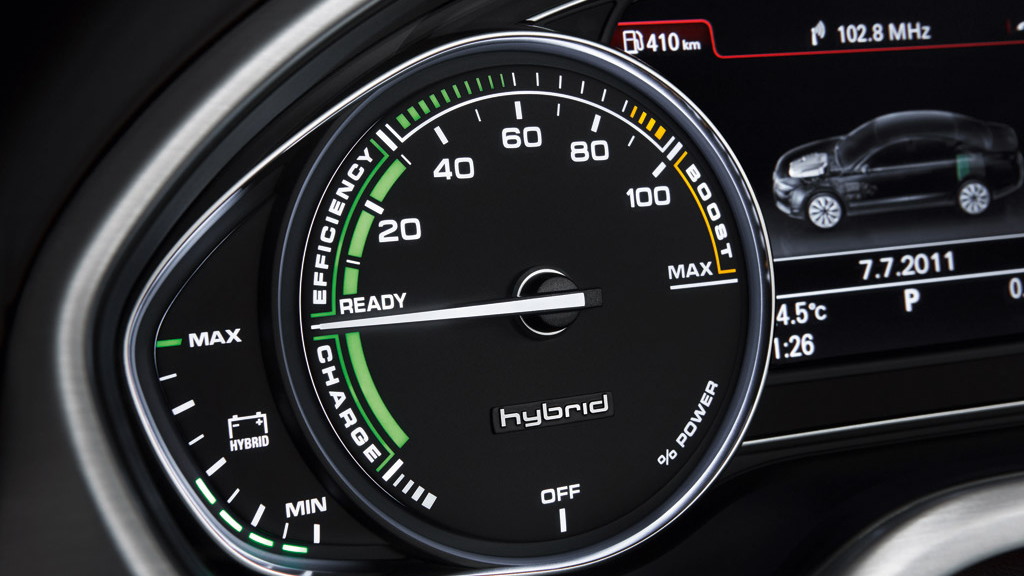
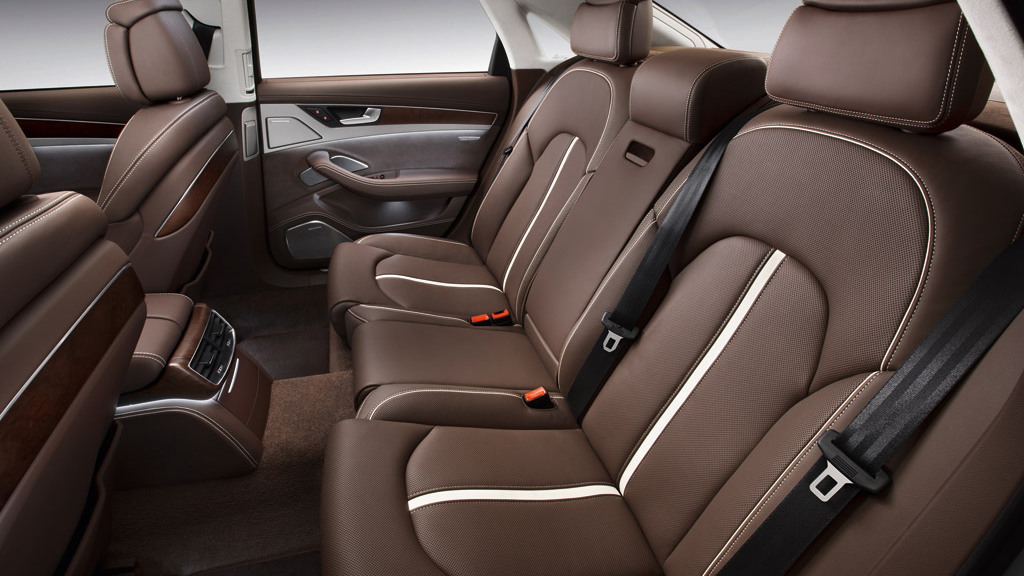
2012 Audi A8 Hybrid
Historically, German automakers were slow to move into hybrid-electric vehicles, relying exclusively on diesel engines to boost fuel efficiency.
That's in the past, though, and the Volkswagen Group is aggressively spreading its hybrid powertrain across models from many of its brands.
But while VW and Porsche already sell hybrid sport utilities in the U.S., Audi doesn't yet offer any hybrids in the States--though you can expect to see hybrid versions of the Q5 mid-size sport utility and the A6 mid-size sedan soon.
Now, Audi has taken the wraps off its A8 full-size luxury sedan.
The 2012 Audi A8 Hybrid uses the second generation of the VW Group hybrid system, with a 40-kilowatt (54-horsepower) electric motor sandwiched between a 211-hp, 2.0-liter turbocharged four-cylinder engine and the group's eight-speed automatic transmission.
Together, the engine and electric motor can produce maximum power of 245 hp and 345 pound-feet of torque. Audi says the A8 Hybrid can travel up to 1.8 miles on electricity alone at a constant speed of 37 mph, and can run solely on electric power for brief periods at speeds up to 62 mph.
Like other single-motor hybrid systems, the Audi system can either contribute electric power to run the car or recharge the battery pack via regenerative braking--but it can't do both at the same time.
The air-cooled 1.3-kilowatt-hour battery pack uses lithium-ion cells, rather than the older nickel-metal-hydride technology of the packs used in the 2011 Volkswagen Touareg Hybrid and 2011 Porsche Cayenne S Hybrid sport utilities.
On the European test cycle, the A8 Hybrid returns more than 36 miles per gallon--not bad for a full-size luxury sedan. Audi quotes a 0-to-62-mph time of 7.7 seconds, and a top speed of 145 mph.
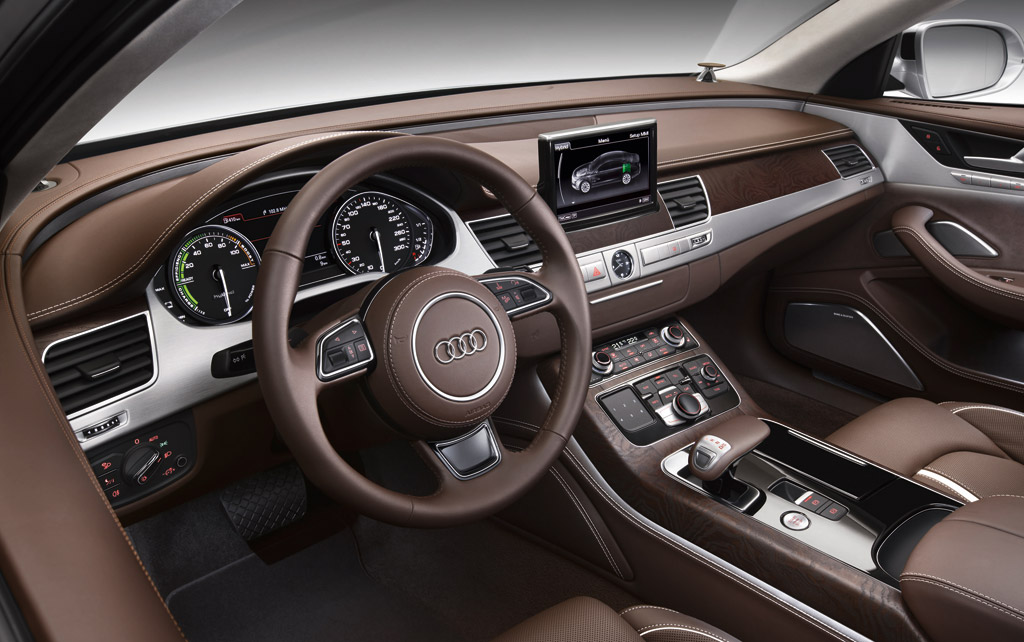
Audi first showed the A8 Hybrid almost 18 months ago at the 2010 Geneva Motor Show. But at the time, it offered few details and said little about when its largest and most luxurious hybrid would go on sale.
Now we know that the big hybrid sedan will go on sale next year in Europe as a 2012 model.
Plans for the U.S. are less clear, although given that the VW Group's other U.S. brands each has at least one hybrid offering--and more on the way--it seems logical to expect the Audi A8 Hybrid in the U.S. at some point.
But Audi's first U.S. hybrid is more likely to be the A6 Hybrid that was shown at January's Detroit Auto Show. The A6 is a higher-volume car for Audi in the States, and mid-size hybrid sedans--even luxury models--sell in greater numbers than full-size ones.
Still, the U.S. remains the largest global market for hybrid vehicles, so Audi clearly had its eye on buyers here when it green-lighted the A8 Hybrid.
Right now, the sole full-size luxury hybrid is the 2011 Lexus LS600h L, which sells in very small numbers indeed. Given upcoming gas mileage rules, that is likely to change.
When it does, Audi clearly intends to be prepared.
[Audi via MotorAuthority]
+++++++++++
Follow GreenCarReports on Facebook and Twitter.
Have an opinion?
20/24 MPG VW Touareg
20/24 MPG Porsche Cayenne
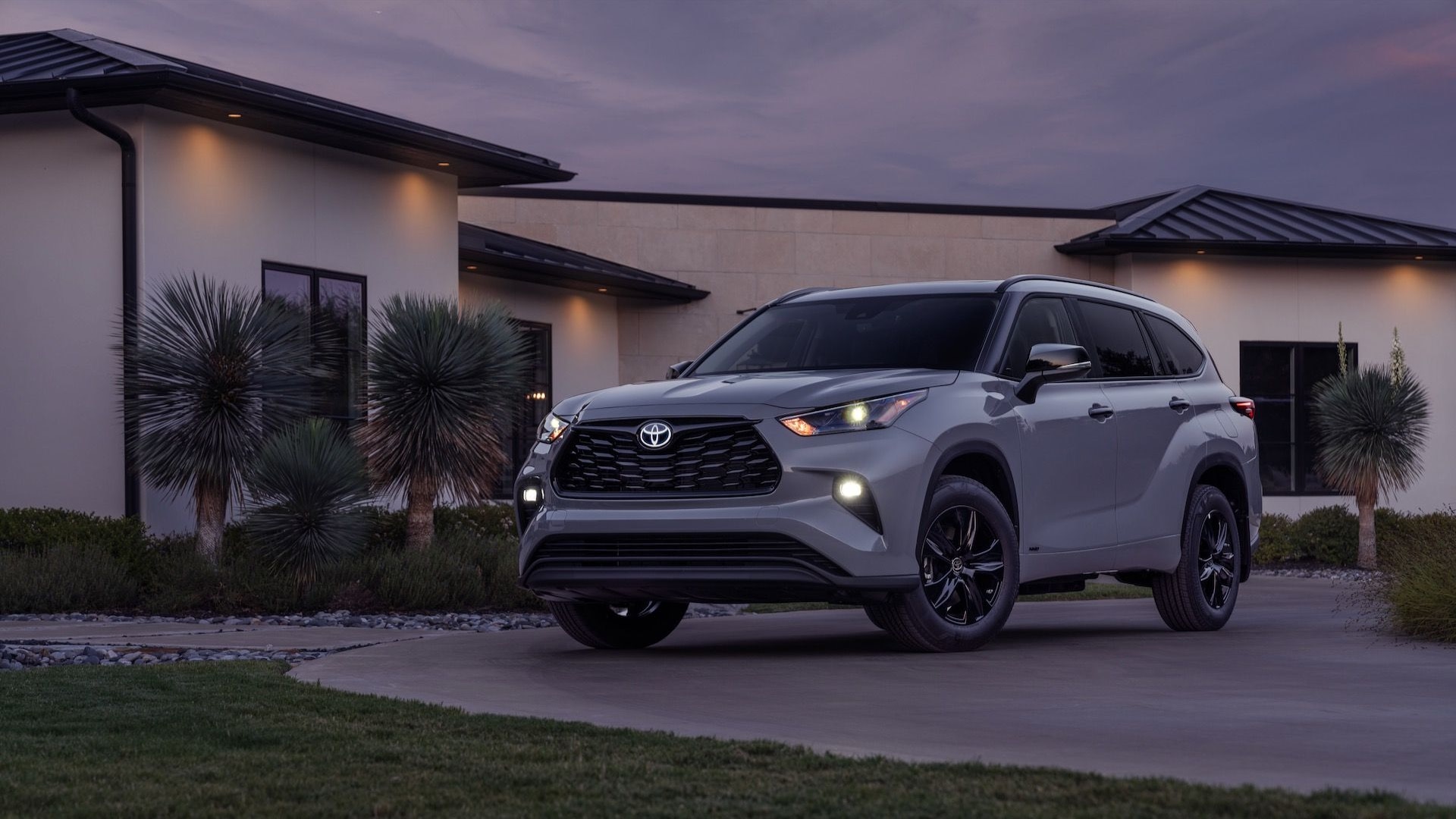
28/28 MPG Toyota Highlander
While VW and Porsche have boosted their gasoline non-hybrid models from 16 to 20 MPG city (a seemingly impressive 25%), the Toyota Highlander betters that 20 MPG to 28 MPG or an additional 40$ on top of the 25%.
So if you want to pretend to be doing something good for the environment and this country's trade imbalance, buy a VW, Porsche, or Audi hybrid. If you actually want to do something to make a brighter future, buy something actually fuel efficient.
For instance, that 16 to 20 mpg city improvement on the VW saves 1.25 gallons per 100 miles. The 20 to 28 mpg rise saves 1.43 gallons, which is only 14 percent more.
A better example is that increasing the combined mileage of a large pickup truck from, say 16 to 20 mpg, saves MORE (125 gallons every 10K miles) than going from a 33-mpg compact to a 50-mpg Prius (100 gallons every 10K miles).
Worth keeping in mind as you assess powertrain alternatives.
Sorry, the Highlander is still dramatically better on city MPG than the Touareg and the Cayenne.
Sure, if I was comparing trucks versus cars, there is some merit to your argument. But in this case, I am comparing SUV to SUV so the non-linear argument is not relevent.
20% improvement from Cayenne ICE to Cayenne hybrid
29% improvement from Cayenne Hybrid to Highlander Hybrid.
43% improvement from Cayenne ICE to Highland Hybrid.
I understand Voelcker's 14% math but it is misleading. The Highlander hybrid uses 29% less fuel (city) than the VW and Porsche vehicles.
16 mpg 6.25 gal/100 miles Cayenne
20 mpg 5.00 gal/100 miles Cayenne Hybrid
28 mpg 3.57 gal/100 miles Toyota Highlander
Why VW and Porsche don't simply get called out for having non-competitive hybrids I do not know.
I do know that if VW accelerated 29% worse than their competition, that would be pointed out clearly.
Buyers choose cars for a wide variety of reasons, among them brand image, styling, features, luxury, capacity, functionality, reputation, and so forth. After 12 years on the U.S. market, the Prius has grown to be the third best-selling Toyota car--which indicates that fuel efficiency is not the topmost factor among Toyota buyers.
1 of 2, continued ...
It is simply erroneous math and a misconception that a higher percentage improvement in fuel economy is better than a lower percentage. The amount of gasoline saved depends ENTIRELY on the denominator of the equation (the car's CONSUMPTION of fuel, not the nonlinear gas mileage).
Reducing or displacing actual gallons of gasoline is, IMHO, a better goal than "increasing gas mileage" on vehicles that achieve already higher-than-average MPGs. This is why I add context and perspective by calculating GALLONS saved. It translates to COST ($$$).
Here, the commenter's 29% was misleading. Only 14% more gasoline was saved by hybrids. Not sure how else to say it.
I did mentioned Toyota Highlander which is comparable in class to the VW and Porsche Hybrids and a very apt comparison.
What is also a fact is that 28 MPG Highlander Hybrid is better than 20 MPG Cayenne Hybrid despite your complex arguments to the contrary.
As I said, this is where the normally brilliant Voelcker comes unglued and starts arguing that 20 MPG is better than 28 MPG.
So dear reader, I guess you will need to do the math to show that 28 MPG is more than 14% better than 20 MPG. Mr Voelcker cannot seem to do simple math.
As for other reasons to buy cars (brand, styling, etc), no argument from me. But when discussing MPG stick to that.
$2742/year on fuel Cayenne Hybrid
$1917/year on fuel Highlander Hybrid
Making the Cayenne 43% more expensive to operate.
Please show me in my comment where I said that, or even implied it.
What I said was that the commenter seems to draw the wrong conclusion from his data: the hybrid model of the Highlander doesn't save 40% more fuel than the hybrid model of the Cayenne or Touareg, it saves 19 percent more fuel. That's ALL.
Each buyer chooses "better" or worse vehicles on different bases. We urge saving fuel, but the reality is that different types of cars are right for different people & an informed, mathematically literate buyer is better equipped than one who doesn't understand MPG.
See here for more on the deceptive and confusing MPG measure: http://www.greencarreports.
John C. Briggs
Toyota produced an SUV that is
188x76x69(LxWxH) that performs at 28 MPG City
Porsche produced an SUV that is
190x76x67(LxWxH) that performs at 20 MPG City.
Given the similar size between the two vehicles, Porsche could have done much better at producing a hybrid. The same can be said of the VW and, sadly, the same can be expected from Audi when they start shipping their hybrid.
Have an opinion?Join the conversation!