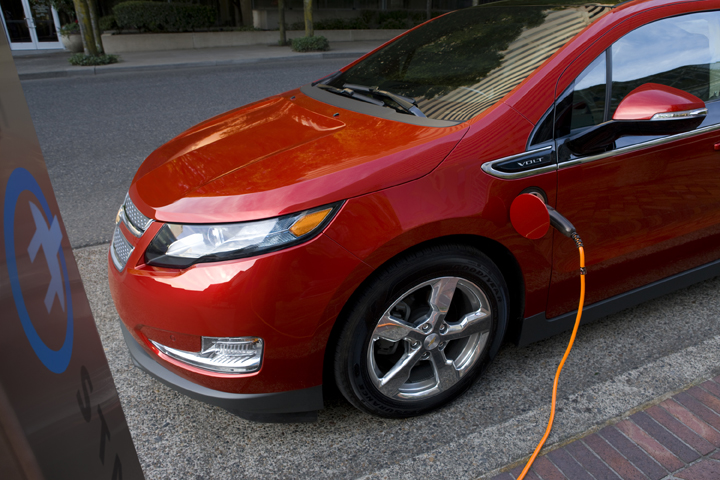
2011 Chevrolet Volt
California's electric-car advocates are often "true believers," and they can be single-minded in the pursuit of what they believe is right.
But the nuts-and-bolts experience they've gained during the state's 15 years of electric-car use can be invaluable--which is why policy-makers and car companies take their views seriously.
Usually.
Which brings us to the strange case of California Assembly Bill 475, and why it has upset advocates so much that they want it vetoed or completely rewritten.
AB 475 is a bill, backed by General Motors [NYSE:GM], to allow Chevrolet Volts (and other plug-in cars with engines too) to use certain charging stations legally.
Plug-in cars, with engines too
Public charging stations have existed in California since the first wave of electric cars started to arrive in 1996. In 2002, a law was passed that restricted parking in certain "EV spaces" to Zero-Emission Vehicles.
About 800 electric-car owners have paid the state $18 for a "Zero Emission Vehicle" sticker that marks their car as authorized to park in these spaces. But not all charging-station spaces in California require electric cars to display the stickers, though some do--no one seems to know how many.

California Zero-Emission Vehicle parking permit, from DanielBusby.com
Because they didn't exist at the time, the 2002 law said nothing about plug-in hybrids (e.g. the 2012 Toyota Prius Plug-In Hybrid) or range-extended electric cars (e.g. the Chevy Volt).
These cars have plugs, but also gasoline engines, so they're not zero-emission vehicles. So they can't get the ZEV sticker, and hence are illegal at charging stations that require a sticker to use.
Drafted by Betsy Butler, staff, GM
The bill that became AB 475 started out by adding language to make this new type of plug-ins eligible for the stickers.
The largest number of plug-in hybrids today are Volts, leading GM to assist the staff for sponsor Assemblymember Betsy Butler in drafting the bill. The company did so, it says, at the request of Volt owners who wanted legal access to chargers.
A subsequent draft of the bill eliminated the need for electric-car owners to get the sticker. At that point, Plug-In America and other advocates got involved to address several concerns about the bill's new language.
GM: We'll work with you
GM said it would work with the advocates, recounted advocate Chelsea Sexton, to refine the new draft so it addressed their concerns. After months of meetings and revisions, the bill was passed by the Senate on August 18. Butler introduced it in the Assembly on Friday, August 19, where it was passed on Monday, August 22.
But the final bill contained none of the revisions urged by advocates. Instead, it used the same wording that had brought Plug-In America and others into the process in the first place.

Sacramento Electric Vehicle Gathering, June 18, 2011
California Governor Jerry Brown has until October 9 to sign or veto the bill. If he does neither, it passes into law.
Plugged in isn't always charging
The final wording requires any vehicle parked at a charging-station space to be "connected for charging purposes," i.e. plugged in. Or as GM representative Shad Balch put it, "Your charging cord is your parking permit."
Balch stressed that GM sees the overall goal of AB 475 as ensuring spaces with charging stations are occupied only by vehicles "using the space as intended--to charge" and to ensure that it does not in any way simply provide a better, "preferential parking" space for any random electric car.
But whether a car is charging is different from whether it's plugged in. If that little green light on a plug-in dash is green, it's done charging, whether or not the plug is still inserted into the socket. If it's orange on the Prius Plug-In, the car is still charging. (On a Volt, solid green is charging, and flashing green means "done".)
Unfortunately, the requirement that a parked electric car be plugged in at all times makes illegal a practice called "charger sharing," which Sexton and others say has worked well for 15 years now.
Share with your friends, kids
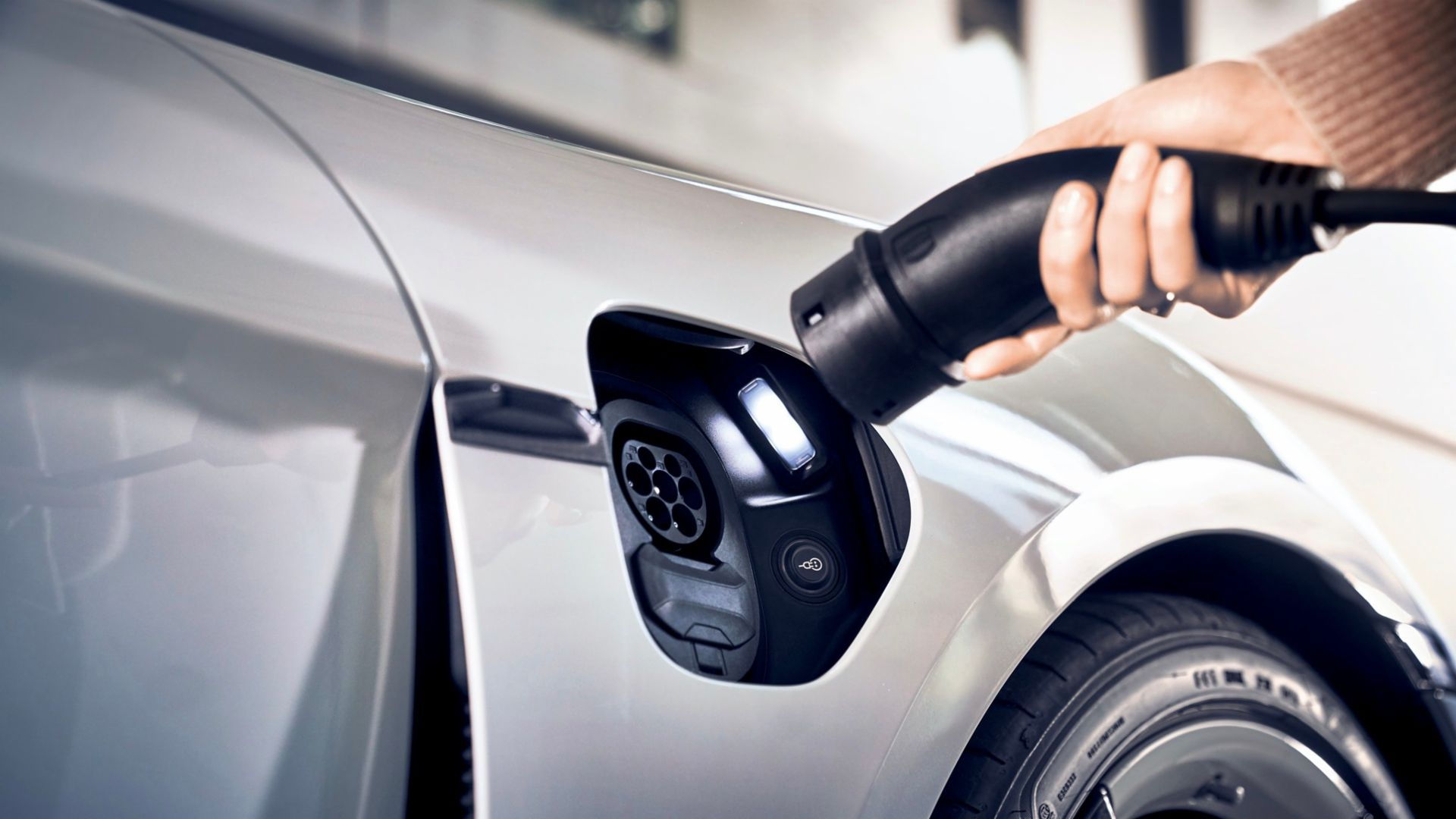
Here's the problem: Suppose you're driving an electric car, you want to recharge while you shop, so you pull in next to a plug-in vehicle already hooked up to a public charger.
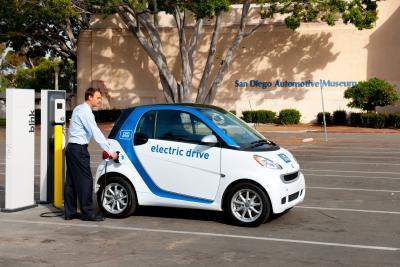
car2go Smart ForTwo Electric Drive charging at San Diego Automotive Museum
You can see at a glance whether it's done charging. Let's say the light on top of the dash is green, meaning the car has fully recharged. And, let's say the owner left a sign on the dash--as electric-car drivers may do--saying, "If my car is done charging, you can unplug it IF you need to charge."
So you unplug the Volt, close its charger door, and plug the cord into your own car to start recharging. It's called "charger sharing." Simple enough, right?
Under the new law, Sexton points out, that would mean the first guy's car could be towed away, because he would now be illegally parked.
You couldn't get ticketed for unplugging. At least, not yet: GM has said unplugging an electric car is "tampering" and should be viewed as vandalism--like smashing car windows or slashing tires--that carries criminal penalties.
Doing the right thing gets harder
The net effect is to reduce access to charging stations, advocates say. And they base their claims on 15 years of experience: If every electric car at a charging spot must be plugged in, so-called "charging" could come to take as long as the owner needs to spend doing whatever she planned to do while the car was parked.
Ask yourself: Which is easier, leaving a sign saying "unplug me if I've finished," or interrupting your business to walk out to your car, unplug it, and move it to a different space further away just as soon as it notifies you it's charged up?
Precluding this additional access to a charging station would seem to ill-serve all plug-in drivers, including the Chevrolet Volt owners whose interests GM says it's representing.

Scenes from dedication of electric-car charging station at Creekside Inn, Palo Alto, CA
She said, he said
Yet when Plug-In America raised alarms about the loss of sharing, Sexton says, the office of sponsor Assemblymember Betsy Butler told the group, "General Motors didn't want changes."
GM says that while it recognizes that advocates had concerns, it didn't see them as critical--so when the Assemblymember reached out, the company said it was fine with the bill as written.
Advocates: Kill the bill
Electric-car advocates are now so upset that they now either want AB 475 killed altogether, or to revert to the original language that added plug-in hybrids to the list of vehicles eligible for a sticker. A Plug-In America action alert has, the group says, generated hundreds of letters to Governor Brown's office urging that he veto the bill as written.
A letter sent by Plug-In America to Assemblymember Butler 10 days ago says, in part:
Plug In America enthusiastically originally endorsed AB 475 at introduction (February 15, 2011), which would have simply added plug-in hybrids to an existing EV parking law. Unfortunately, the current amendments to AB 475 will actually make it more difficult for electric vehicles and plug-in hybrids to share charging infrastructure.
We now oppose this bill because it will hurt the consumers who it was designed to help and will not accomplish its stated goal. This, in turn, could reduce the demand for the next generation of clean efficient vehicles which run on clean domestic electricity.
GM: No backing down
GM is sticking energetically to its guns.

2011 Chevrolet Volt test drive, Michigan, October 2010
Shad Balch, who works with Volt owners in California and is GM's front-line representative both to the broader electric-car community, has written and posted numerous approving comments on AB 475.
One can be found on Volt portal MyChevroletVolt; it's worth reading for the countervailing comments from advocate Mark Larsen and others.
About AB 475, Balch says confidently, "This is the best public policy." In a lengthy interview with GreenCarReports, he made other points:
- It is an entirely voluntary protocol, so any individual parking lots, municipalities, and others are free to adopt its provisions or not
- Even if lots do adopt it, localities can enact their own laws to override it--which could maintain charger sharing where it's an established community protocol
But asked if he thought this was a good model for other states to adopt, Balch said it would be "a good start."
Bad blood like EV1 days
Balch said that GM had not engaged other automakers--like Nissan, Tesla, Fisker, or Toyota--in discussions over the language of the draft bill, nor was he aware of any participants from other makers present at any discussions.
But since advocates called for a rethink, bad blood has boiled up between GM and the advocacy community, to a degree not seen since GM took back and crushed its EV1 electric cars starting in November 2003.
As AutoblogGreen notes: "The funny thing is, one of Chevrolet's slogans is 'It's more than a car, it's a community.' Hmm."
The difference could be based on outlook: GM seems to have a much darker (or less idealistic) view of how its customers and other electric-car drivers will behave than do advocates.

Public Charging Station for electric cars, courtesy Mitsubishi Motors
"Less altruistic" electric-car buyers
Rob Peterson, who works in GM Communications, wrote on a Facebook group for Volt owners:
Today, the EV community is filled with well-intended owners/advocates who are pushing for a faster adoption of electric vehicles, but this community will soon grow to include others who drive electric cars for less altruistic reasons.
You're already seeing dissension among the troops, as owners of pure EVs are pushing to have Volts excluded from public charging as they believe either their EV miles have inherently more "goodness" than those of a Volt or they have specific [knowledge] to understand how much liquid fuel a charging Volt has on board.
Electric vehicles are coming, and we need to be prepared for tens of thousands of electric-car, extended-range electric, and plug-in hybrid owners--some who may not have the same values that those of us in the community share today.
GM's dark fears seem to envision a scenario in which drivers of battery-electric vehicles (like the Leaf) feel free to unplug plug-in hybrids (like the Volt) from charging stations, rationalizing that, "They have an engine to get them home, whereas I'll be stranded if I can't charge."
Under that scenario, Volt owners consistently lose--which would explain why GM wants unplugging anyone's car, ever, to become illegal.

2011 Chevrolet Volt
Sexton points out that there's absolutely no indication that this has happened to date, or that it will happen in the future. "There's no reason to believe the vehicle population will ever outgrow the driver population's ability to behave considerately," she said. "GM's entire point of view is based on a fallacy."
And she noted the plug-in vehicle population will grow slowly as a proportion of the overall vehicle pool--slowly enough to let issues be resolved if they arise.
Why did it get so ugly?
But the dispute has gotten surprisingly ugly. In comments on Sexton's first blog post and in concurrent Twitter discussions, Balch said advocates' concerns are "misguided" and an attempt at "spreading misinformation," among other characterizations.
The tone of the discourse seems doubly odd given that GM invited Sexton to be part of its first Volt Advisory Board, followed by an amusing sequence of articles she wrote about pretending to "hide" her Volt to prevent the company from taking it back.
Just six months ago, that got her slammed by some advocates as "in GM's pocket." My, how times change. For the record, Sexton chuckles, she has less vested interest than most of the other parties--she doesn't own a plug-in vehicle.
But to Plug-In America and other advocates, the question has expanded beyond the bill's language to include: Why is General Motors fighting for it so fiercely?
The company has shad some success after three years of wooing electric-car advocates bitter over its crushing of EV1s. Balch admitted that engaging with electric-car advocates is a primary part of his communications role.
Unclear what's to be gained
But battle-scarred advocates say GM is reverting to type--notwithstanding its bankruptcy, restructuring, new management, and the launch of a plug-in vehicle. "The current stonewalling and refusal to engage ... most closely resembles the EV1 standoff," said a frustrated Sexton.
Why that has happened remains very unclear.
When asked why GM is fighting the advocates so strongly, Balch simply reiterated, "We have a good public policy, and we're standing behind it."
GM out on a limb?
But it's possible the carmaker has gone out on a limb. GM may be the only electric-car maker that supports AB 475 as now written.
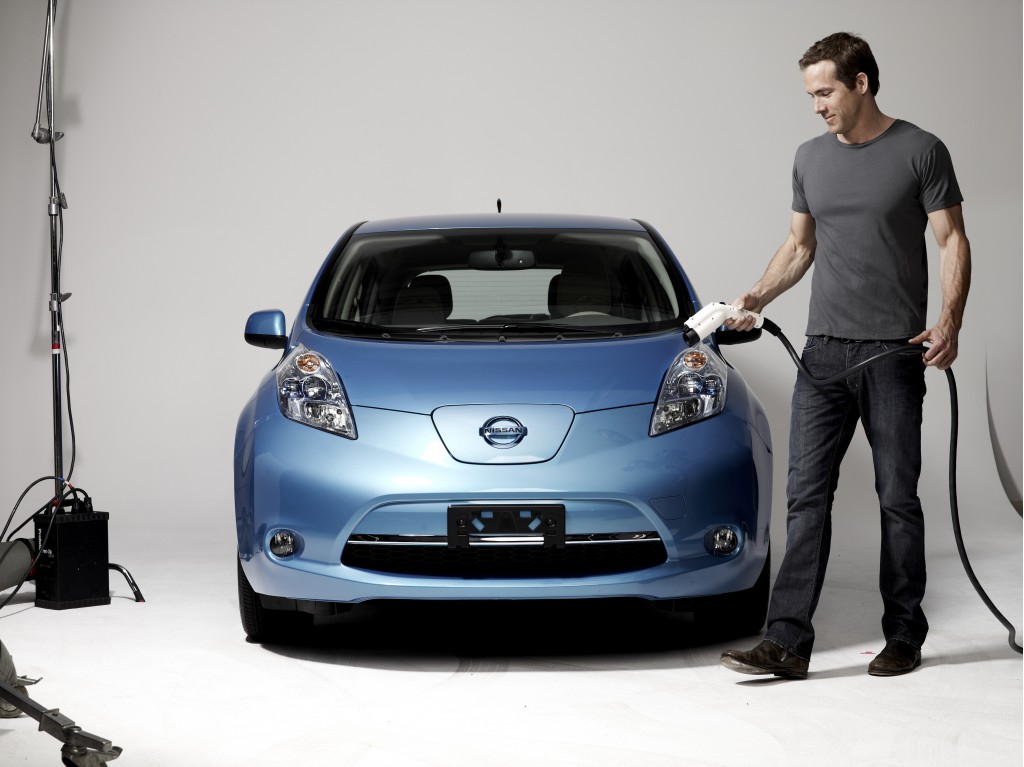
Ryan Reynolds Nissan Leaf Spokesperson
While Nissan's government affairs representative is away on vacation this week, Nissan said she had already expressed its concerns to Governor Brown's office. The company, said Katherine Zachary, is "looking to fully understand the considerations and nuances of the bill."
And Silicon Valley startup Tesla Motors [NSDQ:TSLA] has expressed its own concerns with the bill to the governor's office as well.
New draft altogether?
On Wednesday, Plug-In America, Sexton, and others met with Governor Brown's staff and were asked to draft an amended version of the law that would address their objections. They did so, and have submitted it for consideration.
We'll keep you posted on what happens with AB 475.
And, tell us, what do you think: Should it always be illegal to unplug an electric car at a public charging station? Leave us your thoughts in the Comments below.
[EVchels, MyChevroletVolt, EVchels]
+++++++++++