



MINI E
2013 Nissan Leaf: Driven Through Tennessee...
Could Small 2015 Chevy City Express Van Offer...
2013 Smart Electric Drive To Offer Battery...
What comes first? The electric car or the charging point?
Of course it depends on who you ask. Generally if you’re an existing electric car owner the answer is likely to be the former. If you’re a government official, prospective electric car owner or automaker the answer is likely to be the latter.
Automakers believe this fact so much that electric car rollouts are often limited to areas with good electric car infrastructure and support.
It turns out that isn’t necessarily true, as data collected by BMW shows.
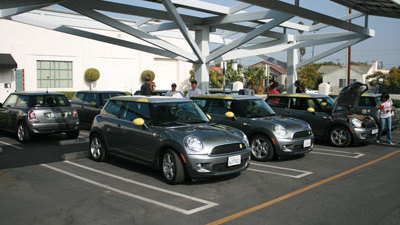
In its 14 month Mini-E test lease program, involving two groups of 40 drivers, two-thirds of participants only ever charged their two-seat all-electric mini at home.
While most of the participants in the trail had begun their short lease believing that public charge points were absolutely essential to the future success of electric cars most discovered that the 100 mile range per charge offered by the Mini-E was more than enough for daily use.
The participants did acknowledge however, that some of their electric car charging behavior was formed by a lack of public charging infrastructure.
In other words, they wanted to charge more frequently, but a lack of facilities meant they couldn’t.
A lack of charging outside of the home didn’t cause Mini-E leasees to leave their cars at home though: drivers reported that despite having severe range anxiety at the start of the trail they soon discovered the Mini-E could provide enough charge for all but the most demanding of trips.
The results should make electric car advocates very happy. For years we’ve been told that 100 mile ranges are more than enough for 90% of the population.
BMW’s trail only validates that further
Has the trail banished range anxiety? No. Range anxiety is most often experienced by those who have never driven an electric car or who have just purchased their first electric car. Drive an electric car for a few months and all but the most paranoid drivers lose it.
While nice to have, level 2 charging infrastructure isn’t as necessary to the success of electric cars as ultra-fast direct current level 3 charging points.
Why?
Because at the end of the day, most people won’t need to charge while away from home unless they’re doing long-distance trips.
And for those, it’s the ultra-fast level 3 charging, not multi-hour level 2 charging, which is essential.
[BMW]

Have an opinion?
Tom Moloughney Posted: 3/18/2011 9:04pm PDT
I did a post here almost a year ago on the same topic: http://www.allcarselectric.com/blog/1047736_are-public-charging-stations-really-needed-for-ev-deployment#comments
Seems to me the people that claim that we need a extensive public charging infrastructure before we can have EV's are the people that have no EV experience. Sure public charging will make EV's more convenient, but we don't need nearly as many as some think. Just a few sprinkled here and there in shopping districts would be just fine for now. I think encouraging employers to install work place charging is actually more important that installing a public charger on every corner as some suggest is needed.
KeiJidosha Posted: 3/18/2011 9:14pm PDT
I did not have that issue, and more than 10% of my trips, destinations, and 33k miles involved opportunity charging. I had placed an order for a LEAF, but the shorter range, slow L2 charger, and lack of QC infrastructure would have been an unacceptable step backwards, so I canceled the order.
Once owners understand that opportunity charging increases the utility of their EV, slow chargers and a lack of infrastructure will not be acceptable.
Chris O Posted: 3/19/2011 2:25am PDT
Jack Rickard Posted: 3/19/2011 11:35am PDT
You finally got it right. We are on the verge of spending a LOT of public money on something totally unnecessary. Level II charging makes NO sense on the road, and for those that DO want that, it is easily available at thousands of RV parks across the country with a simple adapter.
One of the key advantages to electric cars is that when you come out in the morning, your tank is already full. It's not a large tank, but over twice what most people actually drive in a day. And it's full again TOMORROW morning. Without the stop at the gas station.
IF you actually did want to go long distance in an electric car, it's an endurance test with 6 hour charging every 100 miles. But a Level III charge - in 30 minutes, every 80 miles, would work very well. Long soda break every 90 minutes of driving.
Jack Rickard
http://EVTV.me
Scott Posted: 3/19/2011 6:12pm PDT
Bert Posted: 3/19/2011 10:36pm PDT
Ultra fast? Compared to what? If compared to a 120V plug, then yes, it's ultra fast.
The public is used filling up for another 300-400 miles in less than 5 minutes. They won't consider charing in 20-30 minutes ultra-fast or even fast. They'll consider it very slow.
Sean Phelan Posted: 3/20/2011 6:57am PDT
One interesting exception is level 2 charging in workplace car parks, which makes an EV viable for commuters who don't have a garage or driveway at home.
I live in London which is rolling out 25,000 charge points, 90% of which will be in workplace and supermarket car parks. The balance will be street charging.
Patrick Posted: 3/20/2011 12:59pm PDT
1) there is a psychological comfort in knowing that the charging stations are there if you need them.
2) PHEVs with a short EV range (like the Volt and especially the Prius PHV or the rumored cheaper 20 mile 2013 Volt) can benefit greatly from convenience charging at work and business locations.
3) the Mini-E did not have a smart phone app to pre-heat or pre-cool the cabin. this feature only works to retain range when the vehicle is plugged in. during the cold winter days, I am looking forward to having my car plugged in at work even if it is only for this reason.
Kevin Sharpe Posted: 3/20/2011 2:07pm PDT
When based on the "Mennekes" socket the EVSE hardware cost will quickly fall to $100 if you avoid the cost adders of networking and centralised administration.
In my personal experience, having access to a Level 2 EVSE at opportunity locations allows me to extend my journey when traveling at the limits of my range.
However, I fully agree that Level 2 is inadequate when making long road trips for which you need DC fast charge at key road intersections.
There will of course be a chorus of decent from those who don't want EVs "See all the unused charging spots." but we can weather that.
ev enthusiast Posted: 3/21/2011 12:53pm PDT
there are plenty of people who will buy them now. the price is the only big drawback. and that will come down when the supply reaches up to the demand.
simple supply demand economics.
as more and more people get them, there will be less and less "range anxiety".
just let things go as they will. dont spend monies on recharging stations. and may i ask who is gonna pay for these recharging stations ? JUST A BIG, BIG WASTE.
Noel Park Posted: 3/21/2011 12:54pm PDT
ev enthusiast Posted: 3/21/2011 12:56pm PDT
Gordon Gresham Posted: 3/23/2011 8:59am PDT
Gordon Gresham Posted: 3/23/2011 9:03am PDT
rueban Posted: 3/29/2011 8:14am PDT
Have an opinion?Join the conversation!