2011 Chevrolet Volt Drive Review: Five Things That Puzzle Us

 
Follow John

2011 Chevrolet Volt drive test, March 2011

2011 Chevrolet Volt drive test, March 2011

Enlarge Photo

The 2011 Chevrolet Volt is a remarkable achievement for General Motors, but it does have a few features and behaviors that make us scratch our heads.

After living with the car for five days and more than 700 miles, here are five questions we'd love to get answers to.

(GM PR: You know where we live ... drop a line.)

(1) Why isn't the charging cord in a spring-loaded self-retracting housing?

The 120-Volt charging cord stores neatly in a compartment under the Volt's load space floor. But using it is a mess: The caddy is just large enough to be cumbersome, and the standardized plug mechanism that fits into the car's charging port makes it doubly unwieldy.

It gets really awkward when you're trying to wind the cord back around the plastic reel housing that holds the electronics. There's a Velcro strap, which catches on your gloves or coat, and the large plug mechanism at the end of the cord will bang on the floor or ground if you're not careful.
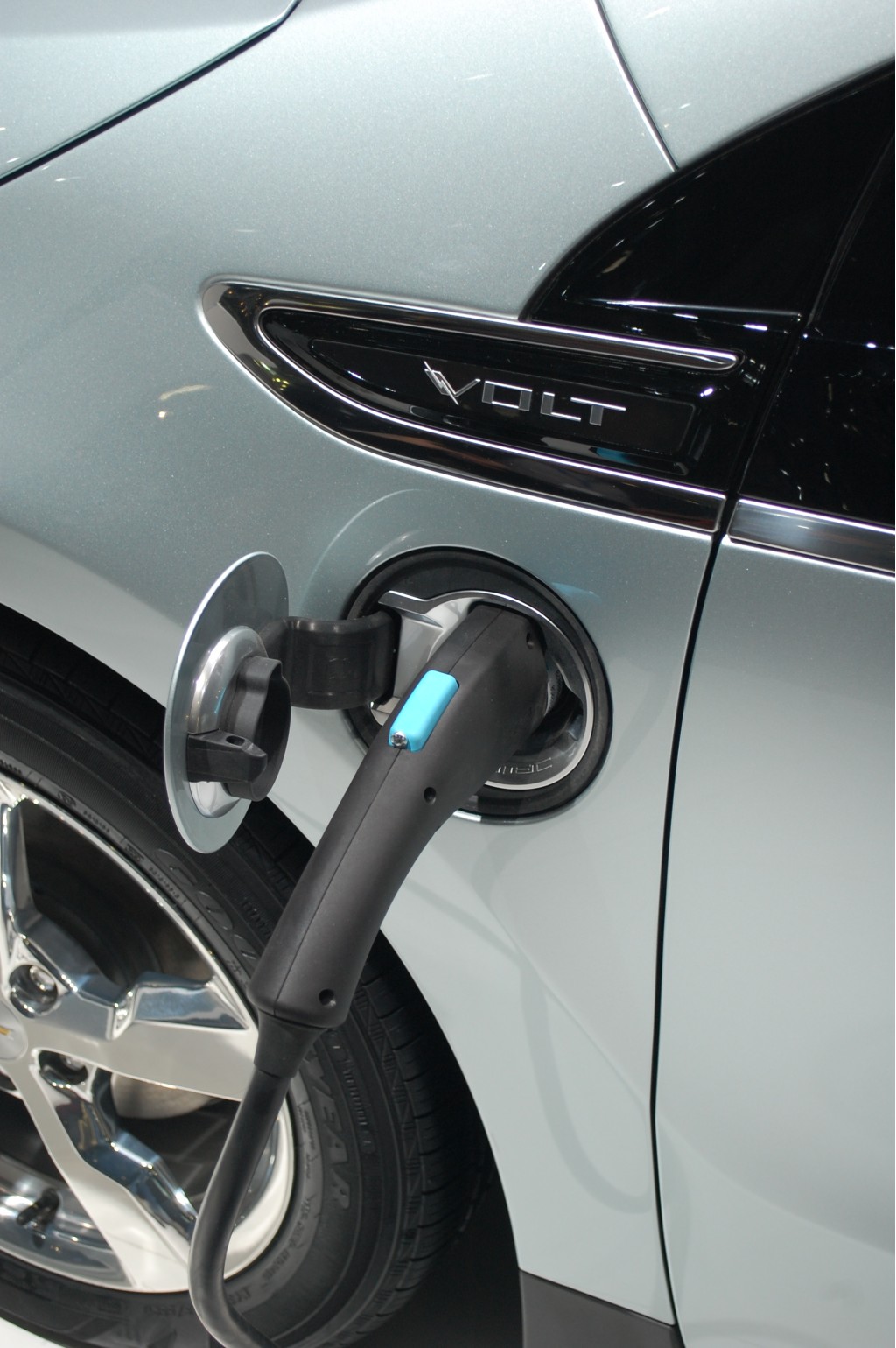
2011 Chevrolet Volt charging port

2011 Chevrolet Volt charging port

Enlarge Photo

We suggest a visit to Home Depot or Lowe's, where any number of self-retracting extension cords in plastic housings can be studied for inspiration. Even a hand crank that turns to reel the cord back inside would be preferable. The current setup is way too cumbersome to unwind and rewind each time you charge.

Hey, Voltec guys: If you can design the world's first production series hybrid since 1920 or so, you're fully capable of designing a much better portable charging cord. Really.

(2) Why is the electric drive motor shown as a rectangular icon on the Power Flow display?

We all know that four-cylinder engines are essentially rectangular, and that's what the engine icon looks like on the Volt's Power Flow display. And the T-shaped battery pack is shown that way too.

But why is the electric motor that actually drives the front wheels shown as a flat rectangular object? We also all tend to know that electric motors are essentially cylindrical.

We suspect the answer is that the rectangle represents the power electronics box under the hood that obscure the view of the actual drive motor. But we think the Power Flow display would be more intuitively understandable if the motor were a little less literal.

(3) What's the weird lag in acceleration under high load before the battery kicks in to provide extra oomph?

Even in modern automatic-transmission cars, there's sometimes a little hesitation after you floor the accelerator before the power kicks in. But on our Volt test car, it almost felt like the power dipped and the car slowed momentarily after we floored it.

2011 Chevrolet Volt drive test, March 2011

2011 Chevrolet Volt drive test, March 2011

Enlarge Photo

Whether that reflects the range-extender engine spooling down to compensate for anticipated power from the battery pack, we can't say. But it felt almost like a momentary stall or misfire would in a gasoline car. And it was the one glitch in an otherwise smooth powertrain

(4) How am I supposed to flash the brights under 30 mph?

Flashing the high beams is a good way to alert other cars or pedestrians of your presence. But in the Volt, under about 30 mph, a quick flick of the indicator stalk doesn't flash the brights, but activates the pedestrian alert tone--a rapid cycling of the horn.

That's fine (and much better than the Federally mandated noisemakers that are apparently coming), but it leaves a problem: How do I flash the lights without annoying everyone around me by making noise?

(5) Are the leaves that tumble across the center display screen on startup a backhanded swipe at Nissan's battery-electric Leaf?

On this one, your guess is as good as ours.

+++++++++++

Follow GreenCarReports on Facebook and Twitter.


Follow Us


Have an opinion?Join the conversation!

  • Posting indicates you have read this site's Privacy Policy and Terms of Use
  • Notify me when there are more comments
Comments (18)
  1. John,
    On the charge cord for the Volt-I have ours semi-permanently mounted on the wall of our garage. The holder has a mounting panel on the back to effect wall mounting, and for the Volt and the smaller battery pack, using the 110v wall plug works out OK for overnight charging. Having the cord unit mounted makes it easily accessible, but I can somewhat agree that a reel system might be more handy for returning the cord to the wall.
     
    Post Reply
    Vote
    Bad stuff?

  2. Criticizing their electric motor icon? What that must be a great car is that is the worst you can come up with.
     
    Post Reply
    Vote
    Bad stuff?

  3. The "weird lag in acceleration under high load" might be due to changing the clutches on the planetary gears. They might need to switch between using just the single 150 HP electric motor versus using both it and the 2nd smaller motor (and mechanically connecting the gas engine when in Charge Sustaining" mode.
     
    Post Reply
    Vote
    Bad stuff?

  4. "Flashing the high beams is a good way to alert other cars or pedestrians of your presence."
    ?????? Uh, that's a good way to temporarily blind somebody and really tick them off. There's this thing called a "horn", perhaps you should learn to use it.
     
    Post Reply
    Vote
    Bad stuff?

  5. @George: Ah, but when you travel overnight with your Volt, do you unmount the cord caddy from the wall and bundle it into the recess under the load floor? We recharged at 3 different locations, so I spent a lot more time than I expected simply packing up the charger cord and stowing it. Gotta be a better way.
     
    Post Reply
    Vote
    Bad stuff?

  6. A couple things from this blog that I'd like to correct and/or comment on. As a point of reference, I've had my Volt for about 2500 miles now:
    #1 - The charge cord - Yeah, that's a little bit quirky to use, but any self coiling mechanism only adds weight, and a reel would just make the cord bigger. In general, I think the cord doesn't even need to travel with the Volt for a lot of people, and it can be easily mounted in a garage. For those of us lucky enough to be able to charge at work, for example (or in the rare longer trips at a hotel), the cord isn't so bad to use.
     
    Post Reply
    Vote
    Bad stuff?

  7. #2 - The "motor" icon - I think showing the power electronics box on the center display is actually more intuitive. Most typical drivers know nothing of electric motors, and what they want to see displayed is the same thing they see under the hood. This was good thinking on GM's part.
     
    Post Reply
    Vote
    Bad stuff?

  8. #3 - Weird lag at high load - This is just a theory, but I think in most situations, the second electric motor in the Volt is ready to provide energy recovery through regenerative braking. The lag may be changing the clutching to provide power. I have noticed this too though; I want to remember to try with the vehicle in sport mode and see if this slight lag still exists. In general the power train is amazing though, and this isn't a big deal to me. Shift-free acceleration is awesome.
     
    Post Reply
    Vote
    Bad stuff?

  9. #4 - Brights under 30MPH - The statement in the article isn't true, the brights DO flash under 30MPH. In actuality, when traveling under 40MPH, when you pull back to flash the brights, the horn beeps IN ADDITION to the brights being illuminated. You'll always have the brights flash regardless of speed.
    #5 - The leaves at startup - Good question, but I think in general they were just aiming for an animation to help exercise the whole LCD screen to help thwart any small burn-in effects.
     
    Post Reply
    Vote
    Bad stuff?

  10. #4: You can pull it back part way to flash the lights I think without turning on the pedestrian horn. You have to be out of (P)ark (duh) as I tried to chirp my friend as he drove by and I just flashed him.
     
    Post Reply
    Vote
    Bad stuff?

  11. #5: You are looking for something that is not there. Leaves have been associated with mother earth, energy, and the environment for a very long time. Do you honestly think Nissan made it up?!? LOL so ridiculous http://www.google.com/search?q=green+leaf+%28environmental+OR+energy%29
     
    Post Reply
    Vote
    Bad stuff?

  12. #1: Weight I supposed and size. Did you realize Volt's Bose Energy Efficient Series system is 30% smaller, 40% lighter, and uses 50% less energy than conventional Bose sound systems? Everything was put on Weight Watchers!!
     
    Post Reply
    Vote
    Bad stuff?

  13. #1: I only used that 120v EVSE once at a bed-n-breakfast on the way home from NY. I understand your point but typically I'd bet they didn't expect it to be taken out and put back daily. Buy an extra when available ($$) or much better yet by a Level 2 charge ($$$). I have mine hanging from the ceiling. So convenient!
     
    Post Reply
    Vote
    Bad stuff?

  14. @John,
    We have appreciated the overnight hosting at our extended family's home in the SF area, so we don't even want to ask about further imposition relative to tapping into their electric system for a 40 mile charge on our Volt. At the hotel we stayed at for another of our roadtrips, there was no convenient electric plug, so I didn't ask them about charging the car either. I believe that we should ALWAYS ask for permission to do such charging at other's expense, and as more EVs appear this is going to be something that is not commonly "granted." However for future roadtrips, I will probably carry the LEAF charge cord and ask for such permission, in case it is granted. Keeping the Volt cord system attached to one side of our home garage makes for a really easy charging system to get both the Volt and the LEAF charged at the same time with those super cheap TOU midnight to 7am PG&E rates here in Yolo County.
     
    Post Reply
    Vote
    Bad stuff?

  15. @George: When I explained that the maximum the Volt could use was 10 kWh, and then pointed out the local electricity rate (from 3 cents to 15 cents per kWh), I found friends / hosts / etc. were fine with letting me plug in. Your experience may differ, of course. There was also the "cool" factor of helping me drive without gasoline, which might convince anyone to give you power costing less than $2 ...
     
    Post Reply
    Vote
    Bad stuff?

  16. @John,
    Not to quibble, but I checked my Volt charging records, and there were several nights when it took just a bit OVER 12kW; our LEAF is typically drawing about 15kW or less from daily commutes that have still left perhaps 30% residual range in that battery pack.
     
    Post Reply
    Vote
    Bad stuff?

  17. @George: I presume you mean kilowatt-HOURS? I don't remember the precise amount of the pack GM now uses (it was originally 8 kWh, then raised to 10.X kWh), but there may also be a bit of overhead for pack heating or cooling, and cabin conditioning if you pre-start the car.
     
    Post Reply
    Vote
    Bad stuff?

  18. #4: I was dead wrong about being able to pull it back part way to get the brights to flash but the pedestrian horn not to chirp. Sorry for misleading anyone. My memory failed me and I tried it today a few times.
     
    Post Reply
    Vote
    Bad stuff?


Have an opinion?Join the conversation!

Find Green Cars

Go!


© 2011 Green Car Reports. All Rights Reserved. Green Car Reports is published by High Gear Media. Send us feedback. Stock photography by Homestar, LLC.