Let's recap.
After 18 months, recalls totaling 9 million Toyota, Lexus, and Pontiac models, and investigations by Toyota, Congress, NASA, and the U.S. Department of Transportation's National Highway Traffic Safety Administration (NHTSA) unit ... what have we learned?
(1) A few accelerator pedals did stick open, for one of two very different reasons.
First, some dealers or owners fitted unapproved floor mats that were too thick, which could prevent the accelerator from returning to its usual position.
In the case of the horrifying and highly publicized crash of a Lexus that sped along a California freeway before overturning, burning, and killing all four occupants, a trapped accelerator pedal is thought to have been compounded by the driver not knowing how to turn off the engine in a car with a push-button start.
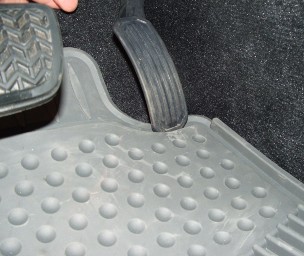
Loose all-weather floor mat jams accelerator pedal. Photo: NHTSA
(The answer: Hold down the "Start" button for a full 3 seconds. Hardly obvious without reading the owner's manual, which few people do for their own car, let alone the dealership loaner that crashed.)
Solution: Toyota amputated the bottoms of low-hanging pedals in some models, leaving clearance for even the thickest floor mats to be used without interfering with reshaped, shorter pedals.
Second, some other accelerator pedal mechanisms stuck under specific temperature and humidity conditions, remaining at about 15 percent of full throttle because moisture prevented a smooth return action.
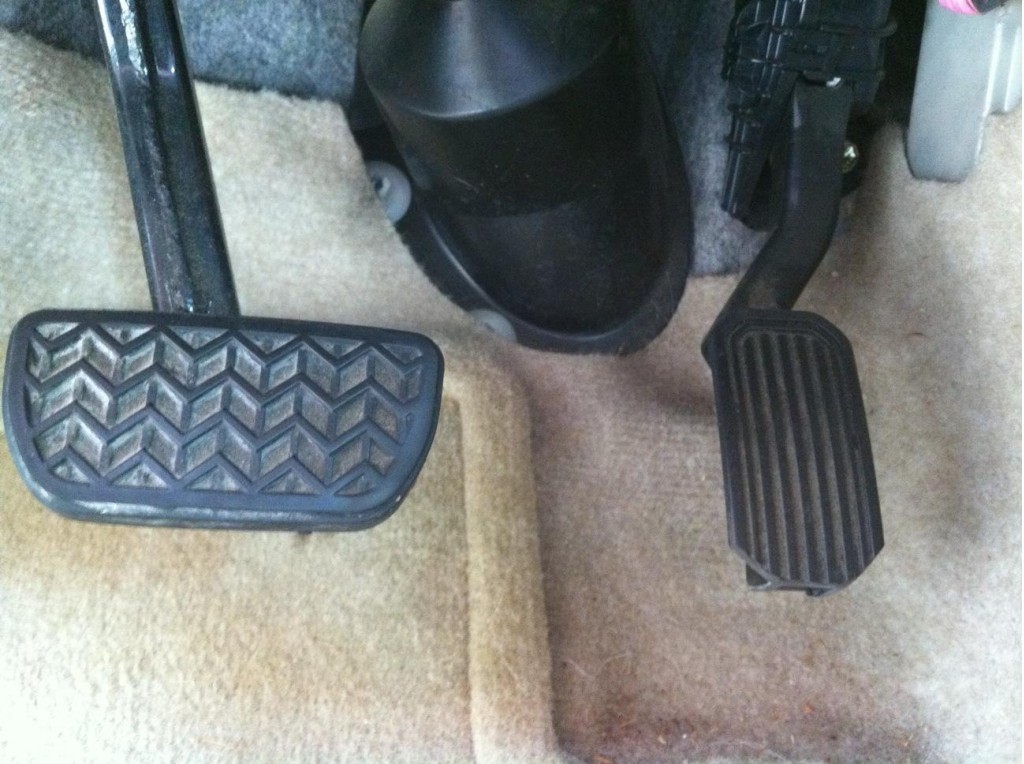
2004 Toyota Prius accelerator pedal after being shortened as part of sudden-acceleration recall
It got complicated: Only pedal assemblies made by CTS, one of two parts suppliers, suffered from the issue. So Toyota [NYSE:TM] first had to sort out which cars got parts from which supplier.
Solution: Starting in February 2010, Toyota installed a steel reinforcement bar on models using pedals supplied by CTS (a different set of cars from those on the amputation list). The bar kept the mechanism away from the position where it could stick.
(For more information, see our summary, Toyota And Lexus Recall: Everything You Need To Know, which gives details on the two separate recalls to address accelerator issues.)
(2) Investigators found no "electronic gremlins" in Toyota's vehicle or engine control software.
This was the big fear, raised repeatedly by plaintiff lawyers and on the floor of Congress. Math is hard, software is confusing, and computerized cars are scary. The lack of technical knowledge among elected officials didn't help either.

Toyota retrofit fix for sticky-throttle recall
But investigators could not replicate a single so-called "sudden acceleration" event once floor-mat and sticky-pedal causes were eliminated.
They pored through hundreds of thousands of lines of code seeking anomalies, unaddressed use cases, or any other problem that might make a car careen suddenly forward.
They even subjected Toyotas to high levels of electromagnetic interference, to see if systems weren't properly shielded. Nothing changed.
The full NHTSA report wasn't released by the DoT until this Tuesday, but as early as last August, the agency sent signals it had concluded that no electronic faults existed.
(3) Drivers who swear their car accelerated out of control are often wrong.
You put your foot on the brake, but instead of slowing, your car accelerates. The harder you brake, the faster it speeds up. Must be "sudden acceleration," right?
Well, no.

2009 Toyota Prius
It is, says psychology professor Richard Schmidt at the University of California, Los Angeles, "noisy neuromuscular processes" that occasionally prevent a limb from doing what the brain tells it to. Translation: Drivers sometimes press the gas pedal when they mean to brake.
The driver thinks his or her foot is on the brake. But it's not; it deviated slightly from the intended path, and landed on the loud pedal instead.
As soon as the car accelerates, the panicky driver presses even harder on the "brake," exacerbating the crisis.
Age may play a factor too, with data showing that the bulk of Toyota "sudden acceleration" deaths involving drivers aged 60 to 80.
In two highly publicized cases of so-called sudden acceleration, including one very suspicious one, investigators found either "strong indications that the driver's account of the event is inconsistent with the findings of the analysis" (for which, read, "he lied") or "no application of the brakes, [with] the throttle ... fully open."
But there are no mysterious electronic gremlins. And drivers do make mistakes.
Honest.
+++++++++++
Follow GreenCarReports on Facebook and Twitter.