Advertisement

Which Is Selling Better: 2011 Chevy Volt Or 2011 Nissan Leaf?

 
Follow John

First 2011 Nissan Leaf delivered to buyer, San Francisco, Dec 2010, photo by Eugene Lee

First 2011 Nissan Leaf delivered to buyer, San Francisco, Dec 2010, photo by Eugene Lee

Enlarge Photo

Related Photo Galleries


See more photos »

The first business day of every month is when automakers release sales data for the previous month. Today, we got January's sales figures, which are an improvement over last January's.

But the question that we keep hearing is: Which sells better, the 2011 Nissan Leaf or the 2011 Chevrolet Volt?

They're the first two plug-in electric vehicles sold in the U.S. by major manufacturers in a decade, and now they've been on sale for roughly six weeks. The first Leaf was delivered in San Francisco on December 12, and the first Volt followed three days later in New Jersey.
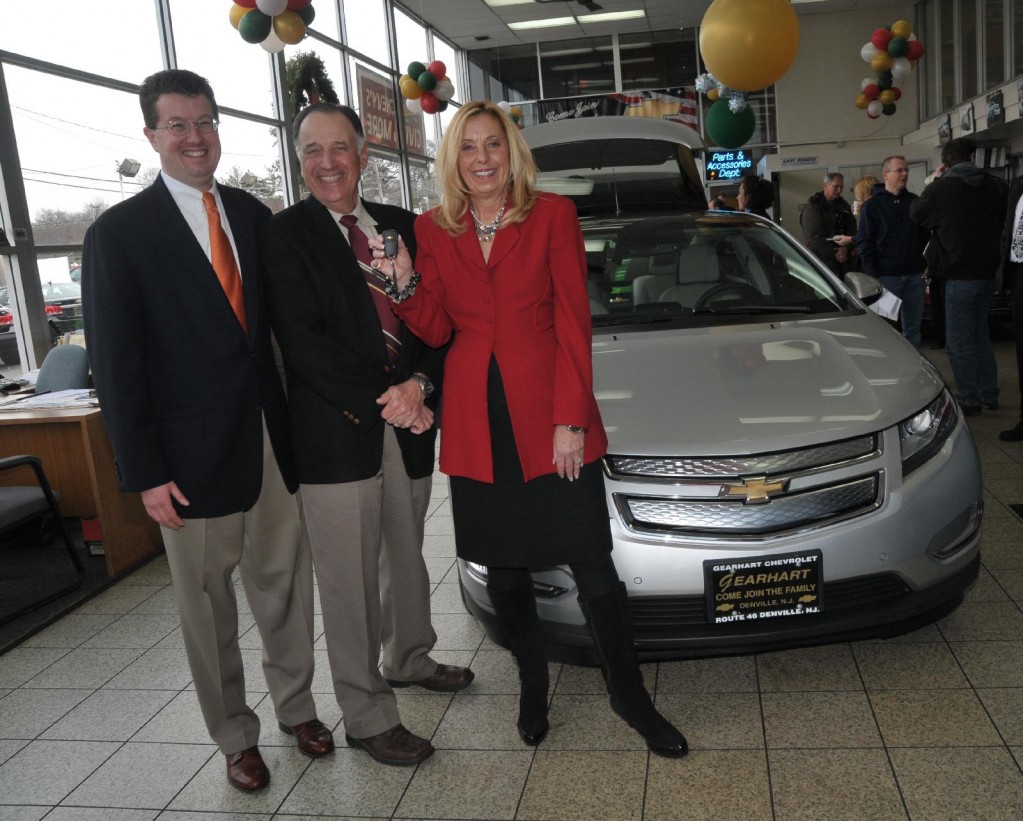

First 2011 Chevrolet Volt delivered to retail buyer Jeffrey Kaffee, in Denville, NJ, December 2010

First 2011 Chevrolet Volt delivered to retail buyer Jeffrey Kaffee, in Denville, NJ, December 2010

Enlarge Photo

Thus far (as of yesterday), the Volt is decisively in the lead, with a total of 647 cars delivered through the end of January. That represents 326 in December, plus 321 more last month.

In comparison, only 106 Nissan Leafs have been delivered: 19 in December, and 87 last month.

(For the record, Smart also delivered its very first Smart ForTwo Electric Drive last month as well.)

Don't go jumping to conclusions about which car will do better in the marketplace, though. Both the Volt and the Leaf are heavily back-ordered, and only modest numbers of each will be built during 2011 as the production line and supply chain ramp up.

First Smart ForTwo Electric Drive with Roger Penske and Smart USA president Jill Lajdziak, Jan 2011

First Smart ForTwo Electric Drive with Roger Penske and Smart USA president Jill Lajdziak, Jan 2011

Enlarge Photo

Nissan has said it will build 20,000 Leafs for the U.S. market--out of global production of 50,000--this year, and Chevrolet initially committed to 10,000 Volts, all of them for the U.S.

In light of robust demand for Volts, however, General Motors CEO Dan Akerson has said the company is looking at ways to raise production this year, perhaps to 20,000 or more. It also accelerated the pace of Volt rollouts nationwide, so that the range-extended electric car will be available in all 50 states by the end of this year.

It won't be until 2013, when Nissan quintuples its global Leaf production capacity to 250,000, that true market demand for plug-in cars starts to become apparent. Until then, early adopters and green-minded organizations are likely to snap up every one that hits a showroom floor.

[Nissan; General Motors; Smart]



Follow Us


Have an opinion?

  • Posting indicates you have read this site's Privacy Policy and Terms of Use
  • Notify me when there are more comments
Comments (12)
  1. Thanks for the update. Seem like Th!nk has delivered more EVs than Smart, perhaps they deserve a mention as well.
     
    Post Reply
    Vote
    Bad stuff?

  2. It makes me smile to see the Leaf and Volt. I wish we had these in great numbers 10 years ago, but better late than never.
     
    Post Reply
    Vote
    Bad stuff?

  3. This article doesn't deliver on it's title. Now I still don't know which sells better or rather, since both companies can't deliver anyway, which of them has the most orders.
     
    Post Reply
    Vote
    Bad stuff?

  4. The Volt is not an electric car, it is a plug-in hybrid. The Leaf is a true electric car. They are not comparable.
     
    Post Reply
    Vote
    Bad stuff?

  5. I disagree Steevo.
    The Volt behaves exactly like an electric car for 40 miles, enough to cover a good portion of most peoples daily driving and thus will be in the same market as pure EV's. Though I agree they're not the same, the Volt covers both the EV market and the plug-in market giving it a wider market to sell.
    I really think the Volt is brilliant combination of the two. I've seen several driving around here in the SF Bay Area and man they look sweet out in the real world.
     
    Post Reply
    Vote
    Bad stuff?

  6. Khadgars, you are incorrect. The Volt doesn't act exactly like an electric car for 40 miles, there are situations where the gasoline engine will turn on before the 40 mile limit has been reached. The Volt is a series hybrid that you can plug in and top off before you leave the house. It is closer to a Prius (parallel hybrid) than a Leaf. The engineering is very similar to the locomotives used for freight trains. I think it is fraudulent to market the car as an "electric" vehicle.
     
    Post Reply
    Vote
    Bad stuff?

  7. The Volt may not be a pure electric car but it is a good transition car until practical electric cars that drive more than 100 miles per charge are available. Purist vs pragmatist. Which are you? I for one drive more than 100 miles most weekends and a Leaf would never work.
     
    Post Reply
    Vote
    Bad stuff?

  8. The Leaf could work for commuters if there is a charger at the work place. Getting commuters off of gasoline by the millions could help reduce oil imports.
     
    Post Reply
    Vote
    Bad stuff?

  9. Clearly the Volt is a lot like an electric car but since it's also a very complex hybrid people are confused about just how electric the Volt really is. It really depends on how one chooses to define and electric car. If a car is electric when it's an electric motor that powers the wheels than the series hybrid Volt is a 100% electric car. Well....it was until GM admitted that at high speeds the ICE sometimes goes beyond it's generator role and directly adds it's power to that of the electric motors. So the Volt is an EV...mostly. But who cares what drives the wheels, cars like the Volt are there to solve the energy problem, not a drivetrain problem. So it makes sense to define an EV as a car that is filled up with electrons rather than some other (intermediate) energy carrier. Now the Volt is a "pure" EV for 40 miles, after that it becomes a gasoline powered car.
     
    Post Reply
    Vote
    Bad stuff?

  10. Hmm, the Volt has yet managed to confuse me.... That last sentence should read: "Now the Volt is a pure EV for about 40 miles at lower speeds; a mixed electric/gasoline car for about 40 miles when driven at higher speeds; a pure gasoline powered vehicle in range extended mode".
     
    Post Reply
    Vote
    Bad stuff?

  11. @Chris O and steevo,
    When the battery is charged the Volt can operate from 0 to 100 mph on electric ONLY for the first 25 - 50 miles. After that the ICE/generator can help the electric motor when traveling faster than ~ 70 mph. For most EV drivers the Volt will always be all electric with a built in generator. If you like to speed and the battery is depleted then you're driving a parallel hybrid when traveling at ~ 70 mph and above.
     
    Post Reply
    Vote
    Bad stuff?

  12. If you can drive your car into a gas station and fill it up with gas, you are NOT driving an electric car. I just object to labeling Volt as an "electric car" instead of a "plug-in hybrid." There are many other articles on this very website which refer to the cars of other manufacturers, with drive-trains similar to the volt, as plug-in hybrids.
     
    Post Reply
    Vote
    Bad stuff?


Have an opinion?Join the conversation!

Advertisement
Advertisement

Find Green Cars

Go!

Advertisement

 
© 2013 Green Car Reports. All Rights Reserved. Green Car Reports is published by High Gear Media. Send us feedback. Stock photography by Homestar, LLC.