Buying an electric car today is hardly cheap. With lithium-ion battery prices at around $450 per kilowatt-hour of storage, the 24 kilowatt-hour battery pack found in the 2011 Nissan LEAF weighs in at a jaw-dropping $10,800, and that's before complex battery management electronics are added. That alone helps to account for the LEAF’s high price tag.
But according to a recent analysis by Deutsche Bank, electric car battery prices could have dropped so much by 2020 that electric cars will truly be affordable for everyone.
The analysis comes as part of a the Deutche Bank’s study entitled The End of the Oil Age - 2011 and beyond: a reality check. Examining everything from the rising oil price to new fuel prices, exploding hybrid sales in Japan and strong Chinese car growth in 2010, the study included a section on electric vehicles.
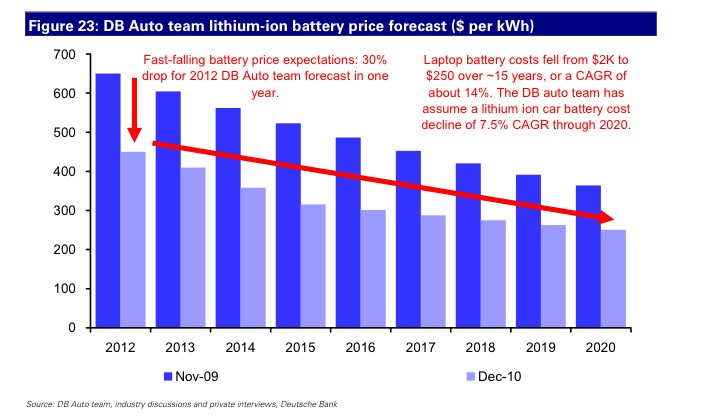
Electric Car Battery Price to Drop (Deutsche Bank)
Predicting a drop in the price of lithium-ion battery technology from the current $450 per kilowatt-hour to nearer $250 per kilowatt-hour and a rise in gasoline of at least $1.50 per gallon in the next 10 years the study predicts electric cars to be financially viable in 9 years time.
The study rates the current payback on an electric vehicle to be between 15.5 years and 9.1 years, depending on the availability of purchase subsidies. In 2020, it predicts that payback to have dropped to under 3 years if subsidies of 2,000 per car are still available.
Without subsidies, it predicts payback on an electric car will be 3.9 years.
As with any study however, there are some flaws in the analysis. Although the study is extremely thorough, the Deutsche Bank makes some pretty big assumptions about the costs involved in electric vehicles.
Firstly, it assumes the price of gasoline will rise over the next ten years, but that the cost of electricity will remain a constant 10 cents per kilowatt-hour used. We’d assume that the price of electricity will increase in the coming years as demand for power grows worldwide.

EVS to drop in Price by 2020 (Deutsche Bank)
Secondly, while the study assumes gasoline fuel economy will improve from 29 miles per gallon in 2010 to 34 miles per gallon in 2020, it does not predict an improvement in efficiency for electric vehicles, returning an average of 4 miles per kilowatt-hour.
As batteries become more efficient and automakers refine electric vehicle technology, we’d expect the miles travelled per kilowatt-hour of power to increase over the coming years.
Nevertheless, we think this study is an interesting one which merits further reading if for one final prediction: peak oil demand will occur in 2020, the same year that it claims electric cars will truly become a realistic transportation solution.
The electric vehicle revolution could be just around the corner.