Right now, six companies are vying to win a contract that would provide 100 electric vehicles to the government’s General Administration services 214,000-strong fleet.
One of them is Ford; the other, a relative newcomer called Smith Electric. But the government isn’t looking for electric sedans to chauffeur VIPs or parade around at White House events — rather, it wants electric versions of the humble, plain old delivery truck.
With all the electric cars poised for release in the coming months, it’s easy to think of 2011 as the year these cars hit the road en masse. But in fact, there’s already electric vehicles trucking about – electric trucks to be exact, and they’ve already been put to use by companies like Coca-Cola and FedEx.
Commercial vehicles like delivery trucks, buses and vans are a good target for cutting fuel costs and are already making a dent in President Obama’s goal of 1 million electric vehicles on U.S. roads by 2015. Precise numbers are hard to pin down, but they use a “tremendous” amount of fuel in the U.S., said David Hurst, analyst at Pike Research. For corporations, that fuel expense is a bottom-line cost they’d like to control like any other. And there are other inherent characteristics of the market that grease the wheels for quicker adoption.

Frito-Lay electric delivery truck in New York City
Right now, most electric cars have about a 100-mile range, worrisome for the average American who has a 30-minute commute and wants to run a few errands on his way home. But the beauty of electrifying a delivery truck is that there’s a set route, and trucks will almost always charge at home base — unlike with consumer cars, where startups and utilities are scrambling to build out charging stations along freeways and in parking lots.
“The performance, infrastructure and availability issues that plague electric car and light-truck models don’t cross over to their commercial counterparts,” said Bryan Hansel, CEO of Smith Electric, which makes all-electric commercial vehicles like trucks. He estimated that most urban-based commercial trucks have a daily route of 30 miles or less.
Smith is delivering 176 battery-powered delivery trucks to Frito-Lay, and the snacking giant estimates it will save half a million gallons of gasoline a year by electrifying its massive North American fleet. But like the commercial electric vehicle market, there’s a backlog for electric trucks too. Hansel says its trucks are back-ordered until the second quarter of next year.

2011 Ford Transit Connect Electric, introduced at 2010 Chicago Auto Show
Still, interested buyers of electric trucks have the same qualms as those looking to buy a Nissan Leaf or Chevy Volt. Prospective customers always ask about range and battery life, says Mark Aubry, Navistar’s head of sales for the company’s eStar electric truck. Navistar has pledged to deliver 400 electric trucks this year.
Delivery trucks are ideal. The cars have one point of origin, with “city-style routes, lots of starts and stops, and [they] don’t use the freeway.
“That’s really the best possible customer that’s out there,” Aubry said. Navistar recently delivered four electric trucks to FedEx. And last month UPS ordered 130 hybrid delivery trucks produced by Eaton, adding to its fleet of 250 hybrids and estimating the purchase will save 66,000 gallons of gas a year.
As in the consumer market, demand will likely outpace supply in electric trucks for some time to come. While businesses can make a sustainability statement with the trucks, Pike analyst Hurst says that right now, it takes a few years for a buyer to see a cost benefit.
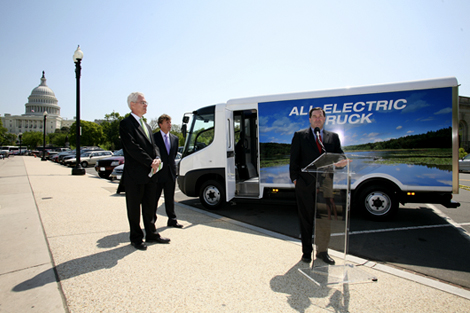
Navistar eStar electric delivery truck in Washington, D.C.
“In fact, it’s a cost penalty right now. With the battery, everything is still more expensive and fuel is still cheap,” Hurst said. “But fuel costs aren’t going to go down, whereas battery costs and cost of these trucks will start to come down.”
Smith CEO Hansel says the company’s customers can expect a return on investment from fuel and maintenance savings in three to four years, though Hurst estimates the industry’s ROI is closer to 5 to 10 years. The federal government offers a $12,000 purchase incentive for trucks and buses, similar to the $7,500 tax credit offered for consumer electric cars.
The segment is rife with competition and varied approaches. Electric Vehicles International makes an electric yard truck, which essentially moves containers around a port. Ford itself is getting into the game, with an electric commercial fleet van called the Transit Connect, which was developed with technology by Azure Dynamics. It’s also working with Eaton to develop hybrid medium-sized trucks – and Eaton itself makes diesel hybrid school buses and trucks. And last summer, Proterra sold three electric buses to a transit agency in California.

New, Larger Newton Commercial Electric Truck
Glacier Bay approaches the trucking emissions problem from another angle. It estimates that idling trucks — those 18-wheelers you see at rest stops — waste up to 2,000 gallons of gas a year. The trucks idle when drivers pull over to sleep but leave on the air conditioner or heater. The company’s ClimaCab fix attaches something like a thermostat in the car which senses and automatically adjusts the temperature, drawing from a retrofited battery — which then gets charged back up when the car is driven the next day. Customers can save $4,000 to $5,000 a year, CEO Derek Kaufman said.
Fuel-cell startup Oorja also set it sights on the commercial market from the get-go, CEO Sanjiv Malhotra said. It makes packs that can replace batteries in battery-powered forklifts use in distribution centers and can provide payback on investment within the first 12 to 18 months of use, Malhotra said. Oorja has signed up buyers in Nissan, McDonalds and U.S. Foods.

2011 Ford Transit Connect Electric, introduced at 2010 Chicago Auto Show
Part of the issue with adoption for commercial owners is cost, since the trucks are still priced higher than their diesel-powered counterparts. Navistar’s Aubry says the company is looking solve that by offering leases and separating ownership of the battery from ownership of the car — that way businesses can equate the battery cost to fuel costs in their balance books.
It’s a similar thing to what charging infrastructure startup Better Place does with battery leasing agreements. The company also has some experience dealing with fleet, having run an electric taxis pilot in Tokyo and ramping up to institute a similar program in San Francisco. The last step to electrifying fleets of trucks, says Better Place’s head of North America Jason Wolf, is instituting software programs that can gather data and intelligently manage itineraries and charging needs of several cars.
“If you’ve got a very smart network and smart cars, there’s no issue there,” said Wolf. “The car will know where it needs to go.”
This story, written by Iris Kuo, was originally posted on VentureBeat's GreenBeat, an editorial partner of AllCarsElectric.