What happens when you take a single electric car and distribute it through three different dealers in the same city? On paper we’d assume that three dealers vying for customers looking to buy the 2011 Mitsubishi i would breed healthy competition, lower prices and excellent deals.
Unfortunately for the masses of would-be electric car owners that may not be true. In fact, we’re more convinced than ever that it’s not the automakers but the dealers who are causing problems for electric cars.
We visited three different dealers nearby, all of which will sell the Mitsubishi 'i' in one guise or another. Their employees ranged from clueless to competent, with one telling us our area would be a hotspot for companies and individuals wanting an electric fleet while another made the remarkable (and entirely wrong) assertion that there was no way an electric car could possibly cope with life outside of the metropolis of London.
But first, let us explain a strange quirk of the auto-market which is prevalent in Europe but less so in the U.S.: badge engineering.
Just about every automaker does it. Take one car and then produce it in collaboration with another automaker. Then rebadge the car according to who is selling it.
Everything from city cars to SUVs and minivans are produced in this way, lowering costs and ensuring customers can remain brand-loyal while getting the car they want.
Enter Mitsubishi. Its 2011 Mitsubishi i - still known in Europe as the i-MiEV- is a European-spec modification of the original Japanese car. But when Mitsubishi start selling the car later this month it will also be rebadged for sale via the French automotive group PSA Peugeot Citroen.
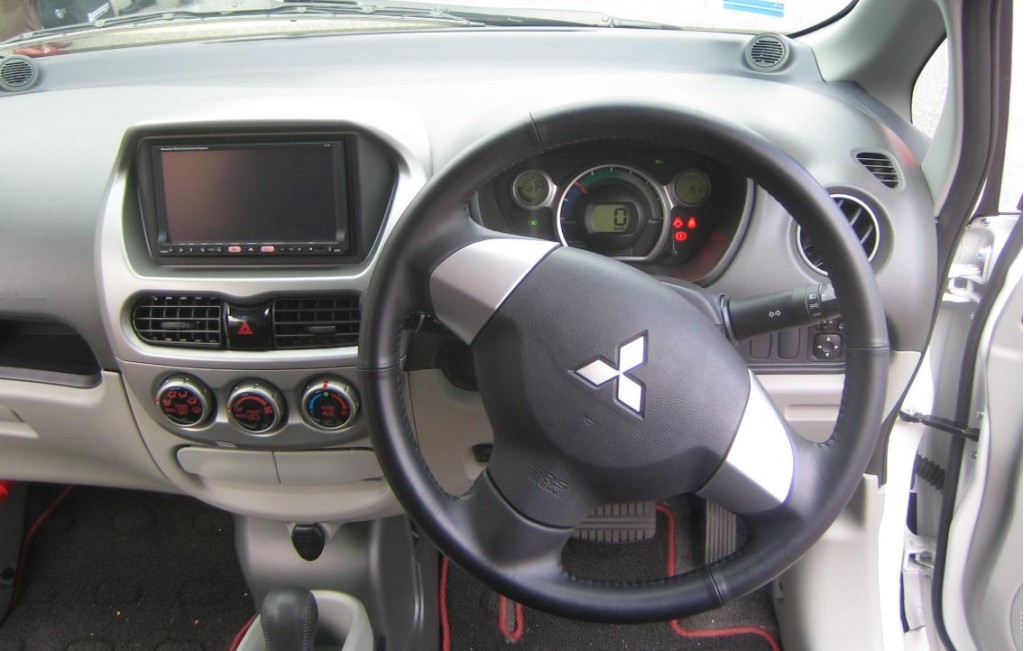
Mitsubishi i-MiEV electric car - interior - December 2008
Sold Europe-wide, the Mitsubishi i, Citroen C-Zero and Peugeot iOn may look slightly different externally but the technology beneath the dealer-specific body panels is identical, from the chassis to the drivetrain and battery.
The European specification 2011 Mitsubishi i-MiEV is set to retail for exactly the same price as the 2011 Nissan LEAF. However, the LEAF enjoys a higher spec list, as well as one extra seat and much larger trunk space.
Top speed will be electronically limited to 80 mph, with range predicted to be 80 miles per charge.
Interestingly, the PSA variants will both be available as lease only, with no option to buy. PSA also displays range as being 93 miles - an interesting phenomenon since the C-Zero and iOn are identical to the i-MiEV.
Enter our test city, Bristol, U.K. Would our dealers, each focusing on a specific rebadged car, offer us any insight into the i, C-Zero or iOn.
To find out, we visited each in turn, asking the same questions:
- Could we have details of their electric car?
- When did would test-drives be possible?
- When could we order one?
Citroen
On being asked about the Citroen C-Zero the salesman launched into a diatribe of why the C-Zero wasn’t a great car, would primarily be sold in London rather than anywhere else, and certainly wouldn’t be coming to his dealership.
It was almost a repeat of our experiences at an untrained Nissan dealer earlier in the year.
Our local Citroen dealership? Unconvinced of electric cars, cynical and more than disparaging of anyone with enough money to spend on a C-Zero. Tried selling us a gasoline sedan instead.
Report Card? F- = A very poor end to 2010.

Mitsubishi i-MiEV Electric Car for Geek Squad, 2009 LA Auto Show
Mitsubishi
Unlike the U.S., where most states prohibit automakers from directly owning a dealership it is legal in the U.K. for automakers to retain a set of dealers. The Mitsubishi garage we spoke to was one such garage.
As such, the dealer informed us that yes, the Mitsubishi i would appear there in early 2011, but only if the local government installed appropriate charging stations throughout the city. Without it, I was told, very few cars would make it to the dealership.
Despite some skepticism on the part of the dealer, leaflets were available and an offer to place us on a waiting list. We were also told that an order could be fulfilled through the dealer even if they didn’t officially sell it.
Our local Mitsubishi? Not completely convinced of the i’s potential the dealer showed some willingness to support the all-electric four-seater. Happy to provide pricing and ordering information, the dealer showed promise.
Report Card? C = A good start, but could try harder.
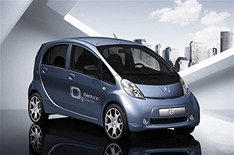
Peugeot iON Electric
Peugeot
Visiting the Peugeot dealer last we discovered someone willing to set up a test-drive as soon as a test-car made it to the showroom. We were told that yes, Peugeot planned to offer leasing as soon as possible. We were even given an unofficial lease figure of around $750 per month based on a three year, 10,000 mile per year scheme. This rough estimate also included all maintenance costs.
Again, while the dealer was clear his own personal view was that Diesel Hybrids were going to get more market share than pure electrics, our chat with him was relaxed and informative.
Of all the dealers, Peugeot was the most knowledgeable and most willing to help us get an all-electric car even if, personally, they were not EV fans.
Report Card? B+ = A promising future as an electric car friendly dealer.
Pay your money, take your choice
All three dealers illustrated completely differing attitudes to the same car. While in this case each dealer offered a different make of vehicle we’re pretty convinced such variations will naturally exist between dealers of the same make.
We’re worried that this kind of disparity between dealers may put off the average buyer from going electric and implore dealers and automakers to work together to ensure that dealers are clued up to electric models even if they don’t plan them to be major cash-cows.
If you are convinced an electric car is right for you, but your dealer isn’t, then shop around. You may find a more sympathetic dealer further away and it may pay to make the trip to someone who really understands your desire to go electric.
Of course, staying in touch with AllCarsElectric helps you stay abreast of the latest EV news, including where cars are being delivered.