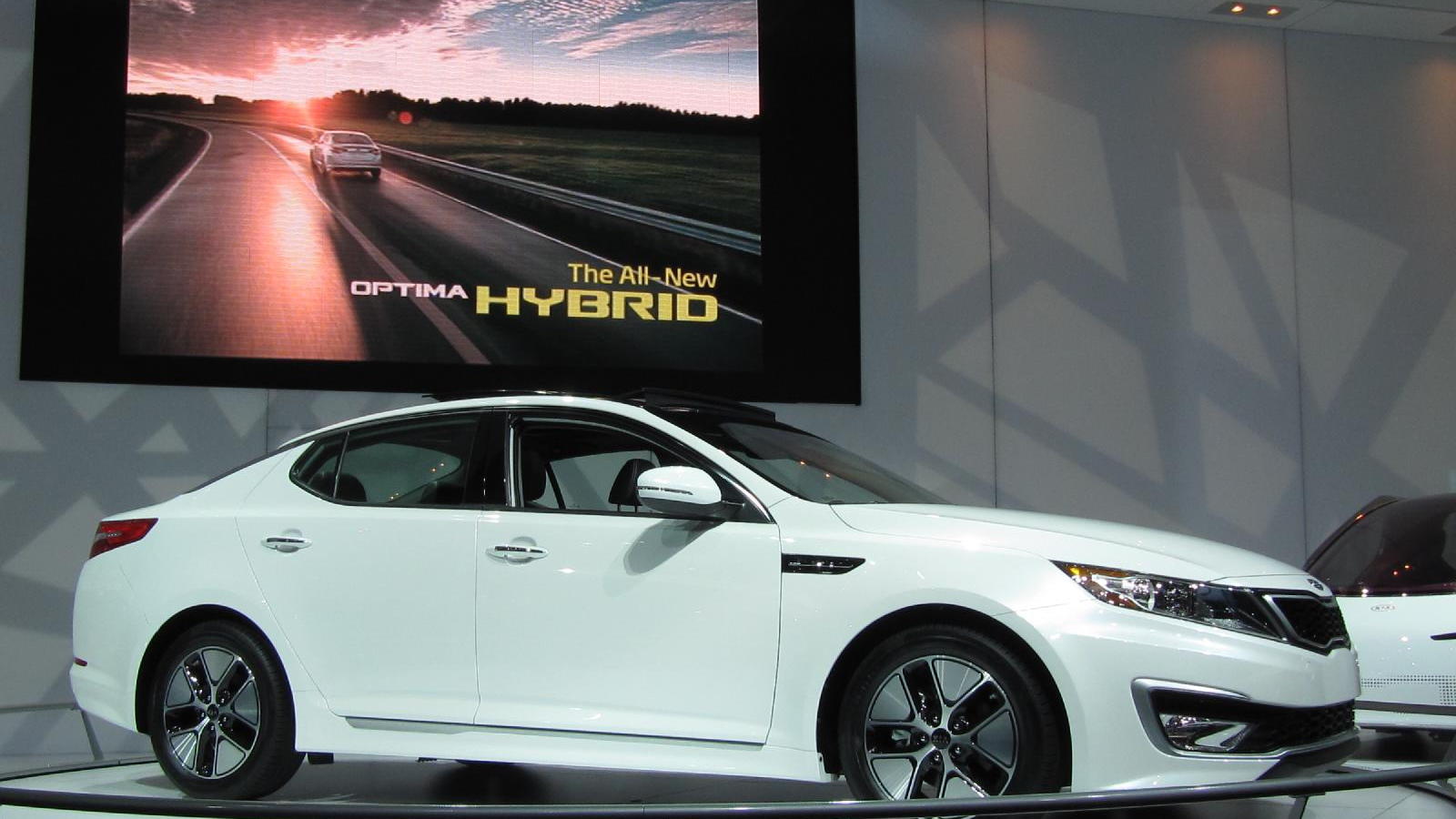
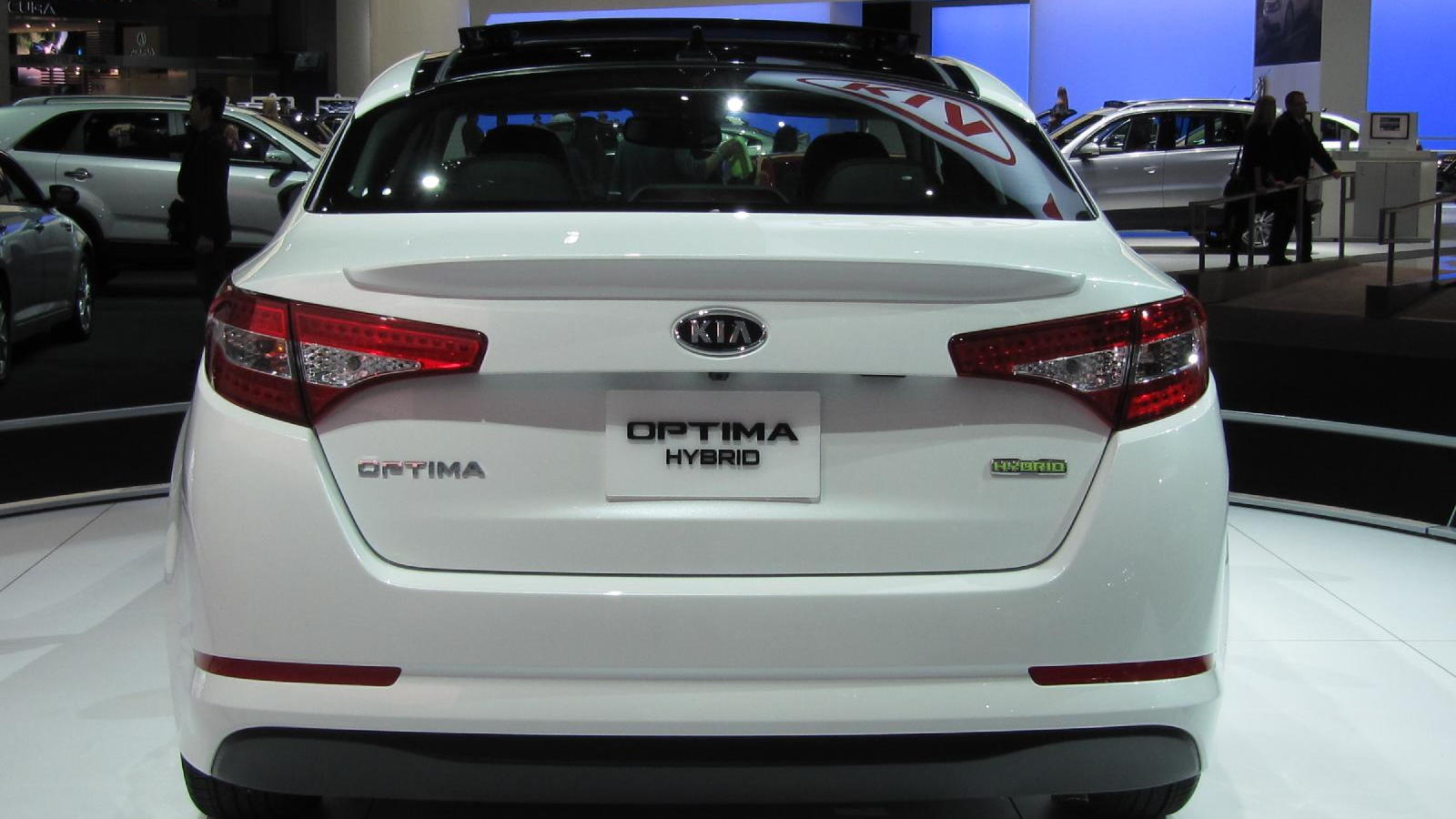
Kia has been on a roll lately. The younger, lower-priced sibling of Korean car colossus Hyundai has received rave reviews for the styling, features, and general competence of its its new 2011 Optima midsize sedan.
Now Kia has iced the cake by adding a hybrid-electric model of the Optima to the lineup, along with a turbocharged and direct-injected version as well. The company launched the 2011 Kia Optima Hybrid yesterday at the Los Angeles Auto Show.
Despite the radically different styling, though, the Optima Hybrid shares essentially its entire powertrain with the 2011 Hyundai Sonata Hybrid launched this spring at the 2010 New York Auto Show.

2011 Kia Optima Hybrid
According to Ralph Tjoa, manager of product planning for Kia Motors, the Optima and Sonata hybrid models share the same hybrid powertrain technology, though they are visually very different and assembled in different plants.
Like its sibling, the 2011 Optima Hybrid uses a 169-horsepower, 2.4-liter gasoline engine similar to the one in the standard Optima. Adapted for use with a hybrid powertrain, it is 10 percent more fuel-efficient than the one in standard Optima models.
The engine torque powers the car through an adapted version of the corporate six-speed automatic transmission, which has an oil pump replacing the torque converter to ensure it continues to operate when the engine is switched off.

2011 Kia Optima Hybrid
Between engine and transmission is a 30-kilowatt (40-horsepower) electric motor that powers the 2011 Kia Optima Hybrid on electricity at low speeds or under light loads as high as 62 mph, and also contributes torque to supplement the engine.
Combined, the engine and the motor produce a maximum of 206 horsepower.
The Optima Hybrid is set up to provide electric assist at higher speeds than hybrids from Toyota, which largely benefit from their electric drivetrain at city speeds.
Unlike the electronically continuously variable transmission (eCVT) systems used by Toyota and Ford, the six-speed transmission shifts conventionally, which the company says provides a much more familiar driving experience.
The 1.6-kilowatt-hour battery pack uses pouch-format lithium-ion cells, also known as lithium-polymer due to the solid polymer electrolyte.

2011 Kia Optima Hybrid
The greater energy density of lithium-ion cells means the pack weighs just 96 pounds, versus the older nickel-metal-hydride pack in the Toyota Camry Hybrid which weighs 28 pounds more for about the same energy content.
The entire car, in fact, weighs under 3,500 pounds--Kia says this is more than 200 pounds lighter than the Ford Fusion Hybrid--and has a drag coefficient of 0.26, among the lowest for on-sale production cars today.
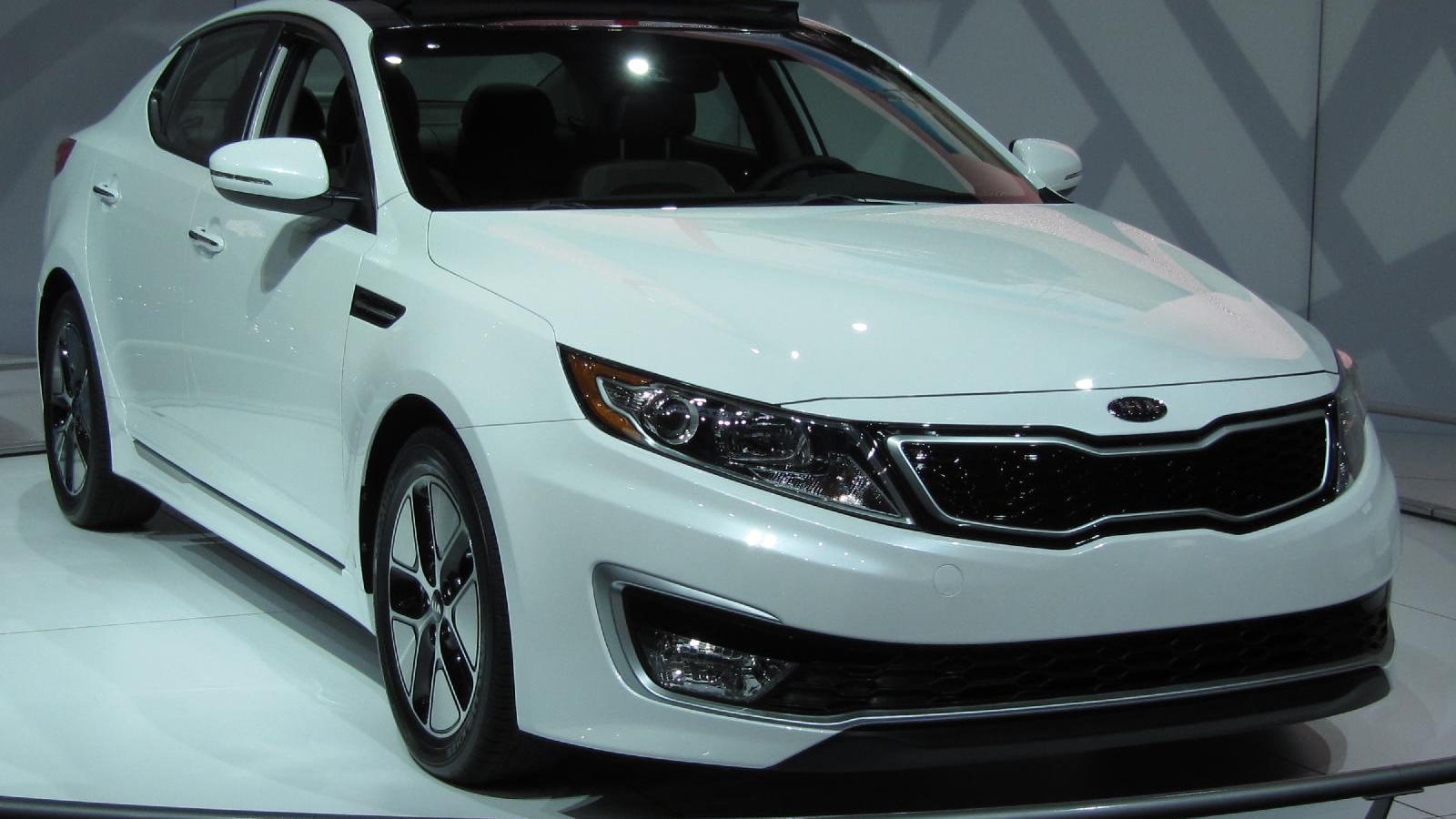
Unlike its Sonata Hybrid sibling, however, the Kia Optima Hybrid does not have a radically different appearance than its conventional counterpart.
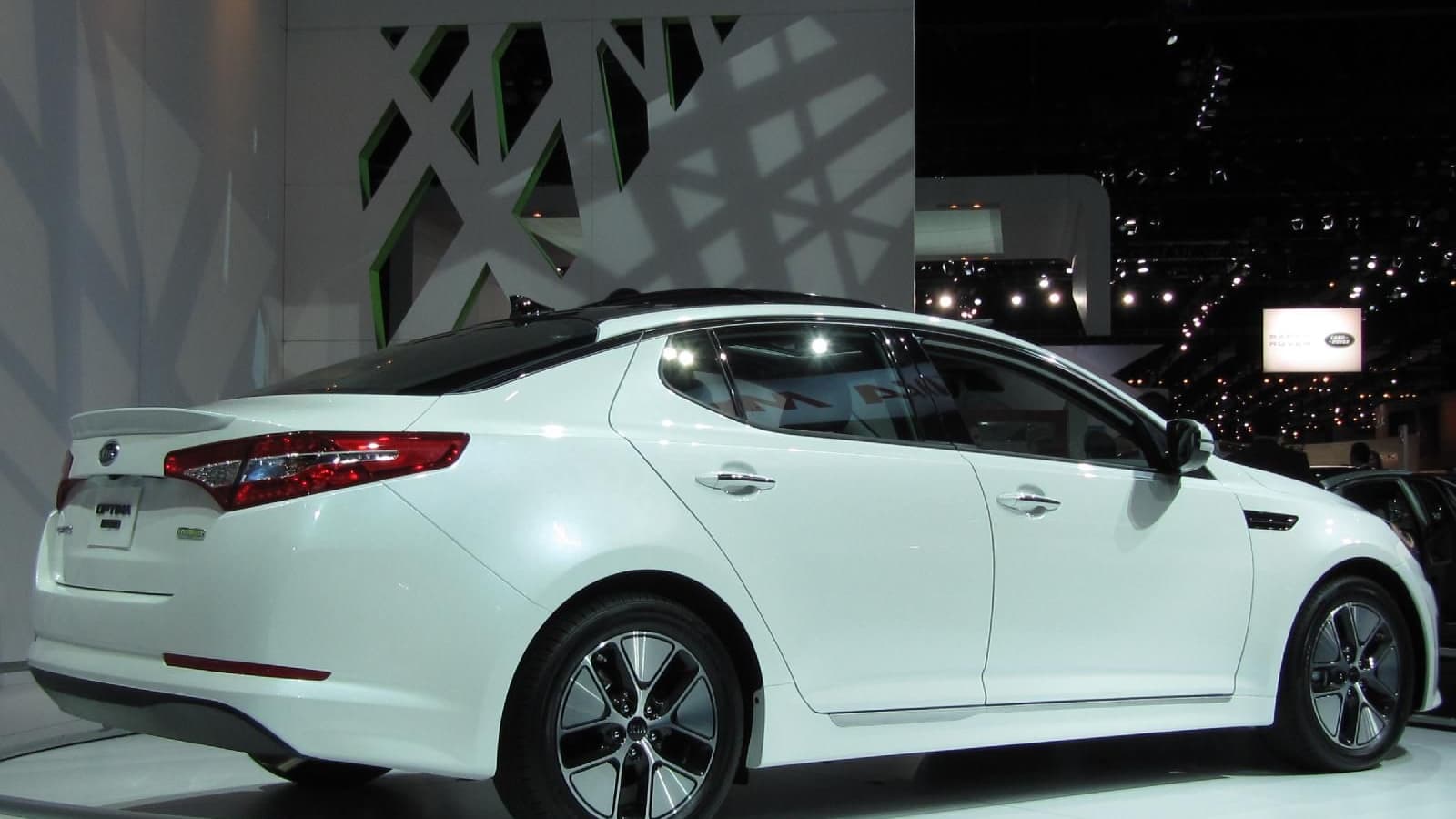
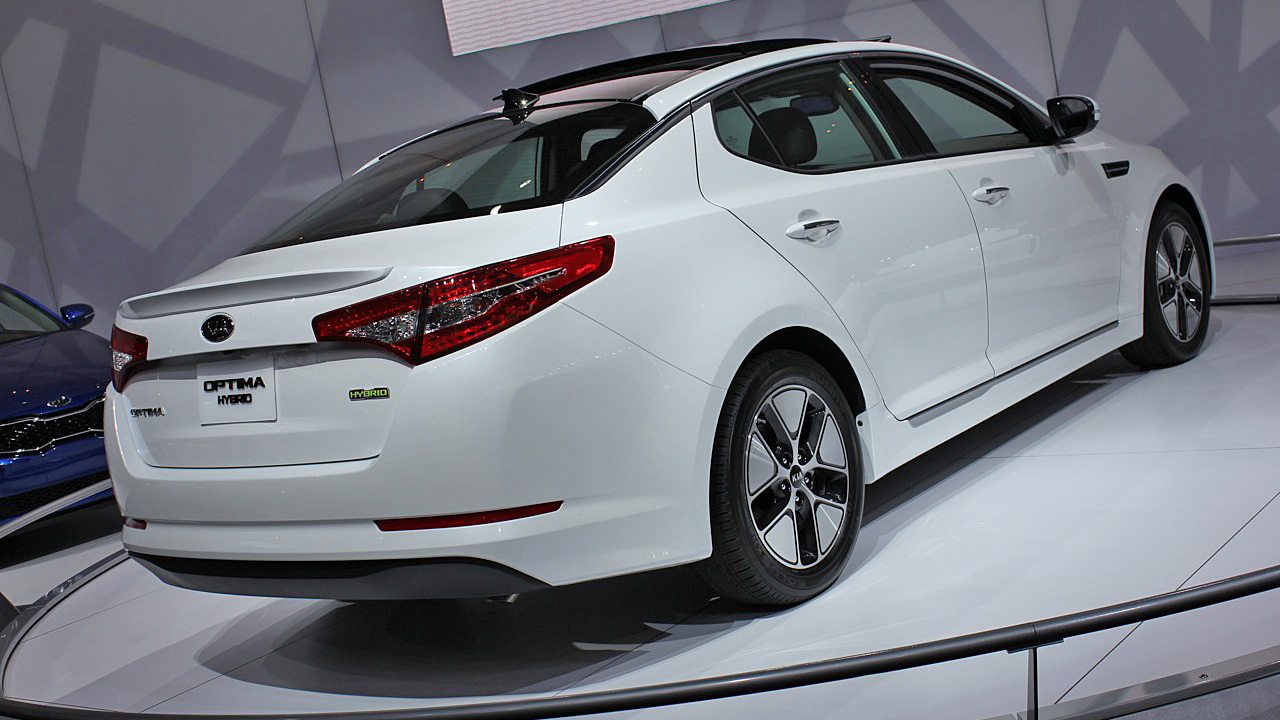
While Kia notes that the Hybrid Optima has unique "front grille design, 16-inch alloy wheel design, headlamp design, fog lamps" as well as heated mirros, various chrome accents, and LED tail lamps, it is far less visually distinctive than the Sonata Hybrid.
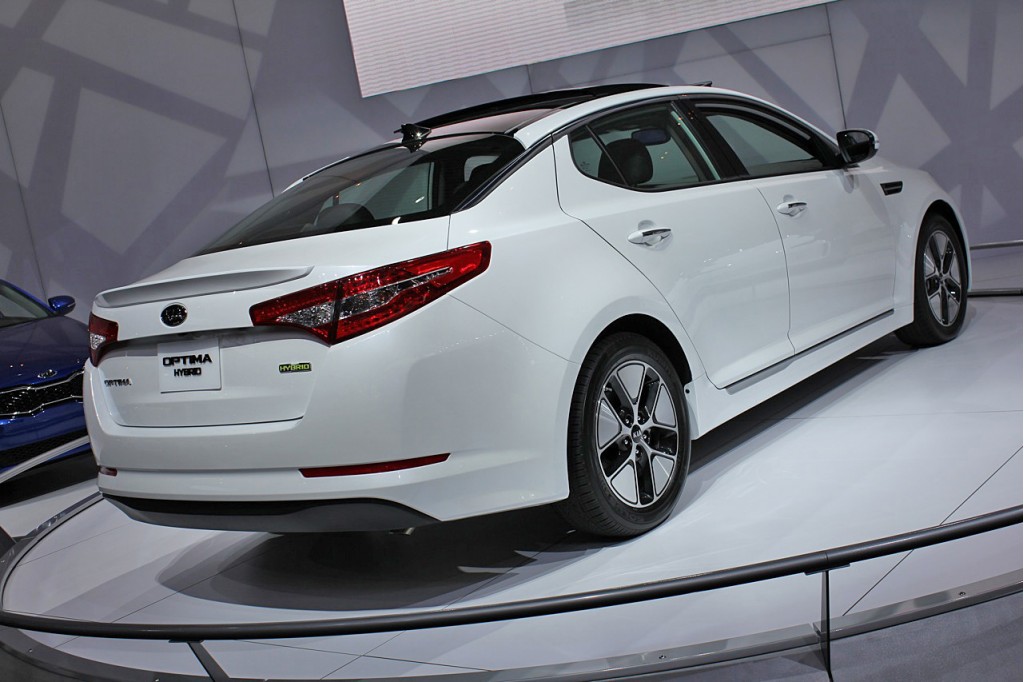
2011 Kia Optima Hybrid
The 2011 Kia Optima Hybrid has all the standard equipment of the Optima LX model with automatic transmission.
To that spec, it adds more standard features, including "eight-way power adjustable driver’s seat, dual zone automatic temperature control with rear vents, push-button start with smart key, leather-wrapped steering wheel and shift knob, automatic up/down on front windows, chrome interior door handles, glove box illumination, rear reading lamps, and fixed rear seats with ski pass-through."
An optional Premium Technology Package can be specified as well, which adds unique 17-inch alloy wheels, a panoramic sunroof, heated and cooled power adjustable front seats, heated rear seats and steering wheel, a navigation system with backup camera, and a host of other options.
Surprisingly, there's also a standard "Virtual Engine Sound System," which electronically reproduces a prerecorded engine noise whenever the car drops into electric-only mode.
[UPDATE: Kia later clarified that the synthesized engine noise is activated only when the Optima Hybrid is operating in pure electric mode at 12 mph or below.]

2011 Kia Optima Hybrid
Questioned on this feature, Kia product planner Tjoa said that the Optima Hybrid would make this synthesized sound regardless of how fast it was traveling--even at 30 mph or above, when it is likely to be on roads where pedestrians fear to tread.
Kia warrants some aspects of the powertrain for 10 years/150,000 miles, with other facets of the warranty at five years/60,000 miles or more.
Kia estimates the fuel economy of the 2011 Optima at 40 mpg city, though the EPA has not yet released its official ratings for the car. The 2011 Kia Optima Hybrid will arrive in Kia showrooms early next year, most likely in February or March.
[Kia Motors]