We don’t hear “death of Detroit” stories as often now as we did a year ago.
When GM and Chrysler plunged into bankruptcy and the entire U.S. industry laid off tens of thousands of workers in one year, the effects on an already battered Detroit region were dire.
And they led to a rash of stories that Detroit was done with. Many predicted that the new, green auto industry of the future would be built around the electronics expertise of Silicon Valley.
EV hub?
A June 2010 piece in the San Jose Mercury News, "Silicon Valley becoming a hub of electric vehicles," argued that following Tesla Motors' IPO, the area's early adopters and its expertise in information technology made it a logical place for new electric-car companies.
NPR boldly pronounced, "The new automobile of the 21st century is likely to benefit from the culture of Silicon Valley, where people are used to taking a chip, a cell or an idea and working on it until it becomes something big."
We’ve thought about it for a year, and discussed it with many people. And we don’t believe it. Silicon Valley is the wrong place to build an auto industry, for three main reasons.
Long cycles, faraway profits
First, the entire Valley is built around quick-turn invention and monetization. Consider famously successful startups like eBay, Google, and Facebook. None required more than a good idea, a few desks, some computers, and smart software coders.
That’s the antithesis of a car company. These days, it takes $1 billion or more to design, engineer, test, certify, and launch a brand-new vehicle. And that takes roughly five years.
We've never felt that venture capitalists and startup automakers were a good match. A new automaker or even a new brand can take more than a decade to break even (despite CEO Elon Musk's claim that Tesla Motors was profitable for a single month last year).
Ten years on, most venture-funded firms have long since either been killed off or sold for parts, or broken even and become self-sustaining and profitable enterprises.

Tesla Motors - electric motor assembly area
Wrong kind of engineers
Second, while Silicon Valley is replete with electrical and electronics engineers, the bulk of them are skilled at microelectronics. But integrated circuits for consumer electronics are very different from the large-scale electric machinery—high-voltage battery packs, electric motors of 100 kilowatts or more, and vehicle-grade power electronics—that electric vehicles require.
Silicon Valley may have proficient coders oozing out of every condo complex, but it lacks—and isn’t likely to develop—large numbers of engineers with the right mix of automotive mechatronics and high-voltage systems skills.
Tesla Motors admitted as much on its recent plant tour. Executives confirmed that the company recruits literally all over the world for engineers with the right mix of experience, including from England’s ample supply of Formula 1 race-car engineers.
Painful place to build things
Finally, California is an expensive and highly regulated place for companies to locate, especially if they manufacture physical goods. And in volume automaking, it's all about keeping costs below revenues.
The state has rules, requirements, and laws that simply aren’t found elsewhere—especially in the largely Southern, non-union states that lavishly subsidized green-field sites to attract plants built by BMW, Honda, Hyundai, Kia, Mercedes-Benz, Nissan, Toyota, and Volkswagen.
Those rules impose both a time and a cost burden. But it gets worse. After half a century of explosive growth propelled by the success of Silicon Valley startups, the San Francisco Bay Area is now very densely populated.
That means factories are no longer the highest and best use for large tracts of land. Office parks or dense residential development simply yield a better return. Sans Tesla, the likely fate of the Fremont plant may have been to be torn down for office parks and condos.
Then there’s the cost of living. The average price of a single-family house in Palo Alto, Tesla’s headquarters town, is over one million dollars—hardly par for the industry globally.

Tesla Motors, Palo Alto, California
When even Stanford University has to build hundreds of housing units to attract everyone from young professors to assistant athletic coaches, startups face huge challenges in luring talented workers from other areas.
But what of Tesla?
Ah, but isn’t Tesla Motors the prototype for this fabled new auto industry in the Valley? Funded by Silicon Valley venture capital, the company is now headquartered in the foothills just above Stanford University, in an old Hewlett-Packard building no less.
Nonetheless, Tesla still has to play by the same rules as the rest of the auto industry. If it truly intends to grow into an independent global automaker—a goal most analysts think is close to impossible—it faces the same high costs.
The company developed its groundbreaking Roadster smartly, by adapting and reusing large portions of an existing car—the Lotus Elise sports car—and outsourcing much of that work to Lotus itself, along with the manufacturing (in the U.K.).
Tesla confined itself to designing, testing, and assembling the Roadster’s battery pack and some other electronic components. They’ve recently brought more of that work in-house in their new facility.
More volume means in-house assembly
But total Roadster production over three or four model years will number in the low thousands, a level at which outsourcing makes economic sense. According to auto manufacturing guru James Harbour, outsourcing only makes sense to volumes of 15,000 to 25,000 cars per year. After that, it’s simply cheaper to set up your own factory.
That’s why Tesla acquired a factory in Fremont, California, from Toyota earlier this year. The Japanese company had inherited the plant after GM pulled out of the New United Motor Manufacturing Inc. partnership that had jointly operated the plant, most recently building Toyota Corollas and Pontiac Vibes. It was also the last surviving auto manufacturing plant in the state.
Tesla says it will build and sell 50,000 Model S luxury sports sedans a year, as well as building battery packs and adapting vehicles for other makers. Its powertrain is currently used in the Smart Electric Drive and the Mercedes-Benz A-Class E-Cell, and Toyota is paying it $60 million to provide powertrains for an electric version of its RAV4 crossover.
Brand survives, factory moves?
If Tesla survives as a company, its headquarters and even manufacturing may stay put. Most analysts feel a more likely scenario is that the brand is acquired by another carmaker, in which case, manufacturing will likely migrate elsewhere.
Maybe not right away, but almost certainly when Tesla wants to build a $15,000 or $20,000 electric car that will sell in the hundreds of thousands of units. Around 2020, say?
Tesla’s headquarters might remain in the Valley. That’s a major part of its brand image, and most automakers have outposts there to keep current on innovations in microelectronics, telematics, and social media. But we’d be shocked if the Fremont factory is still building cars 20 years hence.
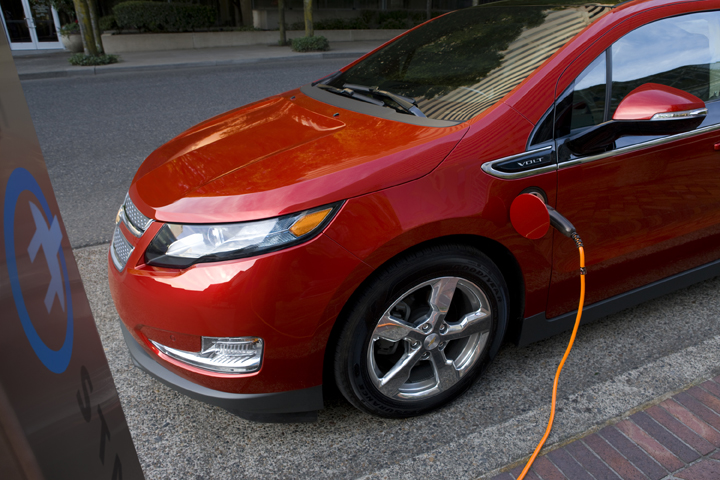
2011 Chevrolet Volt
Fisker, Ford, and GM
It’s worth comparing Tesla to Fisker Automotive, another venture-funded startup. Fisker says it will build up to 15,000 of its first car, the 2011 Karma plug-in hybrid sports sedan. That’s the right number for outsourcing; indeed, the Karma will be assembled in Finland by Valmet.
For its planned second car, Fisker too is taking over a former GM plant. But this one is in Delaware, a far cheaper location. More importantly, Tesla and Fisker are still tiny startups.
So is Coda, which plans to open a vehicle assembly plant for what it says will be up to 14,000 electric cars a year in Benicia, on the northeast corner of San Francisco Bay.
Plus ca change…
General Motors and Ford are now hiring hundreds of engineers to work on hybrid, plug-in hybrid, and electric vehicles, like the 2011 Chevrolet Volt and the 2012 Ford Focus Electric.
And they’re not doing it in Silicon Valley. They’re doing it in Michigan, just where they always have: the GM Technical Center in Warren, and the Ford headquarters complex in Dearborn.
Sure, their designers and engineers visit Silicon Valley to do deals with startups in areas like apps that will connect their cars to the world of always-on information. But then they take the apps back home to where cars are built.
In other words, we suspect that the new, clean, green auto industry in the U.S. will be pretty much where the old, dirty, gas-guzzling one was.
That would be … Detroit.
Plus ca change, plus c’est la meme chose.
+++++++++++