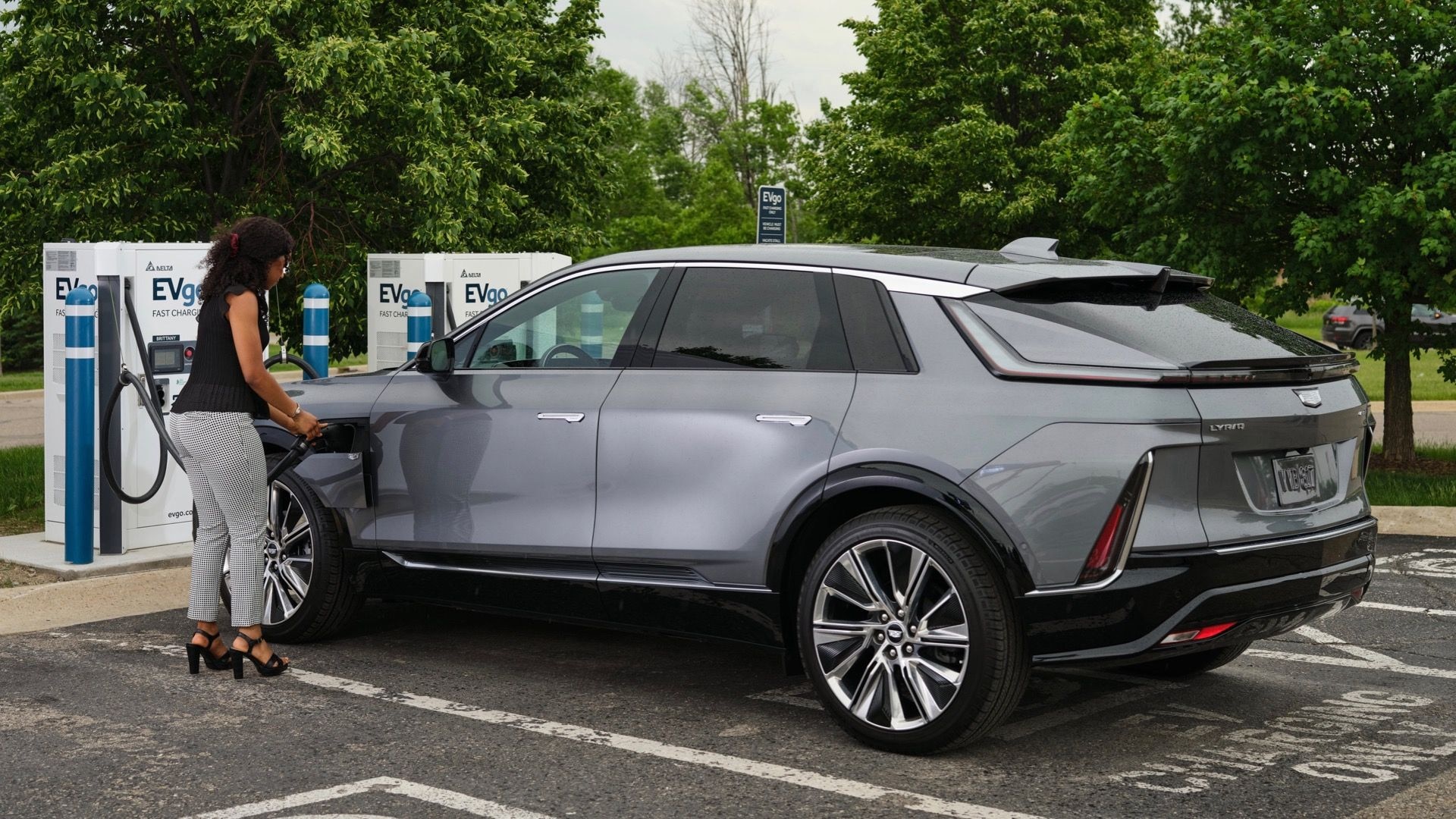
There's been a lot of discussion and consideration given to the topic of public charging stations for electric vehicles. The old "chicken verses egg" conundrum is called to mind as auto makers and politicians seem to fumble around without really knowing what to do and where to allocate funds.
Will people buy electric cars without a complex network of public charging points available? Why should we invest in these charging stations if there really are aren't any electric cars on the roads yet? Shouldn't we wait to see if the public actually buys these cars before we spend tens of millions of dollars to make sure they can charge them?
These are all legitimate questions and I know why people are asking them. There is a tremendous amount of optimism for the upcoming wave of battery electric vehicles and supporters want to make sure we get it right.
The problem is, there is no consensus on just how to do it.
Some want to spend a lot of money on a select few markets to build out a complex network of public charging stations to use as an example and to help the rapid deployment of EV's in those specific markets. Some think it's better to concentrate on quick charge level 3 chargers on major highways and interstates. Others think we should install chargers as the demand increases and analyize market by market based on the number of EV sales there.
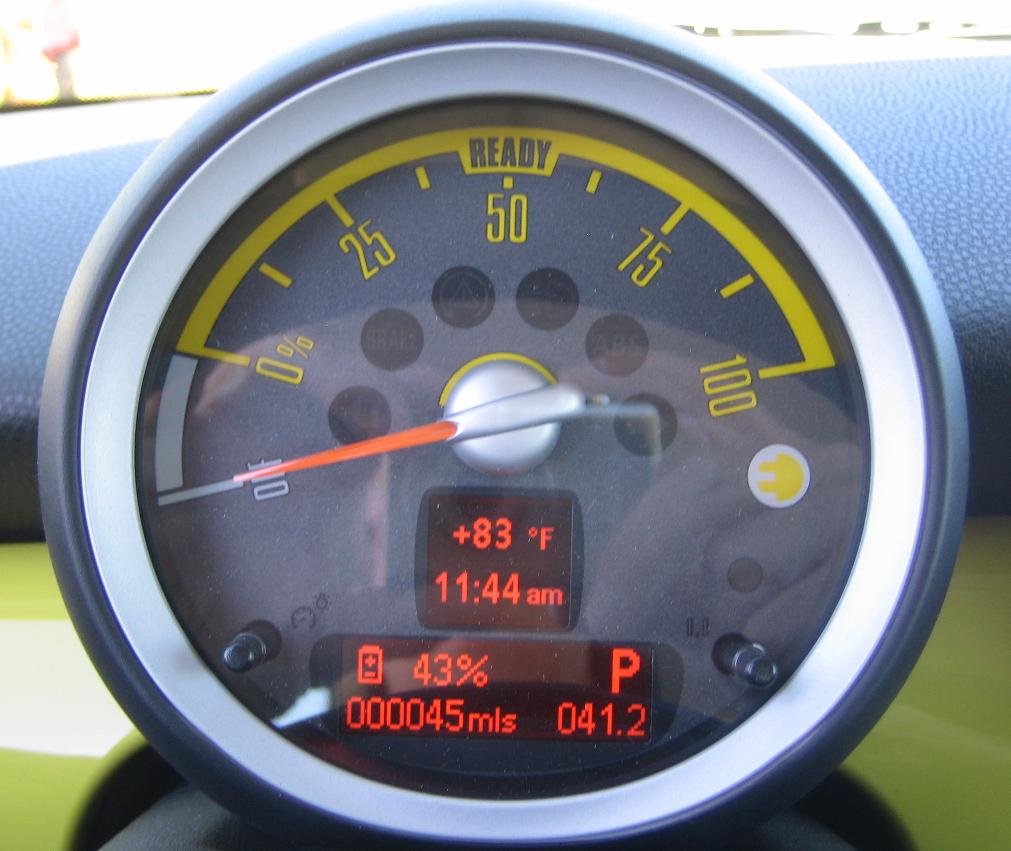
Mini E electric vehicle - battery charge gauge shows charge and range falling, percent by percent
Enlarge PhotoHowever, the one thing I don't see a lot of is input from people that actually have real life EV experience. Wouldn't you think it would make sense to ask actual EV owners what they think of public charging and how they would or wouldn't use them if they were available? I think many people might be surprised what we have to say.
I have been driving a MINI-E for the past 13 months now and have had the opportunity to talk to many other EV owners & lessees. Most agree they really aren't compromised by the lack of public charging stations.
I'm not saying we wouldn't use them if they were available, just that for the most part they aren't absolutely necessary for EV deployment.
I have 36,000 miles on my MINI-E after 13 months of use and I have never used a public charging station. The reason I haven't is because there are none in New Jersey and I've done just fine without them.
Would I have used them if they were here? Probably, but the lack of them hasn't prevented me from using the car as my daily transportation one bit.
By far the majority of charging will take place at home and overnight. I would venture to guess as much as 75-80% of charging will be at home. After that I think the most important 2nd charge point would be at your place of work. I installed a charger myself at my job and my car charges while I work. This allows me leave work with a fully charged car every day in case I need to go somewhere before I return home.
What may be overlooked is allowing private enterprise pick up much of the tab. I'm sure businesses like McDonald's and Wal-Mart will be quick to install chargers themselves as they will want to have a "captured customer" while they charge their car up. Shopping malls will install them as will movie theaters and other shopping destinations. All of these locations need to be considered before public funds are allocated and possibly wasted.
All I'm saying is there are people out there with lots of experience living with an EV and I think it would be a shame if they weren't tapped to offer their perspective on how, where and how many charging stations are needed. I'm sure we can do more while spending less if the right questions are asked and the right people are involved.
EVs aren't for everybody so we shouldn't focus on trying to make them work for the percentage of the population that really shouldn't be driving them. Until we have EV's with ranges that stretch into the hundreds of miles they simply won't work for some folks and no amount of charge stations will make that change.
However there are plenty of people that a 100-mile BEV would fit perfectly into their lifestyle and these people will probably use public charging a lot less than many people think.

Have an opinion?Join the conversation!
By Jerry Posted: 7/30/2010 5:16am PDT
Take, for example, the $100,000,000 grant to Ecotality for putting in charging stations. That seems great, but perhaps that money would be better spent on helping people purchase EVs. Let's say that an additional $5000 was given to people buying an electric car. That would support the purchase of 20,000 cars. Perhaps that is money better spent.
On the other hand, it would need to be done in such a way that the money didn't end up causing a price increase in EVs. A tricky thing to do.
Personally, I would like to stimulate EV Use, not purchase. I wish this was a way to incentivise people to drive more EV miles.
By ev enthusiast Posted: 7/30/2010 7:15am PDT
by far the biggest drawback is the price. but that will come down when supply goes up.
we dont want too many cars out on the road, first year. cuz i guarantee you there will be unforeseen problems with the cars.
these problems will need to be addressed and fixed for the next year.
evs will kill gas cars in fairly short order. we dont need to try to "accellerate" it. not everything is about speed - it is about quality.
By Anthony Posted: 7/30/2010 9:45am PDT
By DC Posted: 7/30/2010 12:03pm PDT
By James Posted: 7/31/2010 6:02pm PDT
By Shawn Posted: 7/31/2010 7:19pm PDT
By James Posted: 7/31/2010 9:11pm PDT
By James Posted: 7/31/2010 9:16pm PDT
By ev enthusiast Posted: 7/31/2010 9:47pm PDT
the market has been there for a long time. big oil has prevented it (with help from gm).
and the growth of evs could occur just as you stated. the govt rebates will make it occur much more quickly.
right now, we have snowflakes forming at the top of the mountain. once it gets to the bottom, it will be an avalanche.
giving customers rebates will get that snowball rolling much faster. but we also want to be able to control that growth, to some degree.
we want to do things correctly. we are gonna need to fix mistakes that we wont know about until people start driving them.
what is occurring now is perfect, for this first year. enough vehicles to get a good test run, but not so many that we are inundated with problem vehicles.
commercial evs will occur much sooner than you might think. and i have already stated that this is the only place we need to have a charging infrastructure.
so whatever we do now for cars should be put in such that we can use it for trucking later on.
By ev enthusiast Posted: 7/31/2010 9:56pm PDT
i have followed the ev industry for 20 years. the coda was around before the leaf. but as you said, it is a start-up company. one of the reasons this company interests me is that i have followed it for awhile.
once evs were more obvious, then the bigger companies are all trying to jump in. nissan was smart enough to jump in headfirst. it wasnt 6 months ago that gm and toyota were naysaying the evs, and gonna stick to hybrids.
well there is rumor that there will be a bev volt very soon, and toyota and tesla are possibly doing something. we shall see how much is talk and how much is action.
i think i am being very conservative when i give new gas cars 10 years of life left. it may be less. i sincerely doubt that it is more.
gosh, 10 years is an eternity for improvements and maturation of the bev industry. 10 years from now who in the heck is gonna use new car money for an obsolete technology ?
the bevs will hit just as big as personal computers, ipods, and cell phones.
By Charles Posted: 8/1/2010 8:59am PDT
The reason the government should subsidize EV's is really to give them a level playing field. We already subsidize oil by spending trillions of dollars around the globe to protect our supply.
We are fighting two wars right now to help keep the oil flowing our way as cheaply as possible. Subsidizing the initial cost of EV's and helping to build out a charging infrastructure will help to reduce our dependence on foreign oil, keep some of our energy dollars here in our economy and employ Americans, even if it's "dirty" coal, it's better than Saudi Arabian oil.
By B-Man Posted: 8/1/2010 8:35pm PDT
By ev enthusiast Posted: 8/1/2010 9:15pm PDT
all products are sold with the same mechanism - they give you whatever is needed in order to get you to buy again.
the increases in range will probably occur in 25 mpg, or so.
so if 100 the first year, 125 the second, 150 the third, etc.
each one of those incremental ranges will bring in a new flood of buyers who will be moving from gas to bev.
but dont pigeon hole yourself too much by what you think now. people's perceptions of bevs will change dramatically as the years go on.
this range anxiety is only a manufactured fear, for the most part.
By ev enthusiast Posted: 8/1/2010 9:21pm PDT
lets play the reverse logic, and we are going from bev to gas. why people would be yelling bloody murder - i am not gonna have a contraption with 5 times as many parts to break. i am not gonna have a contraption that costs me 10 times as much in fuel consumption. i am not gonna have a contraption that i have to stop somewhere to get fuel, when i can take care of it now, while sitting in my easy chair. etc. etc.
for the average joe, these first bevs are already more advantageous than their gas counterparts, when we look at all the pluses and minuses.
By Jerry Posted: 8/2/2010 7:39am PDT
By Robert Posted: 8/2/2010 1:50pm PDT
You have the advantage of owning your own business, and being able to install a second charger. I also drove the MINI E for 12 months, but gave it back. I'm moving and my one way commute will be around 50 miles, too close to make without a recharge. So I'll be getting a Chevy Volt, I'd still like to charge it at work too, but its been very difficult trying to get a charger installation approved, or even 110 outlets in the parking lot. What I'm being told is ask us again when you actually have the car, not a good option if I was buying an all electric car. There really needs to be an incentive for buisnesses to install chargers for their Employees.
Next to work, chargers at Malls seems like the best place to me.
By Tom Posted: 8/2/2010 2:20pm PDT
Yes, you are correct that I had the advantage of not having to ask permission to charge at work. However I did use the car for over 5 months with only my home charger so I could have certainly continued just fine as I was. I do think employers will get on board with this once the cars are available. Most people don't even realize that there will be electric cars for sale in only a few months. It won't cost much and the companies can get very good PR by installing a few in their parking lots for supporting green transportation. I think the malls will put them in rather quickly. They need to give customers every reason possible to come to their stores. Companies like McDonalds & Costco are already installing them at trial locations, just wait till there are Volts and Leafs on the roads, others will follow. I think private enterprise will be quick to install these in their parking areas, they will generate revenue as well as capture a customer for a while as their car charges. The longer people are in stores, the more money they spend there, that's already been proven.
By Jimza Skeptic Posted: 8/3/2010 3:50am PDT
By B-Man Posted: 8/4/2010 6:57pm PDT
By Laurel Posted: 8/16/2010 1:25pm PDT
Nation's first public quick-charge station opens up in Portland, OR [w/video]
http://green.autoblog.com/2010/08/09/nations-first-public-quick-charge-station-opens-up-in-portland/
By Tom M Posted: 8/18/2010 7:15am PDT
If high speed charging stations is the deciding factor upon whether you can function with a Nissan Leaf I would argue that you should not buy one then. I am a big supporter of EV's and want nothing more than to see as many people as possible buy them, but not if their lifestyle doesn't fit the range of the car. High speed charging stations will be good for occasional use but not for frequent use as they will undoubtedly reduce the life of the battery pack on the LEAF. If you don't think that the 100 mile range will satisfy 90% of you r driving needs and you don't have another car to use or want to rent a car for longer trips then as much as I hate to say it the LEAF is a poor choice for you. It's going to take a while before there are plentiful, convenient public charging stations. I would recommend early adopters should count on their home based charger for virtually all their charging needs for the immediate future.
By Laurel Posted: 8/18/2010 6:36pm PDT
The technology is getting oh so close though. And is the limiting factor really the technology in the car or just the infrastructure? Referencing the following two articles:
Details on Nissan Leaf battery pack, including how recharging speed affects battery life.
http://green.autoblog.com/2010/05/27/details-on-nissan-leaf-battery-pack-including-how-recharging-sp/2#comments
Will DC fast charging harm electric car batteries?
http://reviews.cnet.com/8301-13746_7-20011094-48.html
By Laurel Posted: 8/18/2010 6:37pm PDT
By Wheego Dealer Posted: 8/19/2010 1:04pm PDT
But I know a lot of people in the Atlanta area, where I live, are concerned about the weird days, rather than the daily commute days. What happens with a 100-mile range EV on the day the kid is sent home sick from school? Suddenly, there's an unexpected trip home from work, to the school, perhaps to the doctor and the pharmacy. When do you plug in? What happens when you run out of juice? This is similar to the arguments people have against carpooling or transit, and there are always, always ways around it. But I do think more EV charging stations would alleviate a lot of the "what if..." kinds of concerns potential customers might have.
Have an opinion?Join the conversation!