Advertisement

Why Are Few Of Today's Cars Among The Most Fuel-Efficient Ever?

 
Follow John

1997 Geo Metro

1997 Geo Metro

Enlarge Photo

Every now and then, readers write to grumble about new cars and their gas mileage.

The gist is usually something like this:

You wrote that the new 2011 [Make & Model] gets 40 mpg highway? Well, big whoop-de-doo. I always got at least 45 mpg in my 1992 Geo Metro, and it was a whole lot cheaper, so how can you say we're making progress?


The most recent note prompted us to dig up a ranking issued last summer by the U.S. Environmental Protection Agency, in which it listed the 10 most fuel-efficient cars it has tested since it began rating gas mileage in 1985. (Note that all numbers have been adjusted to its most recent test procedures.)
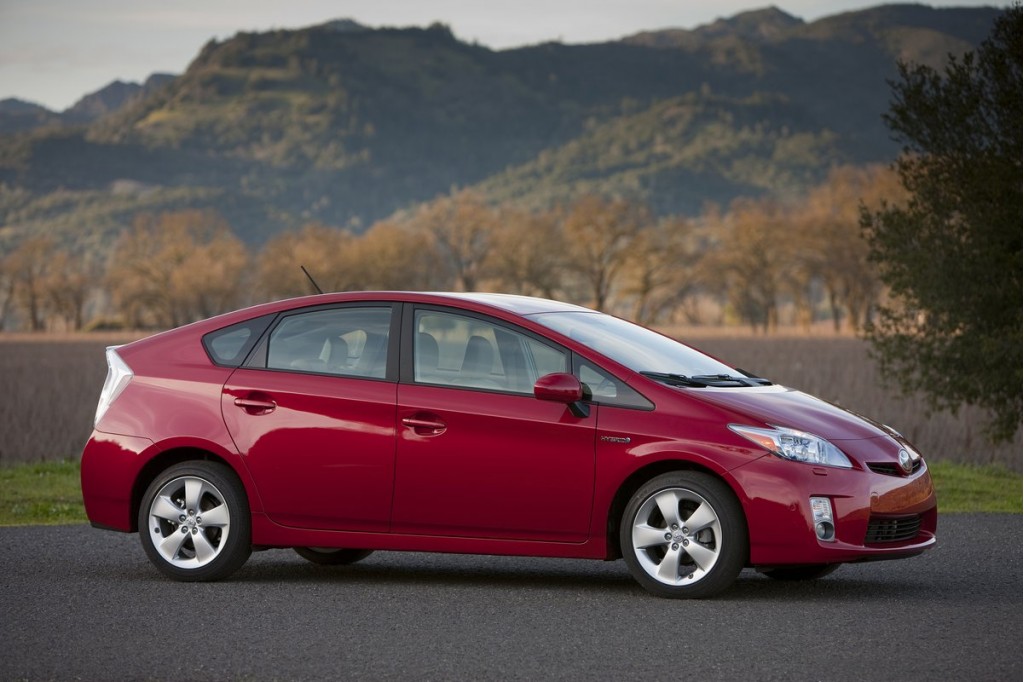
2011 Toyota Prius

2011 Toyota Prius

Enlarge Photo

The best-rated car today is the 2011 Toyota Prius hybrid, which has a combined rating of 50 mpg (51 mpg city, 48 mpg highway). It came second on the EPA's all-time Top 25 list.

It was edged out by the the first-generation (1999-2006) Honda Insight two-seat hybrid, with combined rating of 53 miles per gallon (49 city, 61 highway), about 6 percent better than today's Prius. The remaining eight cars in the Top 10 include no fewer than six from previous decades (and only two hybrids):

  • 1986 Chevy Sprint - 44 mpg city, 53 mpg highway (48 mpg combined)
  • 1990-1994 Geo Metro - 43 mpg city, 52 mpg highway (47 mpg combined)
  • 1986-1987 Honda Civic CR-X - 42 mpg city, 51 mpg highway (46 mpg combined)
  • 1994-1995 Honda Civic HB - 39 mpg city, 50 mpg highway (43 mpg combined)
  • 2006-2010 Honda Civic Hybrid - 40 mpg city, 45 mpg highway (42 mpg combined)
  • 1985 Pontiac Firefly - 39 mpg city, 47 mpg highway (42 mpg combined)
  • 1985 Suzuki SA310 - 39 mpg city, 47 mpg highway (42 mpg combined)
  • 2010 Honda Insight - 40 mpg city, 43 mpg highway (41 mpg combined)

So why are so few of today's cars in the EPA's Top 10? Four answers: Weight, power, safety, and features--all of which have risen substantially since the days of the Geo Metro.
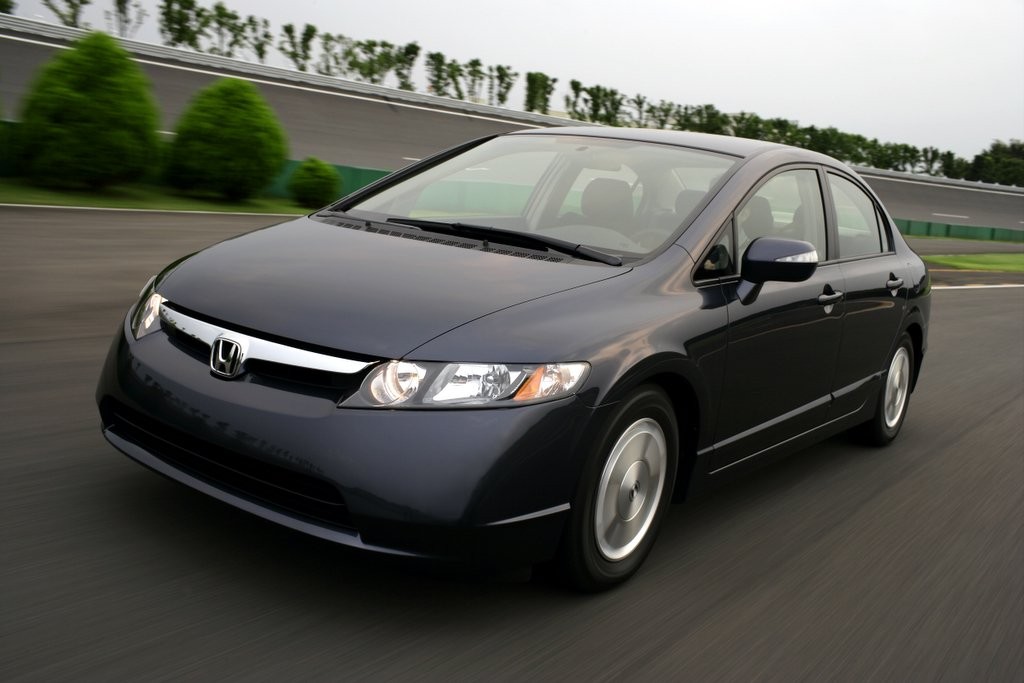
2006 Honda Civic Hybrid

2006 Honda Civic Hybrid

Enlarge Photo

Weight: Today's 2011 Honda CR-Z, a two-seat hybrid sports car that is the spiritual successor to the 1983-1991 Honda Civic CR-X, weighs 2,670 pounds with a six-speed manual. The CR-X was more than 700 pounds lighter.

The weight is due to far stronger structures, for safety reasons, and a plethora of new equipment not offered in earlier cars.

Power: The CR-X of the 1980s featured a 1.5-liter four-cylinder engine that generated 91 horsepower, an underwhelming rating today. Compare that to the turbocharged 1.4-liter engine used in the 2011 Chevrolet Cruze Eco compact, rated at 138 horsepower.

The more power you pull out of an engine, the lower the fuel economy (more or less).
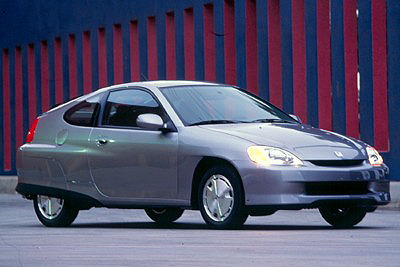
2000 Honda Insight

2000 Honda Insight

Enlarge Photo

Safety: That Geo Metro had no airbags at all, with automated shoulder belts providing its only occupant protection.

By contrast, the 2011 Ford Fiesta subcompact comes with seven airbags, and the 2011 Cruze has no fewer than 10--not to mention vastly stronger structures to withstand new, much tougher NHTSA crash tests.

Features: Today's subcompacts offer features only offered on full-size luxury sedans two decades ago (or not envisioned at all back then): cruise control; air conditioning; power windows, locks, and mirrors; multi-speaker AM/FM/CD stereo systems with satellite radio; and many, many more.

Bottom Line: There's no way a car like the 1990 Geo Metro could be sold new today. It wouldn't pass modern crash-safety tests, nor meet more stringent tailpipe emissions standards, and its performance would be considered far too slow and unacceptably noisy. Then there's the Spartan interior.

In short, we've traded some of our gas mileage for nicer, safer, faster, more pleasant cars.

Would you actually buy a new 1990 Geo Metro? We don't think so.

[Kicking Tires via USA Today]



Follow Us


Have an opinion?

  • Posting indicates you have read this site's Privacy Policy and Terms of Use
  • Notify me when there are more comments
Comments (24)
  1. Thank you for this story. It's long overdue. Not to discredit the auto nuts who are still willing to ply the roads in Geo Metros, but the story highlights some key facts versus leaving it open to broad assumptions.
     
    Post Reply
    Vote
    Bad stuff?

  2. I've got a whole forum full of folks that would most certainly buy a 1990 Geo Metro (as many of them already have): www.geometroforum.com
    Americans will one day have to face the reality that cars are meant to get you from point a to point b, and doing that with the most fuel efficient means possible will become priority as gas continues to climb.
     
    Post Reply
    +1
    Bad stuff?

  3. OK, I think this is an awesome piece. It lays out the success of the Toyota Prius and the original Honda Insight in a historical context.
    I think what is so impressive about the Geo Metro is that it was a cheap car to begin with (and I mean that in both senses of the word). The Prius priced at the middle of the market and is very fuel efficient. The Metro was priced at the bottom of the market and very fuel efficient. You got to love that.
    Did I miss it, or was the lack of AC in older vehicles not mentioned?
    Looking at some data recently, in 1975, average 0-60 was 14 seconds. Meaning some cars were 20 seconds. Now the average is 9 seconds. I think most of use have forgotten what that was like.
     
    Post Reply
    Vote
    Bad stuff?

  4. Please John,
    You need to do more research! My 2000 Chevy Metro (3 cylinder, 5 speed, XFI cam)does have airbags. It also has a 33 month average of 46.01 mpg. The newer "fuel-efficient" cars are all gas hogs! :-)
     
    Post Reply
    +1
    Bad stuff?

     
  5. Hey Tom, I just got a Wild Fire Red 2000 Geo Metro 3 dr Hatchback 3 cyl 5 speed with 255K miles. Need to do some fixing: replace drivers window, correct engine missing & stalling when accelerating. Like to hear from you. Send photo of yours. Later, Tom
    dfix9@yahoo.com, 7-06-11.
     
    Post Reply
    Vote
    Bad stuff?

  6. I have a 1954 Olds, 2 dr, no aluminum, no plastic, weight 3725 with a huge and heavy v8, getting 18 mpg.
    Would anyone rather be in a brand new 54 olds, safer, stronger, then a new minivan, and the 54 olds almost a 1000lbs lighter then a minivan, and mpg not much differet??? We have digressed to a point of weakness. Most of us over 40 spent a great deal of time in one of those so called dinasours, and lived to tell about it. How much have we given up in the name of safety compaired to the cost in vehicle price and fuel economy. I think maybe we have nebt ttoo far in the wrong direction.
     
    Post Reply
    Vote
    Bad stuff?

  7. @Daniel, ... with a cigarette in one hand and a whiskey in the other and we were safer then. Ah the good old days.
     
    Post Reply
    Vote
    Bad stuff?

  8. @TomT, Per your suggestion, I did a little research. 2000 Chevy Metro, 32 city, 41 highway. Not even close to making the above list.
     
    Post Reply
    Vote
    Bad stuff?

  9. 2000 Chevy Metro 32 city 41 highway.
     
    Post Reply
    -1
    Bad stuff?

  10. 2000 Chevy Metro 32 city 41 highway.
     
    Post Reply
    -1
    Bad stuff?

  11. The research suggestion was intended to point out that the 2000 Chevrolet Metro does have air bags.
    Also, the EPA fuel ratings can be confusing because they don't distinguish between the 2 door coupe and 4 door sedan. (Mine is a 2 door coupe).
    A vehicle with a documented 46 mpg (33 month average) should be on the list, wouldn't you think??
     
    Post Reply
    +1
    Bad stuff?

  12. @Daniel,... First, I respectfully challenge you to provide a link to any data showing that a 54 Olds is safer than a modern car. Second, the fact remains that thanks to all of these safety technologies we currently have the lowest rate of fatalities per X miles driven ever (http://www.thecarconnection.com/marty-blog/1043314_u-s-traffic-fatalities-hit-historic-lows). Third if everyone were still driving cars from the 50's how toxic would the air be in cities? Granted I would love to cruise around in a 64 Mustang all the time but I wouldn't want my wife commuting in it for safety reasons. And I wouldn't want everyone else driving them because of smog issues and also because if everyone had one they wouldn't be very special.
     
    Post Reply
    Vote
    Bad stuff?

  13. Regarding the safety of cars from half a century ago, this IIHS video says it all: http://www.youtube.com/watch?v=xtxd27jlZ_g
     
    Post Reply
    Vote
    Bad stuff?

  14. For the 2000 Chevrolet Metro you could have 8 possible combinations of body style/engine/transmission:
    2 door coupe hatchback or 4 door sedan,
    1.0 liter 3 cylinder or 1.3 liter 4 cylinder, and
    5 speed manual or 3 speed automatic.
    Remember as well, the 4 door sedan weighs approx. 100 lb. more than the 2 door coupe hatchback.
    So with 8 possible combinations, the EPA lists just 3, and to add to the confusion, the pictures of the models shown are just the coupe.
    AOL auto also has information on their website, it gives a 2 door coupe with 3 cylinder and 5 speed a fuel economy of 39/46 mpg.
     
    Post Reply
    Vote
    Bad stuff?

  15. @TomT,
    It is pretty clear. For the 1 liter engine 2000 Chevy Metro the original window sticker showed 39/46, the new (adjusted numbers) are 32/41. These are the numbers comparable with the above article.
     
    Post Reply
    -1
    Bad stuff?

  16. Here's an interesting article:
    "2010 Honda Insight vs. 2010 Toyota Prius, 1998 Chevy Metro - Comparison Tests" - Car and Driver
    http://www.caranddriver.com/reviews/comparisons/09q3/2010_honda_insight_vs._2010_toyota_prius_1998_chevy_metro-comparison_tests
     
    Post Reply
    Vote
    Bad stuff?

  17. Here's another interesting link from greencarreports.com:
    http://www.greencarreports.com/specifications/geo_metro_1997_2dr-hb
    It lists Gas Mileage = 44 mpg City/49 mpg Hwy for the 1997 Metro 2 door hatchback 3 cylinder 1.0 liter 5 speed.
    That's essentially the same car as my 2000 Metro 2 door hatchback 3 cylinder 1.0 liter 5 speed.
    My 2000 Metro has achieved an average 46 mpg since I purchased it about 33 months ago.
     
    Post Reply
    Vote
    Bad stuff?

  18. @TomT, Go figure. C/D prefers the 2010 Honda Insight over the Prius. This despite largely bad reviews of the Honda Insight and dramatically worse gas mileage. Good thing C/D doesn't do any scientific testing. They would disprove their own findings. Ah Journalists.
     
    Post Reply
    Vote
    Bad stuff?

  19. @TomT, Honestly, your MPG numbers are wonderful. But for everyone like you that gets impressive numbers on a Metro, there are 10 more people that get even more impressive numbers on a Prius. I will rely on the EPA number for now. They may be wrong, but at least they should be comparable.
     
    Post Reply
    Vote
    Bad stuff?

  20. I owned a 1995 Honda Civic HB which is on the list of highest MPG mentioned in the article. I averaged 38 MPG but that car was dangerously slow. I had trouble on highway on-ramps accelerating up to the speed of traffic. If the highway on-ramp was uphill I would have to merge with 65 MPH traffic while going 35-40 MPH. I believe Honda designed that car solely to achieve high EPA ratings without regard for driver safety. My 1988 Dodge Omni averaged 34 MPG and accelerated quite well.
     
    Post Reply
    Vote
    Bad stuff?

  21. Nice article but you left one big high miler out. My 2000 Golf TDI(1.9l diesel) weighing in at 2974 curb weight with front and side airbags still has never returned me less than 53mpg staying within the posted speed limits. Since I changed out the 5th gear for higher ratio it routinely posts 60's. It's heavier has a real suspension and normal size rims and tires compared to some of the tin cans in the article. :^)
     
    Post Reply
    +1
    Bad stuff?

     
  22. EPA combined rating of the 2000 Golf is 38 MPG combined. Close to making the list, but not quite.
     
    Post Reply
    Vote
    Bad stuff?

  23. Ah,
    The classic battle between the Frugal Eccentric and the Green Elitist.
     
    Post Reply
    Vote
    Bad stuff?

  24. They sold these things for $7,000 new. They're running scared from it because it proves the whole industry is crooked. My 1995 4 door, 4 cylinder gets 50 mpg Hwy (doing 65-70mph even) and 42 City when I'm driving carefully (more like 38 when I just drive it like a sports car). I measure every tank just because it's a huge pick me up at the end of a hard week. This is also a fun car to drive - one of the lightest sedans ever built. So you can get yourself in and out of a lot of trouble really quickly, especially if you know how to use a manual transmission. Cheap like borscht to fix! Mine has dual air bags and being light, and I reckon that if I get in a real accident I'll probably fly and spin instead of crush. BEST. CAR. EVER!
     
    Post Reply
    +1
    Bad stuff?


Have an opinion?Join the conversation!

Advertisement
Advertisement

Find Green Cars

Go!

Advertisement

 
© 2013 Green Car Reports. All Rights Reserved. Green Car Reports is published by High Gear Media. Send us feedback. Stock photography by Homestar, LLC.